



SubBoomBass è il virtual instrument Rob Papen, in collaborazione con Concrete Fx, dedicato ai suoni di basso sintetizzato. Sub Boom Bass e RG (virtual instrument dedicato a suoni di chitarra) rappresentano l’ideale prosecuzione di un percorso di successo iniziato con Predator, il flessibile synth sottrattivo, ideale coltellino svizzero da cui tirare fuori suoni solidi ed usabili.
Sub Boom Bass è una diretta derivazione di Predator, cosa di cui non fanno mistero neanche gli stessi autori. Ma la caratteristica saliente ed il mercato di riferimento del synth in esame è quello del basso con caratteristiche “subsoniche” spiccate. Il termine “sub”, particolarmente in voga, indica infatti suoni con una forte enfasi della fascia iniziale delle basse frequenze (per capirci, al di sotto dei 90hz).

L’interfaccia
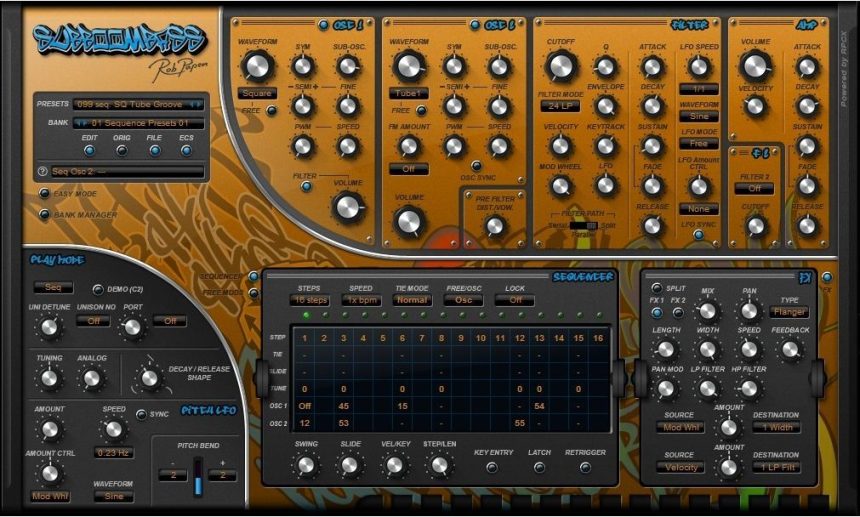
L’interfaccia del virtual instruments in questione ricorda da vicino il lavoro che Concrete Fx ha effettuato per Predator. Sostanzialmente, una metropolitana all’ora di punta risulta meno affollata, ma tuttavia è davvero efficace, con non poche trovate utili per una gestione semplice dei parametri principali. Molto comodo è anche l’utilizzo di “sportelli” per l’accesso o meno a funzioni particolari, quali l’arpeggiatore/sequencer o il bank/presets manager. Una chiara suddivisione concettuale per sezioni la rende particolarmente adatta a “tweaks” volanti.
In breve
La sintesi del SubBoomBass, come in Predator, proviene dal doppio oscillatore, molto simile come struttura a quello utilizzato in Predator, ma con una selezione di forme d’onda decisamente più votata alla creazione di bassi. Ogni oscillatore, inoltre, porta con sé numerose opzioni di modulazione, inclusa “fm” e “ring modulation”. Doppio Filtro, inviluppi e varie opzioni di modulazione, abbinate ad una buona sezione effetti (Mono Delay, Stereo Delay, Comb, Reverb, Chorus, Chorus/Delay, Flanger, Phaser, Wah/Delay, Distort, Low-Fi, Amp Sim, WaveShaper, Stereo Widener, Auto Pan, Gator, Bass Enhancer, FX Filter, Equalizer, Compressor, Ensemble Cabinet, MultiDistort, Auto Wah) e ad un comodo arpeggiatore completano il quadro.

Come suona
Il bank manager consente un’agevole selezione dei presets – di default sono più di mille, ma per gli insaziabili esistono già librerie aggiuntive come quelle realizzate da Bryan “Xenos” Lee (www.xenossoundworks.com).
Dal punto di vista del suono, il Sub Boom Bass può essere considerato un tipico prodotto Rob Papen: rigoroso, pulito e ben strutturato, con un suono molto “dutch”. Ampia, come è ovvio, la selezione di bassi, da tipici “sine” sub basses a prodotti più dubstep e modulati. Molto utile anche la selezione di subkicks, che faranno la gioia dei sound designers. Un piccolo neo da segnalare è che molti presets sembrano suonare in maniera alquanto simile: malignando, forse 300 sarebbero stati sufficienti.
Torniamo al “rigore RobPapeniano”. Una delle caratteristiche del synth in oggetto è che il suo suono non ha quella natura “iperprodotta” tipica, ad esempio, delle librerie Spectrasonics. La maggior parte dei bassi fa la miglior figura sulla tonalità tipica in LA, tanto cara alla dance, comunque in un range alquanto limitato della tastiera. La ragione sta nel fatto che i presets – ed in generale i suoni – non sono “arricchiti” o “dopati” di armoniche, così da renderli spendibili su tutta la tastiera. Qui la sintesi segue il suo corso naturale, anche nel subire le inevitabili variazioni nel punch legate al cambio di frequenza. Questo può, ad un primo ascolto, fornire la sensazione che Sub Boom Bass sia un synth “blando”. In realtà è semplicemente una caratteristica del prodotto, va usato nei giusti range per ogni presets, ma questa impostazione, d’altro canto, consente a chi è più esperto nel sound design di utilizzare e sovrapporre il suono in maniera più pulita e tecnica.
A chi consigliarlo?
Gli utilizzi di questo tipo di suoni sono davvero molteplici e quasi tutti (per non dire tutti) hanno, per l’appunto, motivazioni di “sound design”. Principali utilizzatori saranno dunque i dance producers, interessati a sfruttare il potenziale motorio dei bassi sub specialmente in lavori electro house e tech house. Pensiamo, per esempio, che a volte il sub bass viene utilizzato come sostegno – o anche come sostituto – del kick drum in questi generi musicali. La natura fortemente percussiva del suono, infatti, oltre alla difficoltà di percepirne il pitch, lo rende particolarmente simile al suono di kick drum sintetico. L’altro utilizzatore “di scuola” sarà il sound designer e musicista di colonne sonore: è estremamente diffusa, infatti, l’abitudine di rinforzare suoni di sound design, ma anche l’orchestra vera (!!), con bassi sub. Forse non tutti sanno che molte delle più famose colonne sonore orchestrali hanno avuto un “ritocchino” con bassi sub, qua e là. A chi altro consigliarlo? Sicuramente – ed in particolar modo – proprio a chi si occupa di dance e colonne sonore, in quanto è in grado di rafforzare il low end di qualsiasi pezzo, dance, rock o orchestrale che sia, senza tuttavia prendere prepotentemente il controllo dello spazio sonoro. Un vero “tool” tecnico da scoprire ogni giorno di più.
Pro:
- Ottimo coltellino svizzero sia per tirare suoni e frequenze diverse da quelle che siamo abituati a sentire.
Contro:
- Molti preset inutili
INFORMAZIONI UTILI:
Produttore: Rob Papen
Modello: SubBoomBass
Website: www.robpapen.com
Distributore italiano: www.midiware.com
Costo: Euro 82,50+ IVA
SubBoomBass is the Rob Papen virtual instrument, in collaboration with Concrete Fx, dedicated to the synth bass sounds. Sub Boom Bass and RG (the guitar sounds dedicated virtual instrument) represent the ideal extension of a successful journey started with Pretador, the flexible subtractive synth, the ideal swiss little knife through which we can take out solid and usable sounds.
Sub Boom Bass is a direct Predator follow-up, which either makers themselves make no mystery of. But the main aspect and the target market for the synth in question is the one for the high subsonic feature bass one. The term “sub”, now particularly fashionable, stands for sounds that offer a high emphasis on the initial part for the low frequencies (in other words, lower than 90hz).
The interface
The interface for this virtual instrument closely reminds the work that Concrete Fx made for Predator. Basically, an underground train in the rush hour might be less crowded in comparison, but anyway it is really efficient, with lots of useful options to control the main parameters easily. Very convenient is also the way in through “counters” to particular functions, as arpeggiator/sequencer or bank/presets manager. A clear classification by concept per section makes it suitable to “tweaks” on the fly.
In short
The SubBoomBass subtraction, as for Predator, comes from the double oscillator, very similar in structure to the one used in Predator, but with a selection of wave forms definitely dedicated best on the bass sound creations. Each oscillator, moreover, carries several options in modulation, including “fm” and “ring” modulation. Double filter, envelopes and various options in modulation, combined with a good effect section (Mono Delay, Stereo Delay, Comb, Reverb, Chorus, Chorus/Delay, Flanger, Phaser, Wah/Delay, Distort, Low-Fi, Amp Sim, WaveShaper, Stereo Widener, Auto Pan, Gator, Bass Enhancer, FX Filter, Equalizer, Compressor, Ensemble Cabinet, MultiDistort, Auto Wah) and to an easy arpeggiator complete the picture.
How it sounds
The bank manager allows an effortless selection of the presets – there are more than a thousand by default, but for the insatiable ones there are some additional libraries as the ones made by Bryan “Xenos” Lee (www.xenossoundworks.com).
From the sound point of view, the Sub Boom Bass can be considered a typical Rob Papen’s product: rigorous, smooth and well-designed, with a very “dutch” sound. As obvious as it can be, the bass selection is large, going from the typical “sine” sub basses more dubstep and frequency-modulated products. Very useful is also the subdick selection, which will be the sound designers’ delight. A Little drawback to point out is about the fact that many presets seem to sound a little bit similar: If I have to be mean I’d say that maybe 300 of them would have been enough.
Let’s get back to the “RobPapenian” ‘s strictness. One of the features for this synth at hand is that its sound doesn’t have a typical “overproduced” nature, for example, as the one from the Spectrasonic libraries. The majority of bass sounds does its best in the A note, so overused through the dance genre, anyway within a rather limited keyboard range. The reason is because the presets – and sounds in general – are not harmonically “enriched” or “doped”, so to make them sound amazing throughout the entire keyboard. Here the subtraction follows its natural course, even when going through the inevitable punch variations due to the frequency change. This may give the impression that Sub Boom Bass, at first listen, is a “weak” synth. In reality it is simply a product feature, it must be preset within the right ranges, but this setting, on the other hand, gives the ones whom are more into the sound design, the chance to use and combine sounds in a more clean and technical way.
Who should it be recommended to?
The uses of this kind of sounds are really various and almost each one (not to say all of them) has, as matter of fact, “sound design” reasons. Therefore the main users will be the dance producers, interested in taking advantage of the potential force of the sub basses, especially within electro house and tech house productions. Let’s think about, for example, that sometimes the sub bass is used as a sustain – or also as a substitute – for the kick drum in this kind of musical genres. The heavy percussive nature of the sound, in fact, aside from the difficult understanding about its pitch, makes it particularly similar to the synth kick drum sound. The other “school” user will be the sound designer and sound track musician: In fact, the habit of reinforcing designed sound, but also the real orchestra (!!), with sub basses, is extremely common and widespread. Perhaps not anyone knows that many of the most well-known orchestral soundtracks did have a “touch up” with sub basses, here and there. Who else should it be recommended to? Indeed – and particularly – to those who are involved with dance music and soundtracks, for it’s able to reinforce any tracks’ low end, be it dance, rock or orchestral, yet not taking control of the sound space in a predominant way. It’s a real technical “tool” to discover more and more every day.
Pros:
• Excellent swiss little knife in developing different sounds and frequencies from the ones we are used to listen to
Cons:
• Many useless presets
USEFUL INFORMATIONS:
Producer: Rob Papen
Model: SubBoomBass
Website: www.robpapen.com
Italian distributor: www.midiware.com
Price: 82,50 Euros (V.A.T. escluded)
Italian to English translation: Umberto del Giudice


