

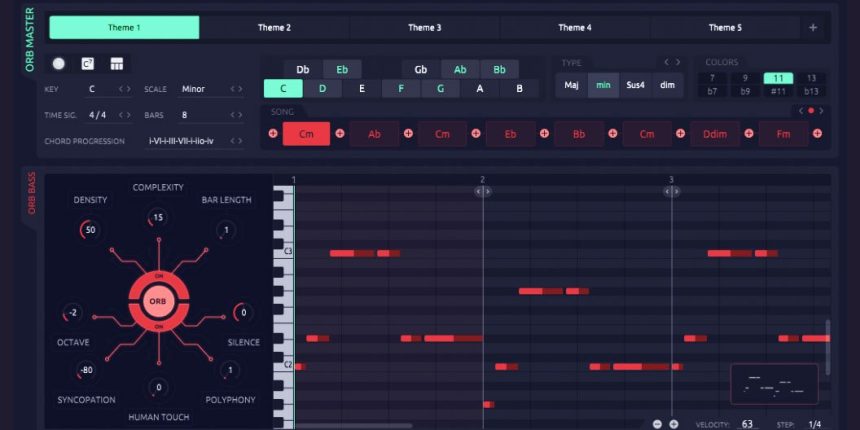
Orb Composer è un software che mette l’intelligenza artificiale (AI) al servizio di chi ha un’idea musicale e vuole realizzarla velocemente senza preoccuparsi di scrivere l’arrangiamento o fare orchestrazioni.
Non intende sostituire il compositore bensì coadiuvarlo nel processo creativo, ossia risparmiandogli il tempo necessario alla scrittura con un sequencer delle parti necessarie, tempo che potrà essere invece dedicato alla sperimentazione delle idee musicali.

Le funzionalità di Orb Composer permettono di partire da idee musicali e terminare con una composizione completa che può essere modificata quanto si vuole. Ogni modello disponibile sia esso Elettronico oppure Orchestrale, comprende la relativa Intelligenza Artificiale, per generare accompagnamenti, arpeggi e melodie.
La scrittura di un brano non si sofferma sulla singola nota, ma si concentra su un lavoro basato su strutture, intenzioni ed emozioni. Il risultato sarà poi una base sulla quale utilizzare la propria creatività e conoscenza musicale.
Workflow
Blocchi
Si parte dai “blocchi” dove creiamo la struttura del brano. In questa sezione scegliamo “Intro”, “Tema”, ma anche l’intensità o il tipo di variazione. Per ogni blocco è possibile scegliere il tipo di struttura (wikipedia) che può essere: Standard, Risposta, Domanda, Risposta prima, Risposta basata su domanda
Accordi
Andiamo a specificare gli accordi presenti nel blocco, possiamo scegliere progressione dalla libreria di Orb oppure crearne di nuovi. La libreria è molto comoda perché permette di trovare velocemente una progressione che può andare bene per i nostri scopi. Inoltre, è possibile fare delle ricerche in base al mood che vogliamo creare nel brano.
Strumenti
Troviamo 6 modelli musicali di “base” che possono essere usati come modello di arrangiamento da utilizzare:
* Orchestrale
* Pianoforte
* Pop rock
* Archi
* Electro

Ambient
I modelli forniscono un elenco di strumenti predefiniti e la relativa intelligenza artificiale. In tutto il processo di composizione, è sempre possibile scegliere gli strumenti, le loro articolazioni e ruoli. Come alternativa si può lasciare che sia Orb Composer a fare scelte basate sulla curva di intensità. È disponibile un elenco completo di strumenti, organizzato per categorie, che consente di sperimentare molte combinazioni di strumenti.
Integrazione con DAW
Orb ha un suo plugin di strumenti, ma ogni strumento e articolazione può essere collegato direttamente ad un VST/AU, permettendo un utilizzo di Orb Composer anche in maniera standalone. Le tracce possono essere esportate (anche individualmente) per ulteriore manipolazione nella propria DAW preferita, oppure è possibile utilizzare Orb con una DAW. Sono disponibili dei template per l’integrazione in Logic Pro X, FL Studio, Ableton Live, Pro Tools e Studio One.
Il test (movie)
In questi mesi mi sto occupando della colonna sonora del film “Un eretico in corsia” del regista Bruno di Marcello con protagonista Ciro Scalera, che vanta nel suo curriculum un inizio alla corte di Eduardo De Filippo e Peppe Barra e una esperienza nel cinema ricca di collaborazioni con Pupi Avati, ma anche con Carlo Verdone, Dino Risi e molti altri.
Ho utilizzato Orb Composer, sulla scena del “Credo” momento di prova quando il giovane Maggi per farsi frate viene in tutti i modi contrastato dalla commissione che deve ammetterlo al convento. Il momento è di grande tensione, sulla scena ci sono dialoghi serrati, fatti di botta e risposta tra lui e i componenti della commissione.

Per questa scena ho utilizzato il template “Archi” e ho realizzato una clip che comunque dovrà stare “dietro” i dialoghi, quindi andrà a marcare le intenzioni e i cambi di scena. Per prima cosa ho diviso la scena delle sue “sezioni”, ossia le parti che io ho ritenuto da evidenziare nella scena. Per ogni sezione ho scelto il tipo di struttura: Q A (Domanda e Risposta)
Ho quindi creato dei blocchi per ogni sezione e per ognuna di esse ho definito le articolazioni degli strumenti, ad esempio ho dato la “Melody” ai primi violini, poi ho stabilito le dinamiche per ogni sezione.

Il giovane Alberto Maggi interpretato da Ivano Conte. Il risultato potete sentirlo nel file audio allegato.
Conclusioni
Può succedere di dover completare un lavoro e di avere poco tempo per farlo, così come può accadere di essere in un periodo personale non proprio creativo. Orb Composer può essere utile per completare un lavoro in poco tempo, darci uno spunto per un’ispirazione o creare una base di un’idea per discuterne con altre persone (ad esempio un regista!).
PRO
- Versatile
- Libreria di Progressioni
- Plugin di suoni integrato
CONS
Alcune parti dell’interfaccia grafica da migliorare, tra cui la gestione dei blocchi e l’accesso ad alcuni parametri.
Note Finali
Sito: www.orb-composer.com
Promo
www.youtube.com/watch?v=7F0gOO-flYg
BackStage
www.youtube.com/watch?v=5Zw1gVux3zk
“Credo” dall’album Un Eretico in Corsia di Umberto Sorbo.
Orb Composer is a software that puts artificial intelligence (AI) at the service of those who have a musical idea and want to implement it quickly without worrying about writing the arrangement or doing orchestrations.
It does not intend to replace the composer but to assist him in the creative process, that is, saving him the time necessary for writing with a sequencer of the necessary parts, a time that can instead be dedicated to experimenting with musical ideas.
The Orb Composer features allow you to start from musical ideas and end with a complete composition that can be changed as much as you want. Each model available whether Electronic or Orchestral, includes the relative Artificial Intelligence, to generate accompaniments, arpeggios and melodies.
The writing of a piece does not focus on the single note, but on a work based on structures, intentions and emotions. The result will then be a basis on which to use one’s creativity and musical knowledge.
Workflow
Blocks
It starts from the “blocks” where we create the structure of the piece. In this section we choose “Intro”, “Theme”, but also the intensity or type of variation. For each block it is possible to choose the type of structure (wikipedia) which can be: Standard, Answer, Question, Answer before, Answer based on question
Agreements
Let’s specify the chords in the block, we can choose chord progression from the Orb library or create new ones. The library is very convenient because it allows you to quickly find a progression that can be good for our purposes. Furthermore, it is possible to do searches based on the mood we want to create in the song.
Instruments
We find 6 basic musical models that can be used as an arrangement model to use:
* Orchestral
* Piano
* Pop/Rock
* Strings
* Electro
Ambient
The models provide a list of predefined tools and their artificial intelligence. Throughout the composition process, it is always possible to choose the tools, their articulations and roles. Alternatively, Orb Composer can be left to make choices based on the intensity curve. A complete list of tools is available, organized by categories, which allows you to experiment with many combinations.
Integration with DAW
Orb has its own tool plugin, but each tool and articulation can be connected directly to a VST / AU, allowing the use of Orb Composer also in a standalone way. The tracks can be exported (even individually) for further manipulation in your favorite DAW, or you can use Orb with a DAW. Templates are available for integration into Logic Pro X, FL Studio, Ableton Live, Pro Tools and Studio One.
The test (movie)
In recent months I have been dealing with the soundtrack of the film “Un eretico in corsia” (A heretic in the ward) by director Bruno di Marcello starring Ciro Scalera, who boasts in his curriculum a beginning at the court of Eduardo De Filippo and Peppe Barra and an experience in cinema rich in collaborations with Pupi Avati, but also with Carlo Verdone, Dino Risi and many others.
I used Orb Composer, on the scene of the “Credo” test moment when the young Maggi is in any way opposed by the commission that must admit him to the convent. The moment is of great tension, on the scene there are tight dialogues, made of blow and response between him and the members of the commission.
For this scene I used the “Strings” template and I made a clip that will still have to be “behind” the dialogues, therefore it will mark the intentions and the scene changes. First I divided the scene of its “sections”, ie the parts that I thought to highlight in the scene. For each section I chose the type of structure: Q A (Question and Answer)
I then created blocks for each section and for each of them I defined the articulations of the instruments, for example I gave the “Melody” to the first violins, then I established the dynamics for each section.
The young Alberto Maggi played by Ivano Conte. You can hear the result in the attached audio file.
Conclusions
It can happen that you have to complete a job and have little time to do it, just as it can happen to be in a personal period that is not really creative. Orb Composer can be useful to complete a job in a short time, give us a starting point for inspiration or create a basis of an idea to discuss it with other people (for example a director!).
PRO
* Versatile
* Chord Progress Library
* Integrated sound plugin
CONS
Some parts of the graphical interface to be improved, including block management and access to some parameters.
Umberto Sorbo