

One of the digital giants, which is making a lot of talk about itself, has put on the market, in addition to one of the most popular high-end virtual instruments, namely Bias FX, also a series of pedals in different formats, in which brought the sound of the virtual instrument directly into physical hardware in stompbox format.
As with all, there are different formats, and here we have the latest release: the Twin.
It will be difficult to test it, digital distortions are the taboo and evil of living for the guitarist, so it is better to prune your mind from prejudices and actually see how this product performs.
Aesthetic Considerations
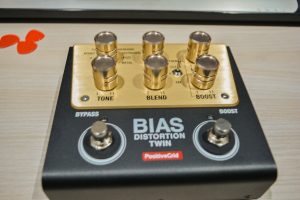
Aesthetically it is identical to its two brothers Modulation e Delay, obviously changing only the color.
The aesthetic impressions remain almost the same: the design is modern and solid, expressing the conception of modernity that Positive Grids puts in its products both with and hardware.
Honestly, however, perhaps the gold color is a bit flashy, but it is a reference to the dashboard of a Marshall plexy, so for many it should not be an eyesore.

Technical Considerations
The substantial difference with respect to Modulation and Delay is the fact of not being stereo, of course, and of having the boost (placed before the distortion stage) which allows to give more saturation and the right amount of nastiness.
In addition of course to the classic controls typical of overdrive/distortions, I find the control of very interesting blend, which allows you to have a mixing of the dry signal of our instrument with the distorted one: it is a detail that I have been seeing often in many pedals lately and I am appreciating it because it allows to have a very crystal clear sound, despite the high amounts of gain.
In place of the Modulation LFO we find a small switch, to give a scoop to the high or low frequencies, a very welcome plus.
For the rest, you can read the rest in the article of Modulation and impressions on the software of the house that allows the editing of presets.

Sound Considerations
In its totality, it performs very well on "extreme" sounds: the most frequent distortions in genres such as extreme metal and hard rock do their job very well, while in "softer" styles it behaves adequately, even if not excellent.
I didn't find the analogue counterparts particularly "bad": some presets sounded much better with the boost active, which I understand is a gain boost, which allows you to have more saturation.
Maybe that's my impression, so if you try it, I'd like to start a debate.
All the standard distortions are good, you can find nice sounds with a little effort, you don't lose whole days if you work only with the pedal; with software, on the other hand, things become much more complex, you can spend months there looking for the sound you like best.
As for the custom presets that are buildable with the software, given that it would take about six months and an infinite amount of takes to understand the differences a little, we will focus for now on on board sounds.
Ibanez RG 1070 + Pickup Zead Raw Standard-> Linfaudio Platinum Way cable-> Hughes & Kettner edition tube-> Cad Audio D84 + Cad Audio Gxl 2200-> Quiklok SS2 + Reference Rmc 01 -> Arturia Audiofuse
We will test one effect at a time, I leave the tracks of the Playlist here.
As mentioned at the beginning, the extreme sounds are particularly successful compared to the rest, you can hear a fairly marked difference, they are well done and beautiful sounds are achieved.
The converter is like the one on the Modulation, it works well and there are no particularly violent frequency cuts, you will not hear important alterations on your instrument.
The booster is linear, being digital there are no empty runs of any kind, it manages to saturate some presets well or add compressions to the most extreme leads.
I had a bit of difficulty understanding how it worked initially, the blend pot is very incisive and if you don't adjust it properly you risk having a very thin sound without any paste: the overdrive and screamer presets, for example, all at first I thought they weren't working properly.
The frequency cut switch works better than I thought, you can clearly hear the difference, when you insert the fat you feel the low frequency boost very clearly.
What I liked least of the whole range of sounds is perhaps the fuzz and some nuances of the screamer: I was not particularly enthused by the fuzz simulation, but it must also be said that they are very particular pedals for their genre, the most beautiful sound in the world as well as the worst.
All in all it has a sound palette that can be called professional without too many hitches.

Economic Considerations
Here things get a little difficult, the selling price is the same as the rest of the house, but the competition in the field of overdrive / distortion with attached booster is particularly fierce; let's say for the same price you can buy a boutique pedal, so it is possible to say that we are slightly out of the market compared to some brands, but also below compared to others.
For its part, it has a basic sound palette already of a good level that with its software can be sculpted indefinitely, which with an analog pedal, unless you make crazy changes, which compromise the pedal, you will never be able to achieve.
In my opinion, the plus of Bias distortion is set here.
Buyers should understand that they are not buying a car that "grabs, attacks, sounds", because all the nuances it can give you must be studied, just as when you buy a standard pedal you have to do the same (exponentially), taking into account a variable which I did not want to touch in this article, which is that of the profiling of analog pedals.
Final considerations
Pro
- Parallel distortion
- Good sound palette
Cons
- Difficulty of use
- Some presets only sound good with boost active
Notes by the author
Digital distortions always leave me with a strange feeling: some are truly incredible, while others are unlistenable. In many machines that I have tried and had over the years, from the Pod to the M5 up to this one, I always find at least three or four sounds that I really like (usually distortions for metalheads).
The first element in favor is that these distortions, despite the lack of bump that still distinguishes them from the analogue, do not make unwanted noises, they are fed even with little without particular electrical stabilizations, and allow to bring home a good result, perhaps not in the studio, but in a decent sized live.
Would I buy it?
For some situations where I would need "extreme" sounds it would be a good choice instead of a cheap gain pedal, it would allow you to have a metal-oriented sound palette at the price of a pair of medium-high range pedals, for example with the tribute to Linkin Park.
Useful news
- Distributor: Goldmusic Srl
- Recommended price: 370 euros (VAT included)