


The triptych of Positive Grid pedals ends with their delay, which, like the other pedals, inherits nomenclature, Form Factor and Structure.
These pedals perfectly convey the idea of the Positive Grid virtual instrument, being present in the pedal an AD / DA converter and a processor that manages the simulation of the software delays.
Digital delays are a standard in today's pedalboards, nowadays it is not very convenient to use an analog delay if not for specific artistic and sound choices that include a specific type of sound. In my experience, I see several professionals, even of the highest level, using what I have called “Super-Delay” over the years, due to the huge amount of options and sounds obtainable.
Among the various "Super-Delays" I will mention a few that you have surely seen and heard:
- Eventide Timefactor
- Strymon Timeline
- Korg SDD 3000
- TC electronics x3 Delay
- Free the Tone Flight Time.
Today to this list it is possible to add the Bias Delay, slightly less "super" than the others due to the lack of MIDI (in its Twin version), but perfectly capable of keeping up with the names listed above.
Let's analyze it in its salient features.
Aesthetic Considerations
As in the previous "episodes", the aesthetic considerations are in line with those of his predecessors, so I refer directly to the previous articles on Bias.

Technical Considerations
Unlike its predecessors, the pedal has a series of interesting controls: in addition to the classic Time and Feedback controls, we can manage the mixing of the dry signal and the effect signal with the Mix control, and add or not a reverb at the end of the queues; last but not least, a small control allows us to add a modulation to our delay.
In general, it is a bit lower than some competitors, which has a more complex control for modulation, a tone control and even an internal loop to add effects to the tails, but it is certainly more plug and play, if it is used only in pedal format. Its plus, as for the others in the Bias series, is the software sector that definitely beats all the delays that I have previously listed: the options are infinite and difficult to replicate.
Sound Considerations
It is always difficult to deal with the sonic aspect, in some cases because for many people some delays almost all sound the same (or so it seems) and it is not possible to grasp the nuances of a particular simulation on the fly: in this case, I have prepared a series of takes suitable for the purpose, to try to give a basic idea.
My favorite preset is the tape simulation preset because, even though analog still has its unbeatable charm, this preset has a decidedly rich, very present and successful sound.
I really appreciated the precision of the mix control, extremely precise and reliable, really well done, unlike my SDD 3000, with which I have learned to live with over time.

The Digital and Analog presets do their job very well: the analog preset manages to transmit a bit of heat, slightly better than some competitors, but starting to work with the adjustments the results you can get are exceptional; Digital instead behaves like the first digital delays of the '80s, returning a feeling of coldness but managing to be more precise and decidedly less "plastic" than the machines of the time, both in live and in studio applications.
I leave here some evidence with the usual chain:
Ibanez RG 1070 - Hughes & Kettner edition tube - Platinum Way linfaudio cable - CAD Audio GXL 2200 + CAD Audio D84 - Arturia Audiofuse
Economic Considerations
The fight between the delays is quite close, there are really many, some with only one sound but frighteningly beautiful, others that seem like mini nuclear power plants, with certainly convincing sounds but without any hint of excellence. In the price range of our delay, the opponents are found both between analog and digital. If we want to make a comparison instead with some valuable instruments I have in the studio, such as the Korg SDD 3000, it is true that the interface is more difficult, but it takes up very little space, it feeds without problems and the sounds are well structured, however of a invoice in some cases higher than the pedal of the Japanese house.
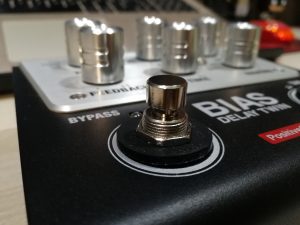
Even if we had to make an evaluation based only on the sounds obtainable on board, it is worth the expense, we are also a notch below the price of a Strymon, which however does not have an equally precise control, although perhaps some different features.
Final considerations
PRO
- Very convincing Analog and Tape presets
- Very precise mix control
- Reverb knob in some cases very useful
AGAINST
- Lack of MIDI
- Preset Space a little lackluster


