


There is a principle in computer science that states that the number of transistors inside a processor doubles in a cycle of time of twelve or fifteen months maximum.
This assumption has been largely made obsolete for years with the advent of increasingly advanced technologies, and even in the musical field the evolution of digital instruments is proceeding at an impressive speed. Looking at the recent past, it is possible to list some digital machines that have proved to be milestones for the creation of a technological standard:
- Zoom (G Series)
- strymon
- Line 6 (Pod HD, Helix, M)
- Headrush
- Bosses (GT)
- Kemper
obviously not counting the countless virtual instruments, for example TH3 di Overloud, which I reviewed some time ago and is still installed on my machine, with satisfactory results.
Today, however, we are touching a decidedly different point, a cornerstone that combines the concepts of a multi-effect pedal and a virtual instrument. Positive Grids is the perfect evolution of his virtual suite with a triptych of pedals that focus on:
- Distortions
- Modulations
- Delay
Talking about FX bias it is a feat, not in the sense of difficulty but from the point of view of the features and options that are really many. The analysis of the strengths and weaknesses will therefore be careful and meticulous, in order to be exhaustive.

Aesthetic Considerations
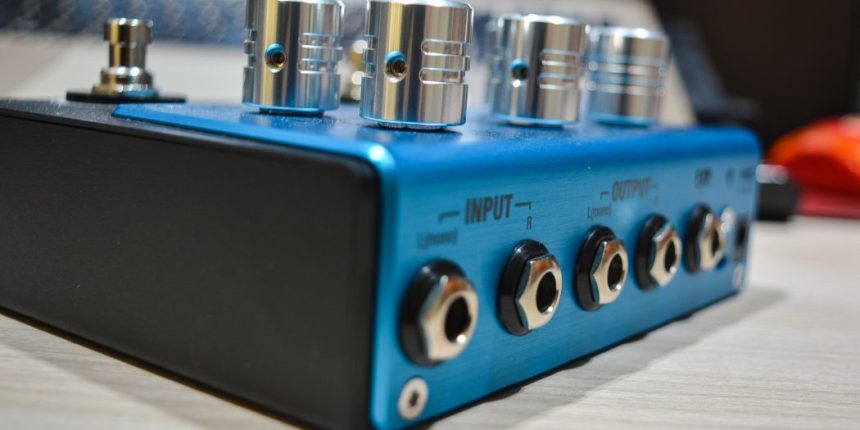
The machine is distinguished by a modern and captivating design, which makes a distinctive sign of a few elements: all the pedals differ in the color of the second metal body, which differentiates distortions (Gold), modulations (Blue) and delays (Silver) .
A special attention to the knobs, whose design is truly beautiful, modern, almost science fiction, worthily represent the idea of modernity and technology.
Small flaw on the footswitch which is a bit harsh compared to the soft-touches we might find on Tc Electronics (alas, once you try it you become addicted and can no longer tolerate anything else).
The pedal is also extremely light despite being made of metal, sturdy to the touch and with all the outputs in order: the audio ones are upwards, to make it easier to combine with other pedals, and personally I always appreciate this detail, since I have always little space on the pedal board.
Technical Considerations
Difficult to argue in this case, because we have to define two very specific purposes: the effects with which On-Board is born and what can be obtained with the attached software. The structural characteristics of the outputs are as follows:
- Power supply (9V - 500mah)
- Input 1 (Mono)
- Inputs 2
- Output 1 (Mono)
- output 2
- Expression pedals
The number of controls, on the other hand, varies from pedal to pedal: as regards Modulation there are a series of classic controls, such as Rate and Depth, and a pair of controls, Tweak 1 and Tweak 2, whose functions depend on the effect being used. he's using. As for the effects, there are:
- Chorus
- Phaser
- Flanger
- tremolo
- Rotary
- Ring modeler.
To this it must be added that there are two presets that can be customized with whatever we want, and here we come, in my opinion, to the best of the technical offer of this pedal.
The number of controls is complete, it must be recognized that the company really intended to create an almost definitive multi-effect machine for many users, the on-board setting possibilities are still many and can be used without problems.
As for the software discourse, I refer to my article on the suite of BIAS Pedal.
Sound Considerations
Let's start talking about an important factor even before turning on the pedal: the converter.
The problem with many pedals is that they eat up a good part of the signal because, not being completely truebypass or in any case having a not fully performing AD / DA conversion, they force to use quite complicated systems (passive mixers and splitting of the dry signal and the effected signal ).
In this case the converter is faithful, it does a good job and I would have to make comparisons in the studio with the instrument alone to see a marked difference, while during a live or using a mix I think it would hardly be heard.
Compared to that ofSDD 3000 which is in my possession, is more respectful of the low frequency spectrum, although the Korg has its own preamp; I don't know, however, compared to that of a Strymon, not being in possession, at least for now.
Il low filter oscillator it works very well, I clearly feel the difference in the sine wave that becomes square or triangular, it is one of the parts that are perhaps the most significant, especially in a totally digital pedal.
On the sound part, we can define the sound as practically "three-dimensional", unlike much more dated material that previously constituted a standard: we can perceive a very different thickness, the difference in the auditory amplitude of the modulations is very engaging, essentially all are decidedly very sounds hi-fi.

A hint of warmth may be lacking, but it can be largely dispensed with if you don't have a specific idea of a particular phaser, tremolo or chorus model that is considered “irreplaceable”.
Let's do some sound examples, so I can make the idea better.
The chain is very simple:
Ibanez RG 1070 + Pickups zead Raw Standard-> Cable lymph audio Platinum Way->Hughes & Kettner edition tube->Cad Audio D84 + Cad Audio Gxl 2200-> Quiklok SS2 + References Rmc 01 -> sound card Arturia Audiofuse.
We will test one effect at a time, listen to the tracks in the Playlist.

Wanting to talk about personal tastes, I found the chorus particularly beautiful, which goes from classic sounds up to those of the 80s and to the modern sounds of Fusion music: frankly it is an excellent replacement for my Boss clone Ce2 because it is less delicate in feeding, very silent and very clear.
Perhaps what convinced me less was the tremolo, but I think more because of my affection for certain analog tremolos that I used in the past and that I can hardly forget even today, it's not bad, but it lacks that involvement that only an analog tremolo of a certain level it manages to give, and that costs as much as the whole Positive Grid pedal.
The remaining effects fare well; Rotary and Ring Modeler also make themselves really appreciated, I have never been an avid user, they are not mixed or muffled.
The pedal is capable of excellent performance even with only the factory presets, with the tonal possibilities provided by the software the possibilities become endless.
Economic Considerations
The selling price is about 370 euros, not exactly low but we are talking about a machine that competes with:
- Eventide Modfactor
- Strymon Mobius
It is a pity, however, that despite a fairly important price there is no MIDI port, which instead is on the PRO model, which has a higher price and is located in the same range as those listed above.
If we compare it to other single pedals, the price is in line with the rest of the market.
Final considerations
Pro
- High level sound performance
- Buildable sound down to the smallest detail
- Wi fi connection
Cons
- It has no on board MIDI port
- Slightly tricky footswitches
Note from the author
This machine is interesting as a step towards a more performing "modulation machine" than an old M5, as it was in my case.
The cost is somewhere in between, between the price of the “Super machines” already mentioned in this article and the various “Mini-multi-effects” that many other brands have put on the market for five years now.
But in this case we have a much higher and well-defined quality standard, since we bring the sound of the vst directly to a pedal and not an ad hoc modeling for a machine with "skimpy" performance.
Would I buy it? Yes, but not this model in particular, because I can't do without MIDI, so I'd go straight to the Pro for the best control possibilities.
Useful news
- Distributor: Goldmusic Srl
- Advised price: 370 euros (VAT included)


