

For those who love music and stringed instruments it is not possible to stop only at the guitar: the time comes when it is necessary to study other instruments, not necessarily six-stringed. This article is my first review of an electric bass guitar, with a very traditional composition, born as a handmade solution within everyone's reach.
The Lodato Guitar Zen 4 was born with solid premises to be an excellent tool to start studying, a tool to work with excellent sound quality, to be worn during a journey to the conservatory or an academy, built with the collaboration of Antonello Losacco .
Let's see what it has to tell us.
Aesthetic Considerations
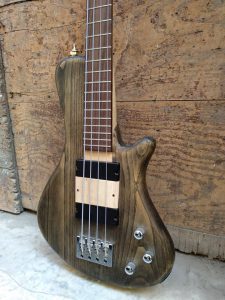
The instrument has a refined design with modern tips, the entire structure rests on a massive chestnut body with natural finishes throughout the instrument, creating a beautiful combination of aesthetics and wood grain. The chrome hardware and black pickups marry well, making the instrument not too flashy and stately, so that it can be used in environments a little more intimate than a stage.
It is a bass that presents itself quite well, many perhaps will find it a bit lackluster in terms of finishes, but keeping the wood exposed always has its timeless charm that hardly gives way to sparkle or fluorescent paints. The only drawback is perhaps the headstock a little too small, which makes the instrument slightly unbalanced backwards, but otherwise it is not at all bad to look at.
Technical Considerations
- Body French Chestnut or European Ash
- Neck (bolt on) Maple
- Rosewood fingerboard
- Modern Style Brass Bridge
- Strings Sansone String
- Wilkinson or Gotoh mechanics
- Handcrafted Humbucker Pickups in Alnico V MP Pickup
- Nut 45 mm in bone - Scale 34 "
- Radius 20 "- 2 volume + Tone controls (Pot CTS)
- push / pull humbucker / single coil
- 1/4 ″ Jack output
The equipment is not very different from the rest of the instruments on the market, but it stands out for the fact that it combines a good level of hardware with electronics and a series of magnets that do a good job and manage to be dynamic and powerful enough, despite the much smaller size than the humbuckers found on a Musicman.
The model in question, in particular, has a chestnut body; for the rest, this is the typical equipment of an instrument of this range.
Sound Considerations
These considerations are completely personal, since they arise from my experience as a Guitar-User reported on an electric bass. Having no experience with this instrument, I first thought of closing myself "in seclusion" to practice with the exercises, since while I already had an idea of auditory memory on the sounds, I felt I had to be able to get my hands at least professional on the instrument.
The sound in general is similar to the classic sound of the two humbucker pick-ups in split mode, very reminiscent of the typical sounds of the Fender Jazz Bass, to which we are all used by now and which remains a milestone; however at the same time the sound turns out to be more rounded and perhaps at times less charged with attack; the volume stroke is linear and has no vacuum points of any kind; the equalization section is quite basic and does not lead to overly open sounds.

In this mode you can get the classic sounds of the electric bass, managing to cover a range of not indifferent needs: obviously my opinion, bordering on banality, is that the jazzy, pop and funk sound are the masters for this type of magnets, but the humbucker mode is no exception.
The humbucker mode manages to give satisfactions for more driven sounds: they gain a very strong dose of harmonics, you can get a worse and more decisive sound than the single coil counterpart, of course.
Great for genres such as hard rock, a little less for heavy metal and for some modern pop sounds, where the bass must have a great roundness and a great presence.
It can be said that the sound range is between the Fender Jazz Bass and the Warwick Streamer, but with a good dose of resonance and a much more full-bodied, rounded and defined sound.
I made a spectrographic analysis of the instrument.
Here we can see the behavior of the bass, totally dry and directly in the presonus studio 1824 for the neck magnet:

As previously said, the sound is decidedly soft, not very bad and with a strong presence of frequencies in the low and very low frequency regime, a strong presence on the medium regime but not much on the highs.
Here instead we see the behavior of the magnet at the bridge:

In this case, things are a bit different: there is a more pronounced presence of highs and much more volume, a less muffled and more decisive sound, much more suitable for less "polite" genres.
The second aspect I want to talk about is handling: although the instrument has a light headstock compared to the very powerful body, it is comfortable to play; my path as a neophyte was not traumatic, I felt the right amount of vibrations, but I did not encounter problems with intonation or "extraneous" sounds. However, I found myself testing the instrument during an alas bad season, which is summer, so I had to largely take into account that there could be problems due to the change in temperature from one moment to the next, which happened but in minimal part, with a loss of tuning of about an eighth of a tone (which also happens to very famous instruments), but I have not lost intonation.
The neck is well made, it did not create any position problems for me, not even daring, always as a neophyte, to play rather narrow areas of the neck between the 13th and 15th frets: here too the intonation maintained well and it was possible to play with a discreet comfort.
In conclusion, the Zen 4 is an instrument that covers a decidedly wide range of sounds compared to some competitors, but maintaining a superior quality of wood and electronics, and managing to guarantee a relationship between timbre and handling that I cannot complain about.
Economic Considerations
The bass comes on the market at a price of around 950 euros, including taxes and housing. It is not a very high price, we are at the level of a Mexican or American jazz bass (used), Warwick, Scechter or Ibanez. The idea is to offer a practically handmade product at an honest price, offering a tool that is built on specific requests and that allows it to work for quite a few years.
Nothing to add, the price is appropriate and it would be difficult to ask for more.

Final considerations
Pro
⦁ Good hardware
⦁ Versatile
Cons
⦁ Head too light
⦁ The natural finish may not like it