

In the early 70s, with the ever-increasing success of the analog synthesizers introduced by Bob Moog, American engineers built a synthesizer in the garage below the house that would soon enter the annals of the history of musical instruments, known as the ARP 2600. Today, in the era of digital simulations, a small Californian software house, Wayoutware, re-proposes this myth of electronics in the form of a virtual instrument, renaming it TimeWarp 2600.
The ARP 2600:
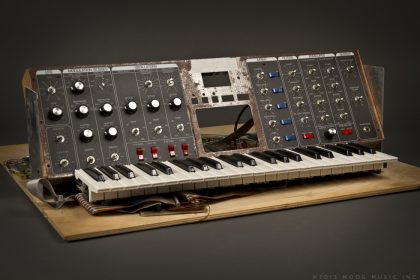
ARP is the acronym of American Recording & Performance but they are also the initials of Alan Ropen Pearlman, an electronic engineer and music teacher who in 1968, in the laboratory set up inside his garage, began to design a device that could serve universities and research institutes to study the applications of electronics in modern music and learn better the world of artificial sound synthesis. Of course Mr. Pearlman did not imagine that such an instrument, in the years to come, would become one of the most used and desired synthesizers by the most famous pop musicians of the time (among which I would remember the great Stevie Wonder who signed the advertising brochure), in direct competition with the works of Bob Moog. The ARP 2600 (Fig.1) it's a semimodular synthesizer, monophonic, built entirely by hand inside a wooden case that can be positioned vertically and with the possibility of adding an external keyboard, with a somewhat raw and somewhat confused front panel. It was introduced to the market in 1970 and remained there until 1981, and in total just under three thousand examples have been sold, so few that having one today means having a real rarity.

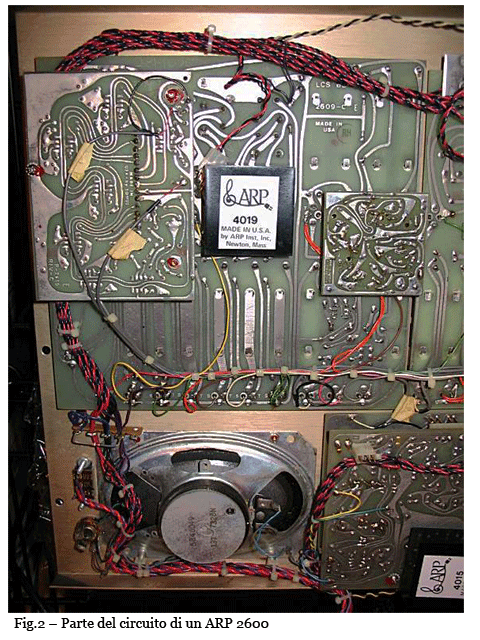
The first version was infamous for its flaws and almost complete instability, although it was precisely the one valued most today. In 1971 a new version came out with minor improvements and a different look, with bare wood finishes instead of the black tolex upholstery. Until then the ARP 2600 was equipped with a low-pass filter a 24dB on octave literally copied by wire and by sign from Bob Moog's "ladder filter" project (Fig.2), so much so that Pearlman was sued for using Moog's patent illegally without his authorization. This prompted him to redesign a new filter circuit, thus the third version of the 2600 was born the following year. In 1978 the fourth and latest version of the instrument came out, once again with a different look, black panel with orange serigraphs, a new and very original filter much more stable than the previous ones, and for the very latest models there was also the possibility to extract individually the different modules to facilitate maintenance. The same graphics, the same logo and the same filter can be found in another famous instrument produced by ARP in the same years, theOdyssey. As mentioned earlier, the ARP 2600 is a monophonic type synthesizer semimodular: unlike Moog's modular systems, in the 2600 the various modules are already pre-wired internally, but it is possible to bypass the factory connections through patch cords external connectors which, when inserted into the front sockets, automatically interrupt the standard signal path, giving free rein to the imagination of the wildest keyboard player! According to this logic, to obtain a sound from a semimodular, no external wiring is required at all, it is enough to simply use the front controls as on any other non-modular synth, nevertheless the real fun comes when you begin to reconnect all the modules to your liking. . Among other things, it must be said that the 2600 was the first instrument of this type, closely followed by Korg with the PS and MS series and Roland with its System 100. In an ARP 2600 there are three VCO oscillators with waveforms square, triangular, sawtooth and sinusoidal, two envelopes of which an ADSR and an AR (attack and release only), a filter, a noise generator, possibility of sample & hold, a ring modulator, a enveolpe followers, a spring reverb, stereo outputs and two built-in speakers. The keyboard is connected externally, the most famous and complete is the 3620 model which in addition offers an LFO oscillator, portamento, a transposer and a duophonic to be able to play two notes at the same time.
The TimeWarp 2600:
The programmer of this virtual instrument is called Jim Heintz (Fig.3), one who for years has repaired hundreds of ARP synthesizers and who, without a doubt, knows them deeply from the inside out. For the development it used a technology that in recent years has been expanding like wildfire, called rather generically "Virtual Component Modeling", inspired by the synthesis of physical models, with the only difference that the various components are modeled here active and passive electronics of a circuit rather than physical elements existing in nature. Thanks to this system, much of the operation of the synth is obtained by digitally recreating the entire circuitry of the 2600 as shown on the original wiring diagrams, with the exception of only some parts that do not directly affect the sound quality (for example the management of the midi flow and presets). The TimeWarp 2600 is the only sponsored ARP 2600 simulation and guaranteed directly from Alan Pearlman himself, so much so that at the 2005 Winter NAMM Heintz showed up with a real 2600 and showed direct comparisons with his software, a real challenge, boasting the collaboration of Pearlman throughout the process of development.

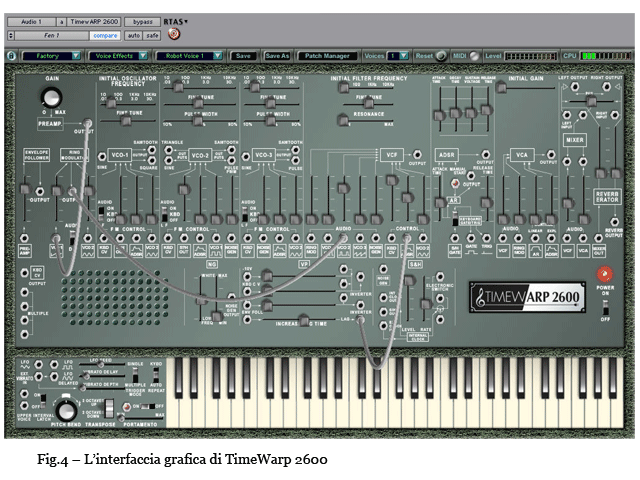
The large graphic interface (it takes at least a 17-inch LCD monitor to see it well!) Mirrors the control panel of the 2600 with the connected keyboard (Fig.4), and each control shows a pop-up window when you hover over it indicating the name of the parameter and its respective value. Everything is divided into sections, and from left to right we find the oscillators, the filter, the vca, the mixer and the output section with the reverb effect. Note that, since the original 2600 did not have a dynamic keyboard, in TimeWarp when there is something that responds to the midi velocity, the related parameter on the screen moves automatically in conjunction with the variation attributed to it. The ARP 2600 was not only used as a musical instrument but also as a generator of noise and special effects used in films such as Star Wars and numerous TV series of the 70s, therefore among the numerous presets that we will find in the standard distribution of TimeWarp there could not be dozens and dozens of special effects, from explosions to lasers, from space sounds to war sounds, weapons, atmospheres, etc. all ready to use, recalled with a few simple clicks on the upper part of the graphic interface dedicated to the quick management of presets and global settings.
And to better manage your sound library, by clicking on the button Patch Manager you access a window from which you can organize the presets into groups and categories (Fig.5), and in addition they can be exported and imported. In addition to the characteristics of the original ARP 2600, in TimeWarp 2600 we will find new implementations such as velocity response and aftertouch midi, polyphony up to 8 voices, response to midi continuous controller for each parameter, support for host automation, the ability to load customized midi mappings, management of microtuning and a very good simulation of the spring reverb, slightly improved compared to the sound given by the original one (according to Pearlman!). Compatibility is ensured with all the most famous hosts, both in Windows and Mac but there is also a stand-alone version. The installation is very simple and fast and the protection system is based on the Peace Anti-Piracy. The CPU power requirement is certainly not negligible, but if you limit yourself to monophony you can use the TimeWarp 2600 easily even on an older computer while maintaining more or less low latency times. The sound? Well, what can I say, the possibilities given by such a synthesizer are almost unlimited, and if you don't pay attention to where you connect what, you risk getting noises and noises as well as sounds and sounds, really everything. The test, as usual, I did it on a Pentium 4 with a Pulsar sound card and, at least by ear, there is no audible defect, no aliasing or clipping of any kind.

I fiddled with virtual patch cords for hours, experimenting with the different effects that can be obtained by connecting the modules together in the most unthinkable ways (Fig.6), and I must say that not only does the response to the controls remain fluid and precise even using an external midi controller, but the general stability of the software is really excellent, especially considering that at certain moments I saw the CPU rise to alarm levels. Among the factory presets there are some beautiful basses that, inserted within an entirely electronic musical context, make their noble figure, give a nice sense of roundness and remain well balanced over wide frequency ranges. Lead sounds are also excellent, especially if you assign some external controllers and indulge in real-time modulations. Of course this is not a synth for beginners, it is not very easy to understand and requires a little study even for those who already know a lot about synthesizers but have never used a semimodular like the ARP 2600. But if we really want to compare it to the its counterpart in flesh and blood (indeed, in wood and silicon!) Let's say first of all that a real 2600 today is valued at around three thousand euros and is very difficult to find, especially if you expect to find one that works perfectly. Having said that, a good software alternative can only bring all the advantages of the case: it does not break down, it does not go out of style, it does not risk destroying it because the software allows only "feasible" connections (outputs can only connect to inputs), it integrates seamlessly into our audio workstation, has presets and all the nice things the world of music computing has to offer, not to mention that it costs less than a tenth of a real ARP. Although not many have had the opportunity, in the past or present, to personally use an ARP 2600, certainly many have heard the sound without our knowledge listening to the records of the Who, Stevie Wonder, Jean Michel Jarre, Depeche Mode , the Weather Report, Rick Wakeman, and many other great artists. Today, however, thanks to software and computers, we can all get our hands on this amazing tool without necessarily being rich.

Guido Scognamiglio