




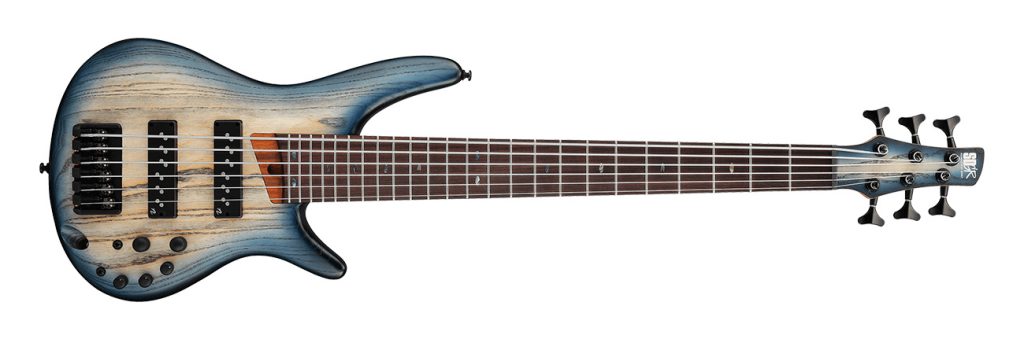
The SR606E bass features an ash body, rosewood fretboard. It features Nordstrand pickups and a custom Ibanez 3-band EQ, which can be bypassed via a switch.
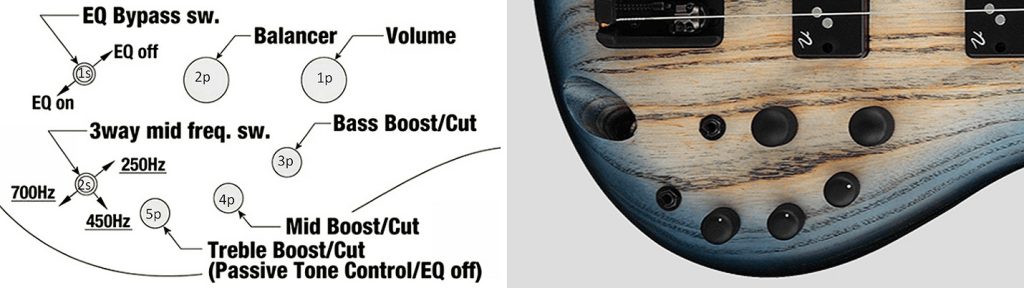
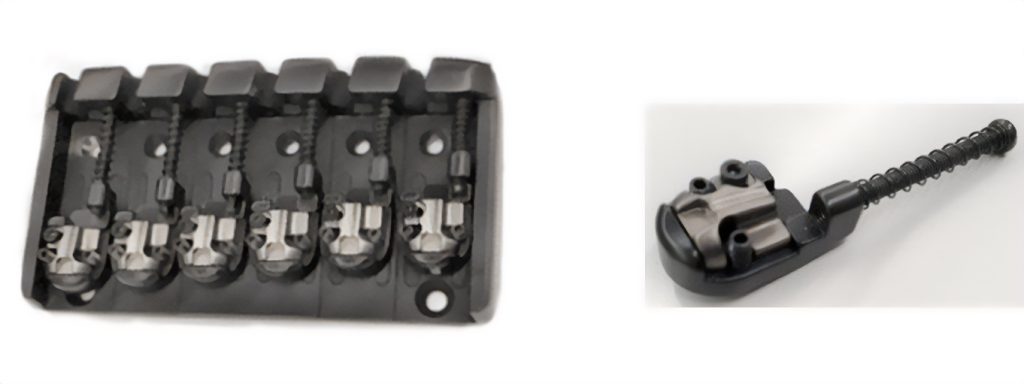
In this specific case, the passive tone control is located on the treble pot. As for the equalizer, there is a switch a 3 positions which allows you to select the mid frequencies (250-450-700Hz) on which it will be possible to intervene. The bridge used is a Accu cast B506 offering string spacing of 16,5 mm. This spacing, not very wide for a bass, is usually used by Ibanez for its 6 strings.
The manufacturer has thus found its right compromise between neck width, playing comfort and playability. The ladder is 864 mm.
Controls Section
The controls section consists of 5 potentiometers e 2 switch whose functions are clearly described in Fig 2 and which for expository convenience I have indicated with numbers and letters.
1s– on-off switch for active or passive operation
2s– 3-way switch for selecting the mid frequencies to enhance or attenuate
1p– Volume control
2p– Balance Pickups
3p– Bass Boost/Cut
4p-Mid Boost/Cut
5p– Treble Boost/Cut. Also when the EQ is off, this pot functions as a passive tone control
Frequency curves
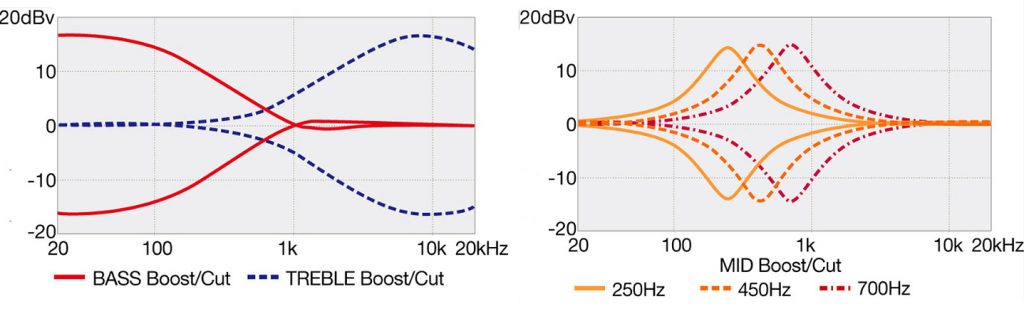
The boost/cut frequency curve of the bassi has a peak at 20 Hz, with a variation of approx ± 15 dB. The course of the curve has such a slope that the amplitude is variable is reduced to zero about 1000 Hz.
The boost/cut frequency curve of the acute it is centered at approx 10.000 Hz. Here too we have an allowed variation of approx ±15dB. The treble curve adjustment extends down to i 100Hz.
The boost/cut frequency curve of the average it is also about ± 15 dB, with a bell-like pattern that is selectable (by the musician, by adjusting the 2s switch) at a frequency of 700, 450 e 250 Hz. The width of the curve is such that the variable range becomes zero close to 20 Hz and around 10.000 Hz.
The graphs of Fig.3 summarize in a very clear way the interventions of the EQ just described
Bass neck
The handle of the SR606E is screwed on and is in five pieces Jatoba/walnut.
Keyboard
The fretboard is in rosewood and represents a universally recognized standard for the choice of wood. The inlays are oval and abalone
Fig.4
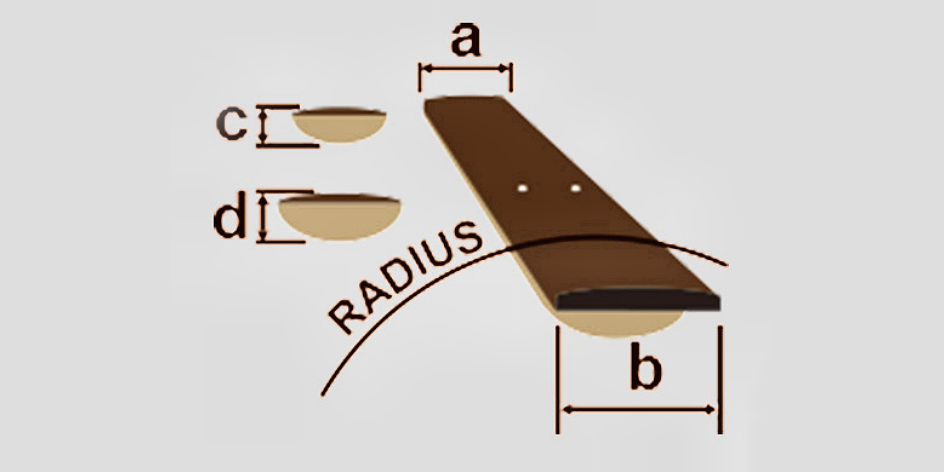
The dimensions of the handle are:
a: 54mm wide at the nut
b: 83mm wide at 24Freet
c: Thickness 19,5mm at 1Freet
d: Thickness 21,5 mm at 12Fre
Radius 400mm
Scala 864mm
Pickup
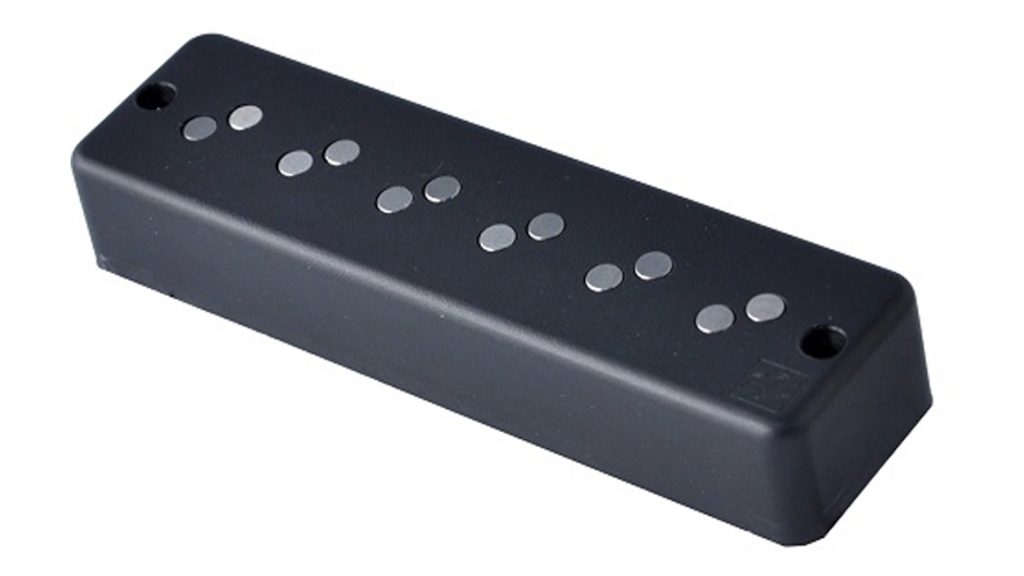
The SR 606E bass features pickups Nordstrand™ Passive "Big Break", soapbar-style split coils that participate, with the other luthier elements and design choices, to give the instrument a full-bodied and powerful tonal texture, while maintaining the clarity of the single coil tone.
If I had to describe the sound produced by this bass in very few words, I would define it as “modern from the classical tradition”.
Get up
In the BRIDGE Accu cast B506, the saddles, in addition to the standard adjustments, provide the possibility of varying the spacing of the strings between +/- 1,5 mm.
The color of the tool is defined as Cosmic Blue Starburst Flat with satin finish. The hardware however is black.
Field test
The constructive choices (woods with a sure reference timbre such as ash and rosewood, hardware, pickups, adjustments, project …) make the instrument very versatile and with a professional sound. When listening we have the perception of deep and clear bass with an excellent attack. The timbre tends to be modern without however denying the past (see also the possibility of using it in the passive). The pickups and their equalization/regulation system work very well and allow you to find the timbral solutions most suited to the genre played and/or the executive context. The bass in passive mode, like a true passive instrument, works even without the battery (from 9v housed at the rear). This, as you surely have already guessed, is particularly convenient in fact, in the event that the battery in use goes flat and you don't have a spare battery, you can (even if only in passive mode) continue playing in any situation, without having to interrupt the performance. From a tonal point of view, even setting the controls in a completely flat position, the difference between active and passive mode is felt.
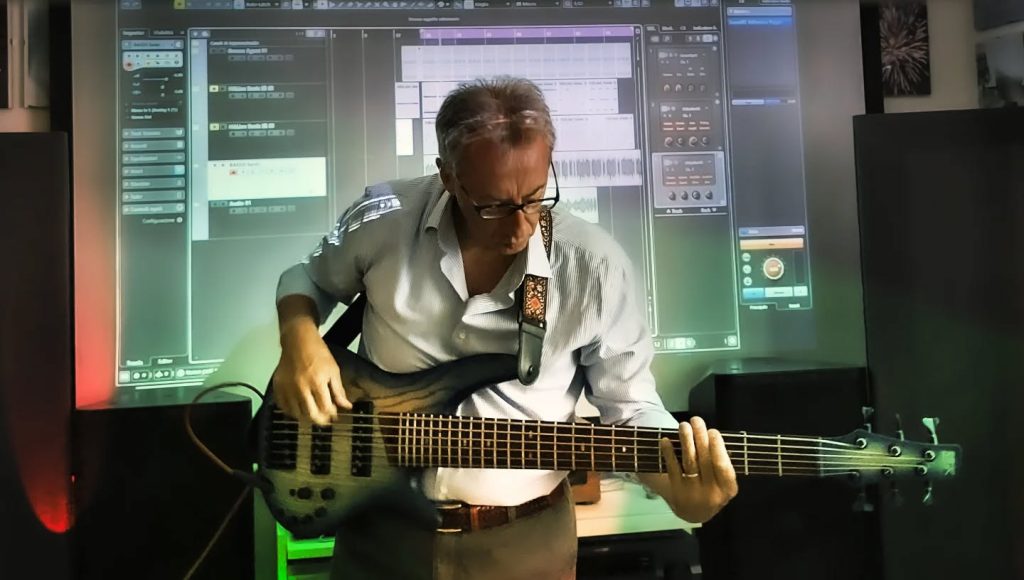
In active mode the sound acquires a certain "modernity" presenting itself deep, sufficiently bright, wide and with a good attack. In passive mode instead, the sound tends to "dry out" getting closer to its passive being.
The neck is "comfortable" for a six string, with the right compromise between size and space between the strings. Anyone who knows Ibanez basses already knows what I'm talking about. Ibanez has always opted for a space between the strings of about 6 mm for its 16,5 strings. Perhaps, slightly narrow for those accustomed to a classic spacing of Fender-style 4-strings (about 19,5mm), but which allows for a not excessive neck size of a 6-string. However, after a little time, you tend to get used to this setting, eventually appreciating the practicality with which you can perform some steps.
For cost containment, one of the main choices made by Ibanez was to have the SR606E made in Indonesia. A choice that has allowed the manufacturer to offer musicians a respectable 6-string bass at a competitive price.
Can you get more by spending more? Certainly! However, oftenin medio stat virtus” that is, “virtue lies in the middle”. So, if you are willing to buy a 6 string bass, which does not cost much and which allows you to enter or continue in the world of 6 strings with an instrument with an excellent Q/P ratio, I think you should also try the SR606E, you will surely discover many interesting things.
Thanks Cav. Music House Fifth Fabio for the availability and timeliness with which they procured my Ibanez SR606E
Useful Information
Sito: www.ibanez.com
Product: www.ibanez.com/sr606
Price: Around 880 euros


It seems like a great option for those looking for a 6-string bass without breaking the bank. The Nordstrand pickup is always a good starting point.