
Behringer had announced and presented it for the first time at NAMM 2011, together with the new X32 digital super-mixer, the result of the union of forces between Behringer and Midas. I'm talking about the Powerplay P16 system, consisting of the P-16I control unit, which connects to the P-16M personal mixers and the whole thing can be expanded dramatically by adding the P-16D hubs.

This is certainly not new, the monitoring system with "personal mixer" has already existed for years and the American is the king in this sector. Aviom, and anyone who has ever played on “big” stages or recorded in “big” studios knows what I'm talking about. Why am I talking about “big” stages and studios? Because "big" is also the cost of a system Aviom: for a control unit and a set of 4 mixers perhaps 4000 euros are not enough! And that's where Aunt behringer comes to the aid of us mere mortals, those who work in small studios and play on medium / small stages with good but “humanly affordable” equipment. The system P16 it is, in short, a real manna from heaven, a salvation for all those musicians who, obviously, to express themselves well need first of all to feel good, and then to hear the rest of the musical context well. in which they are performing.  How have we done so far, we who couldn't afford Aviom? We came up with absurd solutions, we used the old Power play HA4700 (I am convinced that this is Behringer's best-selling product! It has been around for almost 10 years and they really all have it!), or any other traditional headphone amplifier capable of carrying the same signal on 4, 8 or more headphones at the same time. The problem was that everyone heard the same thing, so you had to forget to tell the technician “can you raise my microphone and lower my keyboards a bit?”… Er, no… not if a bit ago! Or it could have been done but using the auxes of the mixer and therefore offering mono and always very approximate monitoring, with great frustration for both the musician and the sound engineer who wasted more time doing the monitors than all the rest. With a personal monitor system, on the other hand, the sound engineer thinks of being a sound engineer, and once he has made sure that he has sent the necessary channels to the monitor control unit, it is the musicians who each provide their own mix in the headphones. Ah! What a liberation!
Control unit P 16 I
So let's see how the new P16 works, which is finally available after more than a year from its first presentation. Let's start by saying that it is certainly inspired by the Aviom A16 but it is not the same thing, here perhaps there is something more.
 The P-16I control unit is very sober, usual Behringer robustness, well cut aluminum, well painted, all elegant and solid. On the front there are 16 selectors to set the input level of the 16 channels individually; next to it are the 6 exits RJ-45 and a few various LEDs that indicate the way of use, the origin of the signals, etc. On the back side, on the other hand, we have the 16 balanced analog inputs on the TRS connector and two lightpipe inputs, because we can connect this little gem to the system both in analogue and in digital through two ADAT connections. It goes without saying that the audio quality is sui 24 bit a 48 KHz.
P-16 M mixer
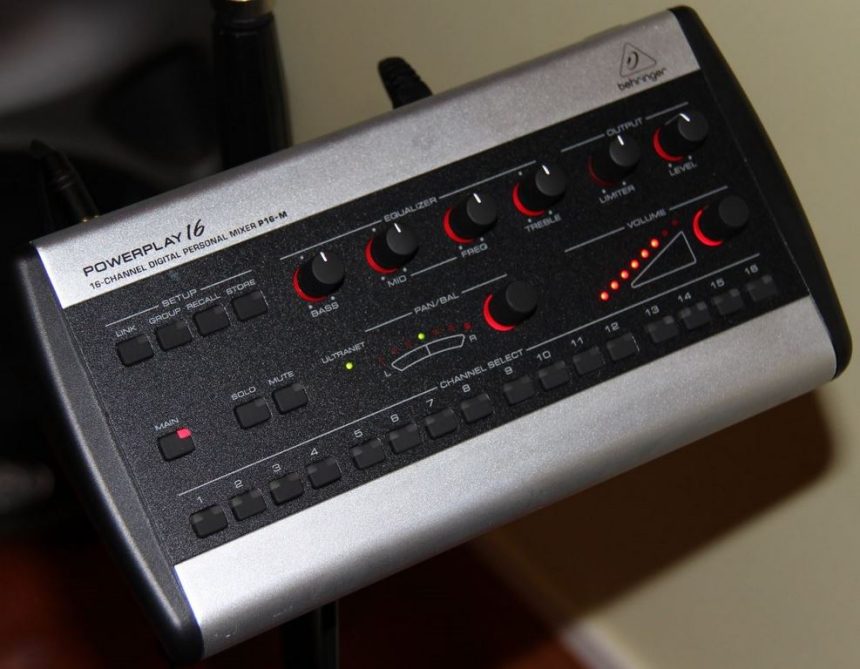
 Let's move on to analyze the strong point of the system, the P-16M mixer. Come on, look at him, isn't he cute? In my opinion there are some ingenious solutions. Let's not forget that it's an all digital system, that's why so few controls for so many channels, but so much is also the quality and versatility. The connection to the control unit takes place via a single CAT-5 cable, in short, the normal network cables, through which both the power supply and the 16 digital channels pass. Ah, note that Behringer, inside each package of the mixer, also makes us find an excellent 5 meter cable! They think of everything, huh? The mixer is powered by both the CAT-5 cable and an external power supply (also supplied, but not needed unless you connect the units in a daisy chain). So once the control unit is turned on, the cable connected, the mixer turned on, here we are. The buttons at the bottom make us select the channel, for each of which we have the volume, adjustable through the appropriate endless encoder, the pan, also adjustable through an encoder, and in addition we have an equalization section on three bands, of which the central is semi-parametric, and finally we have the master volume and a limiter. The eq can also be applied to the master (or “main”). A strong point? A scary output volume! Tested with headphones Sony MDR7506 a volume came out to break the eardrums! But luckily there is the limiter, which with only one potentiometer allows you to always find an optimal setting without crushing the sound too much. And anyway, the volume is so much that in most cases it will never be necessary to keep it at maximum. The volume and pan encoders are also push buttons: by pressing the volume encoder you have the mute function at your fingertips, without necessarily having to use the appropriate key; instead, pressing the pan encoder resets the center. The mute and solo keys are used to mute or solo individual channels.
  Then there are the link and group functions: with link you can connect the channels by creating stereo pairs in combinations 1-2, 3-4, 5-6, etc., and when you create a link between two channels, these are automatically panpottati left-right, so that if, for example, on channels 1 and 2 we have the mix of the keyboards, we just link them to obtain the stereo mix and adjust it referring to it using the channel selection button 1 or 2. The groups instead you can create between 2 or more channels of your choice, and when you make an adjustment on one of the grouped channels, this is reflected on the other channels in a proportional way.For example, if I have 4 channels dedicated to choirs, on the 5 I have the voice of the bass, on the 6 I have the tenor, on the 7 and on the 8 I have two sopranos, I can start by adjusting each channel individually, perhaps also creating a certain stereo panorama, and once they are grouped, I just need to adjust the volume of any of these 4 channels to adjust the whole group in oneonly once. Ok, these are not new features, they are the classic things that have always been on all digital mixers from the Yamaha Promix to today, but isn't it cool to know that all this can be done in a very small mixer dedicated to monitoring?
There is also the possibility of storing and recalling snapshots of the mixes made, and an interesting thing is that when the system turns off, everything returns as it was left when it is turned on again, even if nothing has been saved. This seems little, but it is very important!
Another couple of niceties: on the back, in addition to the RJ-45 input for connection ULTRANET, there is also an output that you can use, as I said before, to create a daisy chain between these mixers. So we can connect them all to the control unit, go through the optional P-16D hub, or connect them one behind the other using these outputs.
Furthermore, there are two balanced analog outputs, and these are also very important and greatly expand the versatility, for example to use the mixer with a ground monitor system or with an in-ear monitor. There is only one headphone output. Too bad, had there been two it would have been more interesting.
Another nice thing is that under the channel selection button strip there is a lot of empty space on the aluminum casing. Nothing comes to mind? I say "gummed paper"! Yeah, how do we remember what's there for each channel? And then we attach a nice strip of gummed paper and with a thin-tipped pen we write our notes underneath.
And we want to talk about the optional P-16MB auction stand? It seems nothing, but even that is a genius: the iron base comes out in the package to be screwed to the mixer with 3 star screws, this base can then be screwed directly onto the screw of a straight microphone stand or it can be hooked to the additional arm that allows us to connect everything laterally to the tube of any rod. And on the iron base there are also guides to stop the cables!
In short, Behringer really put everything into this product: power, clean sound, versatility, elegance, but above all it gave the possibility, finally, to have a real personal monitoring system at an affordable price, let's talk about 180 euros for each mixer it's about 220 euros for the control unit. In short, a small studio with less than 1000 euros makes the system for four musicians, and the small studio takes a new big step towards the "big" studio!
Pro:
- affordable price considering the existing competition
- high flexibility, number of channels, connectable units
- high volume output in the headphones
Against:
- only one headset per mixer
- for the connection to a pole you need the optional kit
See you next Guido Scognamiglio
USEFUL NEWS:
Producer: Behringer
Model: P-16
All photos were taken by the editor Guido Scognamiglio and are Copyright © fabiop139.sg-host.com/