


Paraphrasing a scene from Luciano De Crescenzo's film "Thus spoke Bellavista", we could exclaim "Stratocaster, aneme 'do purgatorio", an exclamation that the grandfather - in a semi-vegetative state - used to repeat every time he heard the word "one million", to indicate the importance of that sum.
Fender Stratocaster: the myth, the guitar that together with the Telecaster and some Gibson models made the history of electric guitars. Thinking about customizations becomes, therefore, rather difficult but not impossible, as we will see shortly. I state that I already know the first thought of the “savvy” reader, which can be summarized in one word: why? The answer is simple: every now and then - when free time permits - it is useful, beautiful, healthy and fun to meet and rediscover laborers, architects of one's own destiny (also musical), to understand each other in a reality in which one is not prosthetic of machines but … Generators of phenomena. Immersed in this spirit, we can continue!

As all guitarists know, the Fender American Standard Stratocaster comes with one 5-position switch, which allows you to select the following pickups respectively:
1 Position: Pk Handle;
2 position: Pk Handle + Central;
3 position: Central Pk;
4 position: Central Pk + Bridge;
5 position: Pk Bridge.
As you can easily observe, there is no possibility of selecting the Bridge + Neck pk (Telecaster type) simultaneously, as well as all three PKs. Here is the idea of modifying the electrical circuit in order to obtain these other 2 possibilities. Below you will find my personal experience. To do this I have equipped myself with a Phillips screwdriver, soldering iron, tin, scissors and small DIY tools. In Fig.1 a small diagram of the new electrical circuit is shown. I anticipate that everything was not complicated to achieve. However, allow me an appeal: dear reader not accustomed to the use of the soldering iron or inexperienced in DIY, if you plan to repeat what you will read I recommend that you rely on someone who has a minimum of experience in this regard.
Let's go back to what to do:
First you have to disassemble and lift the grille that carries the pickups and electronics. Then, you need to place the micro switch (Fig. 3) between the 5-position switch and the potentiometers, making a small hole of the right diameter in the bezel. Then, you can proceed to solder a piece of wire between the positions A of the two switches. The same goes for positions B. Reference point for the operations described can be found in the diagram shown in Figure 1, where, with red dots, the welding points are indicated.

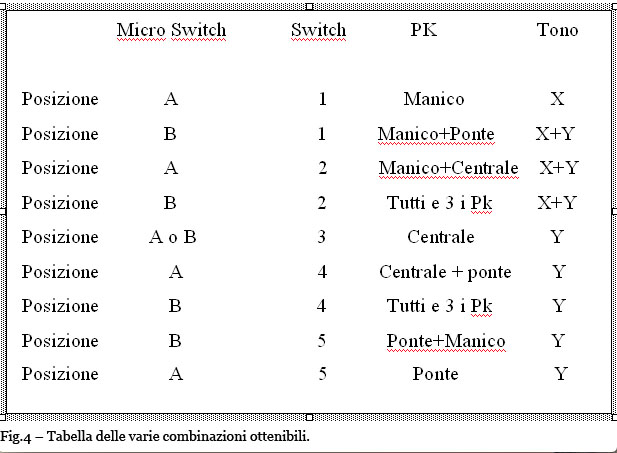
The result of the operation should bring a result similar to what is seen in Fig.0 and the combinations now obtainable are indicated in Fig.4.
AThe classic tones of the Stratocaster have thus added two new opportunities:
Pk in the bridge + Pk in the neck (standard solution telecaster), where the resulting sound is different from those obtainable without modification and is less aggressive than the pk alone at the bridge, but also less sweet than the pk alone at the neck, with generally softer attacks.
- The 3 Pk simultaneously, with which we get a very complete and almost acoustic sound.
Many will ask: why tamper with a Stratocastes, icon of solid-bodies?
The answer is simple: an incessant desire for research and experimentation, a passion that should always accompany any man of science.
From the very beginning, in fact, my goal has never been to improve a historical guitar (which I think is very difficult), but to expand the sound possibilities of the instrument.
So here I looked for access to those combinations of pickups that were at hand but that were denied with the traditional circuit.
This very low cost operation is repeatable, with small variations, also on other Fender / Squire - Stratocaster models with a 5-position switch-pk.
The excellence of a guitar sound depends on taste, therefore it is a subjective element, but it can also be a function of the kind of music to be performed, of the touch and of a thousand other variables. However, having greater flexibility, with further combinations, seemed to me a good opportunity, even if in reality each instrument becomes attached to one, maximum two characteristic sounds, which will be used practically always.
Attached you will find some examples of obtainable sounds.
In order for everything to be as precise and experimentally reproducible (here is the man of science who reappears), the recording was made as follows:
- Same riff;
- Same take (the guitar was inserted in a boss GX700 where an amplifier was simulated Roland jc-120);
- Clean sound with slight added reverb.
In sequence you will hear the sounds as per the file name.
Good music everyone!


