


Those who like me already have some white hair, but also many young people, associate the name Rupert Neve with the audio recording par excellence. In fact, many records produced in the past and not only have been recorded using Neve equipment that greatly contributed to the characterization of their sound.
A bit of history
Porch 5015


Connections

* key related to phase inversion, by pressing which it is possible to rotate the phase by 180 degrees;
* phantom power button;
* gain knob, which is adjustable in 6 dB steps up to a maximum gain of 66 dB;
* knob for fine adjustment of the gain that allows a continuous variation in a range that varies from -6 to +6 dB, up to a maximum pre-amplifier gain of 72 dB (66 + 6);
* 8-segment LED output level indicator;
* mute button;
* “to Compressor” button with which it is possible to send the signal directly and internally to the compressor without making an external patch;
* HPF key with which it is possible to insert or not a high pass filter, with a slope of 12 dB / octave and adjustable cut by knob from 20 to 250 Hz;
* “Silk” key: simplistically we could define it as the introduction of an effect that enhances the sound qualities of a vintage type. It technically works by reducing negative feedback and adjusting the sound spectrum, thus resulting in a sweeter and more musical sound;
All the buttons that activate the various functions, if pressed, light up, indicating their activity. Compressor section controls Proceeding always to the right we arrive at the side of the front panel dedicated to the controls of the compression section. The first key we encounter is the one relating to the insertion or not of the compressor (“In” key). Following, as in the most classic compressors, we find the various potentiometers relating to the regulation:
* threshold / threshold from -30db to +22 dB;
* slope / ratio from 1: 1 to limiter;
* attack from 20ms to 75ms;
* release from 100ms to 2,5 seconds;
* final gain adjustment from -6 to + 20 dB.
Also for this section there is an 8-segment LED indicator that signals the level of Gain reduction. Then follows the FF / FB key that allows us to choose the feed-forward or feed-back compression mode. With the “s / c link” key we can link the controls of 2 compressors such as, for example, two 5015s or a 5015 with a 5043. Obviously it is assumed that the two modules are connected to each other via the aforementioned link connections. Brief technical notes Returning to the design philosophy of the machine, we can say that the microphone input is balanced and uses a TLA configuration (see “TLA deepening”) which makes use of a toroidal transformer. This eliminates electromagnetic disturbances and works as a low-pass filter excluding frequencies above 150 KHz, responsible, according to the designer, for intermodulation disturbances. The signal then, proceeding in its path, arrives at the real input transformer which determines the galvanic isolation and which, like any component inserted in an audio path, will contribute to the formation of sound. Focus on TLA The input and output transformers are specific projects by R. Neve. The designer pays particular attention to the realization of the transformers, which according to many are the elements that more than any other contribute to the characterization of the NEVE sound. In fact, it is widely believed that the sound of some tube tubes is mainly due to the use of transformers rather than the tubes themselves. As the most attentive of you will have already noticed, the Pre of the 5015 features only the microphone input. The absence of a Line level input does not allow the use of this machine to "analogize" digital tracks; in fact, we will hardly be able to correctly pass the Line signal coming from the sound card through the microphone input of the preamplifier and perhaps with the “Silk” button inserted to add further analog paste to an audio track. Logically, if only because one is obliged, in the case of using Line signals, the use of a passive DI Box can be envisaged (see “In-depth DI Box”). Focus on DI Box
The input signal, after passing the transformer, is suitably amplified until it reaches the output transformer and then the "Mic Out" line output, allowing us, along its path, all the adjustments seen previously (variation of the Gain, phase inversion, Phantom introduction, High Pass Filter, ...). From the declared technical data, we highlight a frequency response at -3 dB from 18 Hz to 150 KHz. I remind you that the latter is the frequency at which the TLA circuit intervenes. The noise level, unweighted, measured with a passband from 22 Hz to 22 KHz at 66 dB is equal to -62 dB. The total harmonic distortion at 1 KHz +20 dBu is less than 0,002%, while it rises to 0,2% with the “Silk” key inserted: this is by express wish of the designer. The signal path of the Pre section can be seen from the block diagram (Fig.4).

The signal, using the “to Comp” key, can be sent internally directly to the compressor. The working principle of the compressor is of the VCA type. The circuitry of a compressor or limiter can be different. In the case of the 5015 there is a control voltage amplifier (VCA) whose gain can be varied according to the applied voltage. Through the adjustments, therefore, we can vary the level of the threshold value, the attack and release times as well as the input and output level. The compressor block diagram is shown in (Fig.5).

In-depth Compressor Field test To try to better appreciate the strengths and weaknesses of the 5015, the test was conducted both in my home studio, where I obviously know well every instrument present and the environmental acoustics, and in some studios in the area thanks to the availability granted to us by the owners. In this case the test was conducted by Antonio Campeglia. The 5015 was used almost exclusively as a mic pre (due to the lack of Line and DI inputs). However, I did not miss the opportunity to use a high quality passive DI, with which I was able to record a '75 Fender Jazz Bass: but we will talk more about this later. Regarding the microphones used, I mention only those that have alternated more frequently: among the small diaphragm condensers we find the Shure and the Audio Tecnica, while among the large diaphragm condensers a Samson C03 (with an excellent Q / P ratio . ed), a SE Electronics 4400A and the Neumann U87. Dynamic microphones are represented by the classic Sennheiser 421 and Shure Beta 58.
In this regard, we thank Giuseppe Sasso of Amarcord Studio and Gennaro Morra of Orange Work for hosting us at their recording studios. How does it sound? Musical! This is the adjective that better than any other expresses the sound that comes out of this Ruper Neve Design. Surely the 5015 was not designed to amaze you with special effects nor is it a monster of versatility, given some shortcomings described above. However, when called upon to do his job on what it was designed for, he does it very well, with professionalism and thoroughness. The sound that comes out is warm, never confused; on the contrary, all the various nuances of the acoustic instrument or of the recorded voice are always clearly audible. Sure you will find some “bigger” or more analytical Pre, but the art of this Neve lies precisely in putting things together without excess with a particular eye for fullness. With the “Silk” key inserted, the sound loses its body slightly and is colored by presenting a sensation of saturation for the peaks that sometimes becomes perceptible. All this, I repeat, as per the express will of the designer. The compressor section also reflects this musical philosophy. In fact, the introduction of the compressor does not distort the sound but, in fact, compresses it in its dynamic range, making it more manageable in some contexts. Personally, I don't like processing the sound to be recorded. My approach to recording is almost always dry, leaving any treatments for later. In some circumstances, however, a small compression set on the 5015 during the test was comfortable and useful. In the test conducted by Antonio Campeglia, the machine did not disfigure compared to some Pre already present in the studio such as the LA 610 Limited Edition, the ISA 220 MK II and other similar products: indeed, the results were in line with our forecasts (Fig.6).

Excellent on both male and female voices, the 5015 manages to reinforce the signal well without distorting the attack, a very important element for the accuracy of speech listening. Compared to the Avalon 737, with the modified compression section it seemed much more open and airy, ideal for a less pronounced sound but richer in dynamic variations. Singular characteristic of the 5015 and that even being a solid-stage product, it manages to give body to the source, as if the signal were passing through a tube stage, while maintaining a faster attack on the transients. Compared to its cousin ISA 220, also a Rupert Neve, it is perhaps less “characterized” as by pushing the PRE section almost to the limit, the ISA gives the signal a much more colorful and interesting saturation. Compared to a product like LA 610, which uses 5 valves divided into 3 sections, the 5015 loses a little in the management of light - dark. Convincing on feeble but well-tuned voices, the Portico returns a fairly predominant sound but without distorting the voice. Excellent on acoustic guitars, perhaps a little less on classics. It obviously depends on what we are looking for, as on the Classic, and in other similar sounds, you may not like a Rupert sound, but rather a completely clear and crystalline sound. The same goes for strings (viola, violin, cello), where the 5015, used very sparingly, can come in handy to make a string section recorded in multitrack more compact. With the brass section, sax, trumpet, etc., it is to be used paying a lot of attention to the adjustment, since the problem in this case can be represented by the compression section, especially in finding the right threshold. Needless to say, to make the most of the Portico, like all professional outboards, the choice of the microphone and its positioning, as well as the choice and use of cables, become equally fundamental elements in order to bring out the best of the instrument's qualities. Premise: Antonio is very fond of acoustic music, jazz and all those sounds where you hear the sound “breathe”, which is why he prefers large diaphragm microphones a lot. The fact is, however, that on classical guitars he does not disdain small diaphragm microphones and this choice has allowed us to appreciate the Portico combined with the DPAs in his possession. In order for a test to give a lot of information, you have to experiment. In our tests, therefore, the 5015 was also tested with tube and ribbon microphones. In the first case, as expected, the resulting signal was a bit too colored, and most of them were difficult to handle, given that the gain was too high, requiring a reduction of as much as -6 dB for the 5015 stage. However, in some combinations, it was possible to find some very interesting sounds, especially for male vocals. In the second case, however, the management with the Ribbon microphones was literally dramatic, often requiring the compression section to handle the peaks.
Shooting techniques and analysis of attached audio files
In the audio files, attached below, you will find several examples of the Portico 5015. All instruments, unless otherwise specified, are DRY recorded, ie without any external processing (except for a couple of examples of the electric bass where the instrument has been slightly equalized). Even the connections, except the electric bass (see below) are always direct: that is, the jack goes from the microphone to the Pre and from the Pre to the sound card for recording. The resulting file is thus brought to your listening so that you can appreciate its sound without further processing. The riffs are simple and repeated as the main goal was to give you the listening of the Pre in the different settings / combinations. The maximum effort in the repeated execution of the riffs was precisely to make them as similar to each other, avoiding any variation and / or interpretation. All this, it should be reiterated, to ensure that any changes heard are attributable to the different adjustments / combinations of the machine under test. In fact, for each instrument different recording takes were performed with different settings of the 5015. Those used were:
* Pre only;
* Pre with “Silk” key pressed;
* Pre+Comp;
* Pre + "Silk" + Comp.
All this, in the hope of providing you with as much information as possible. Note: All recordings were made on PC based DAW with Cubase while the sound cards were the RME Fireface 400 and Presonus Inspire. The plays are in mp3 format at 320 Kbps. Those who want to listen to the files in Wave format can download them directly from the download page starting from this link. Then we invite you to listen to the demos through quality monitors, so as not to run the risk of missing the small, but important, nuances between one file and another.
Classic guitar
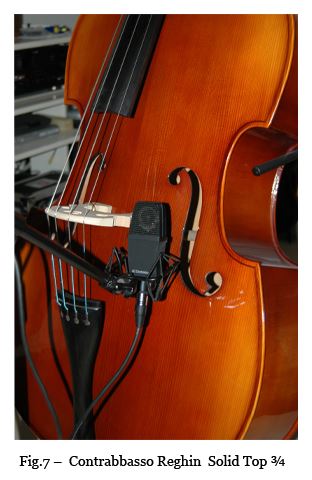
The classical guitar used is an Admira Janita model rigorously built in Spain; the microphone was positioned about 20 cm from the instrument towards the neck joint. 01 Ktr 5015 Pre: Samson C03 microphone set for omnidirectional recording and without low cut filter. The signal thus obtained only passes through the Pre-Amplifier. 02 Ktr 5015 Pre “Silk”: Samson C03 microphone set for omnidirectional recording and without low cut filter. The signal thus obtained passes into the Pre-Amplifier with the “Silk” key inserted. 03 Ktr 5015 Pre Comp: Samson C03 microphone set for omnidirectional recording and without low cut filter. The signal thus obtained passes into the Pre-Amplifier and into the compressor. The compression used has the following parameters: Treshold -8; ratio 2: 1; Attack 55ms; 500ms release; Gain +1. 04 Ktr 5015 pre silk comp: Samson C03 microphone set for omnidirectional shooting and without low cut filter. The signal thus obtained passes into the Pre-Amplifier with the Silk button inserted and from there into the compressor. The compression used has the following parameters: Treshold -8; ratio 2: 1; Attack 55ms; 500ms release; Gain +1. Double bass The double bass used is a Reghin model Solid Top ¾ built in Romania. The microphone used was the SE Elettronics 4400 positioned just above the f (Fig.7). Double Bass 5015 SE: the signal from the microphone only passes through the Pre-Amplifier.
Electric bass
As already mentioned, using a passive DI (Reference) of excellent quality, I used the microphone input of the Pre to record live a Fender Jazz bass of the 75 with maple neck and ash body. The choice of a passive DI is linked to the need to electronically influence the signal path as little as possible (pure utopia, as everything that enters the path will inevitably affect the sound). Low DI Pre El: Low => DI => Pre Low DI Pre “Silk”: Low => DI => Pre with “Silk” key activated; El. Bass DI Pre “Silk” comp: Bass => DI => Pre with “Silk” key activated => Compressor; El. Bass DI Pre “Silk” comp-Eq: Bass => DI => Pre with “Silk” key activated => compressor => mild software equalization. El. Bass DI Pre Silk Eq Soft + Piano: Bass => DI => Pre with “Silk” key activated => compressor => mild software + piano equalization. All this to highlight the behavior of the bass thus recorded in a more complex ensemble. In the files where the compressor was inserted, the settings were the same as in the previous examples: Treshold -8; ratio 2: 1; Attack 55ms; 500ms release; Gain +1.
Male Voice
The male voice is that of a young friend, Lorenzo Vargas (whom we thank), "captured" while he was intent on recording an audition of a Dark Metal song. In singing we pass from almost whispered moments to screamed moments in the throat with high dynamic excursions. The vocal was recorded with the “Silk” key inserted, as this setting made it more genre-appropriate. Later a compressor and a software reverb were added. LV1 voice: whispered voice LV2 voice: shouted voice
Female voice
The female voice, recorded in the studio, is by singer Adele Cacace (Fig.8). The mic used is a Neumann U87. On the vocal tracks we find a mild EQ with a slight 2KHz emphasis of 1,5 dB and compression with a fairly fast attack, -8dB threshold and slow release. No bass cut was used AC1 voice AC2 voice Pros: musicality; the sound that comes out is warm but never confused, so all the various nuances of the acoustic instrument or of the voice recorded are always audible. Very useful for reinforcing and giving more thickness to the incoming audio signal and for making productions where a vintage style sound is required.

Against: price; lack of a line input, a DI input and an output Gain control for the Pre section.
Extra: The use of the machine is partially limited by its unique microphone input, but if we add a professional DI we can further expand the possibilities of use by using it for example to reinforce the weakest audio tracks of our mic, or to give life to sounds generated by VSTi , more and more beautiful and close to reality but without that expression and that air generated by a real instrument picked up by microphones.
USEFUL INFORMATION
Distributor: Midiware
Model: R.Snow Portico
Website: http://rupertneve.com
Price: € 1.750,00 approximately


