



On test: Fender Custom Shop Heavy Relic Stratocaster 1962 and 1968
After the test appeared in the last months on the pages of Ageofaudio relating to two "Women in red" Gibson, this time we are going to try two Stratocasters produced by the Fender Custom Shop and, in this case, two "Signore Stratocasters" ...
(Fig.1, Fig.2)

The rivers of ink used for this mythical instrument that Leo Fender began producing at the beginning of the Years' 50, advises against retracing its history once again. Never has a modern instrument been so thoroughly studied in every detail: The literature relating to Fender Stratocaster it is really impressive and we intend to deal with it perhaps in the future, if anything from a new and different angle of view ...
Today we are analyzing two Stratos of recent production, “unfaithful” reproductions of the vintages '62 e '68, as well as instruments resulting from a careful selection which, as we shall see better, lead to the choice of two real ... false historians. In other words, these are two re-editions for which the Fender Custom Shop it has deliberately deviated from certain characteristics of the originals of the reference year.
In short, a “free reinterpretation” aimed at providing the end user with a slightly more unique and exclusive tool. Ironically, these details are the best they can match the writer's tastes and preferences. Let's be clear: totally personal tastes that will surely find one of the many schools of thought in the universe at odds ... Fender.
What is the "real" Stratocaster?
The prevailing "Fenderian" thought and the consequent collectability ratings, want the Stratocaster rigorously with "maple" neck of "fat" dimensions, a ash body (even heavy) and the classic "two tone sunburst". To these features I would add three single coils “Imperfectly” wrapped by hand on disassembled alnico V magnets, the classic three-position selector and pickguard 8 screws, white and in a single layer.
As we move away from these (and other) characteristics of the Strato of the 50s, the evaluation ratings decrease due to historical reasons (... in short, Leo conceived his creation ...), as well as timbre reasons. Not to mention that the manual component of the pioneering era to which we refer, such as the winding of the pick ups or the paintwork, made each Strat something basically unique; including errors or constructive compromises such as i body in four o five pieces, the "canned" sunbursts covered with opaque colors or the pick-ups with more or less windings (more or less regular in laying) around the magnets.
Already the introduction of the rosewood fingerboard at the turn of the years '58 / '59 makes many purists turn up their noses. And if the reported "slab-cut" rosewood keyboards have many wealthy admirers, the veneered ones introduced towards the end of 1962 (no-slab or veneer fingerboard), plummet ratings and market prices.
We are not talking about the disappearance of the "spaghetti logo" which took place between 1964 and 1965 and subsequent industrial (and mass) production by CBS starting in 1966 with the adoption of innovations that are not very popular with guitarists: large headstock, non-debonded pickups, monolithic bodies with little “contour”, heavy paint with polyurethane resins. Here the prices drop further.
By the way… let's not be fooled: for an “industrial” Strato CBS '68 or '69 you often and willingly need five figures… expressed in Euro.
(Fig.3, Fig.4)

The Fender Custom Shop: are we at Custom of the Custom?
Legend has it that Leo Fender was extremely reluctant to "custom orders" and for this reason refractory to the considerable pressure of customers for the use of particular woods or finishes. Suffice it to say that in many years of production it is very rare to find an instrument that had - for example - a “flame” neck rather than a non-standard production finish.
In short, Leo, obsessed with the idea of spartanity, indestructibility and functionality of his productions, imposed standard and strictly “plain” woods. In addition to some sporadic "custom colors" linked to the 60s "surf" fashion and extended to a certain number of units in production during the year, as well as some rare headstock painted in the same color or some rosewood fingerboard (initially supplied as an option) Leo Fender just didn't want to go.
The current Custom Shop has a different opinion which, having exhausted the baggage of re-editions in all sauces and in all possible variants, has finally indulged in some "philological derogation" with excellent results, in the opinion of the editor.
The peculiarities concern both instruments under test which are, respectively, one pre-CBS reissue (Strato '62) and a post-CBS (Strato '68): As if we had been privileged by the acceptance of a "custom order" in spite of the philosophy of absolute simplicity and effectiveness that at the time inspired "The Genious", indisputably the father of the modern electric six-string.
Fender Stratocaster Custom Shop 1962 Heavy Relic - Limited Edition "Dakota Red"
Production period September 2007
Retail price Eur 3.400 approx.
(Fig.5)

Here is the first of the two "relics" (Relic ... in fact) in its splendid and rare "Dakota Red" livery. It must be said that, apart from the "Candy Apple Red", the "Dakota" is the only true "red" ever produced by Fender. The other colors - above all the well-known "Fiesta Red" - refer, despite the name, to pigmentations resulting from the combination of different shades of color between "Pink" and "Orange".
The "Dakota Red" was in production as a "custom color" from 1960 to 1969 and was of automotive inspiration, we find it in the Cadillac catalog at the end of the 50s.
The painting of the instrument under test is therefore philologically correct not only for the respect of the vintage, but also for the presence of the underlying white background visible in the scratches and in the artificially abraded parts of this “Relic” specimen. The white undercoat was often used by Fender to give uniformity and shine to the final finish. Also corrected (too much ...) the slight general fading - due to oxidation - of our "Relic-Dakota".
(Fig.6)

The test instrument is very light (3,260 Kg. about) despite the use of ash for the body, proof of a very careful selection of woods. And here is the first "reinterpretation" of our. Custom Shop: Ash bodysuits were produced by Fender until 1956. From this year onwards the use of ash was reserved exclusively for instruments with a “Blonde” finish. Outside of the "blondes", therefore, Fender resorted exclusively to alder bodies. Philological doubts also arise from the body in two symmetrical pieces (however an obligatory choice for a re-edition of this price range): In reality, from the late 50s onwards, Fender used more sections due to the incipient scarce availability of the woods and the consequent increase in cost for large section boards.
(Fig.7)

The "D-neck" is splendid (... but Fender declares it "Fat C-neck"), really generous in size and surmounted by a very thin and refined "no-slab" fingerboard in rosewood: it is still free reinterpretations and of details taken from other years of production. The neck section in fact is more reminiscent of the very first Strat of the 50s than the subsequent "sixties" and the "no-slab" keyboard was adopted by Fender only towards the end of 1962 and in any case only from 1963 in such a thin section.
(Fig.8)
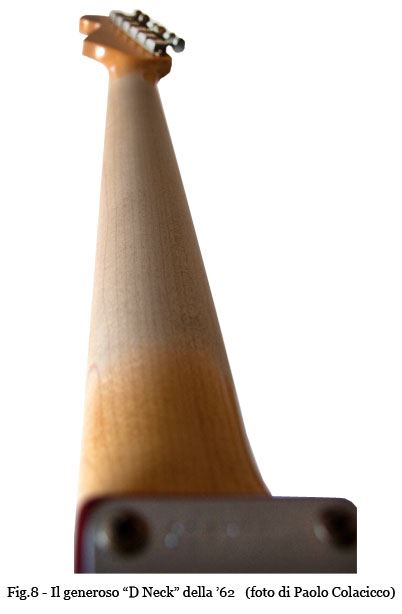
The pick ups used are the Custom Shop '60, the central one is "reverse wound" and the selector has five positions: Also for the latter, so far supplied as an optional equipment to be fitted by the end user, the CS Fender has adopted a free and practical criterion, offering the “5-way toggle” as standard on a '62 re-edition while, historically, it was definitively used on the Stratocaster only starting from 1977.
Fender Stratocaster Custom Shop 1968 Heavy Relic "Candy Apple Red"
Production period November 2007 (?)
Retail price Eur 3.350 approx.
(Fig.9)

And here is the other red on test in a spectacular “Candy Apple Red”.
Also with a light ash body and in only two pieces: guitar of equal lightness compared to the '62 if we think of only 3,510 Kg. And the greater weight deriving from the type of painting with underlying "gold" bottom (for metallization), the transparent polyurethane varnish for the gloss finish, the bucket and the CBS-era mechanics.
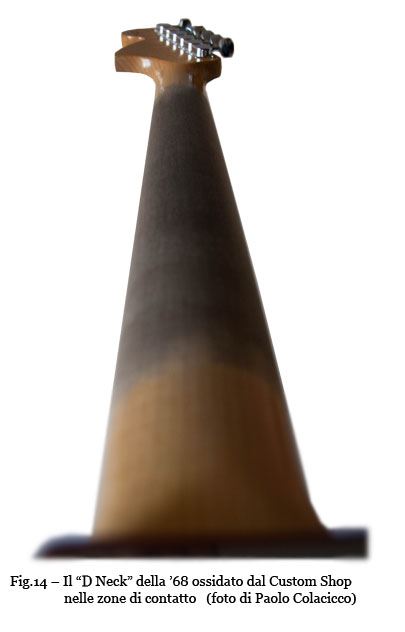
Also in this case we have some free reinterpretation: The "contour body" is almost identical to the '60s and is far from the coarse post-CBS sculpting. The neck is a "fat D" and looks like a true copy of the '62.
(Fig. 10-11-12-13)


The pickguard is 11 screws and in white triple layer, while the older sister sports a mint green triple layer pickguard; both guitars, therefore, respect their respective pickguards like the vintage originals.
For the pick ups and the selector, what was said about the '62 applies, with the difference that the magnets used are the Custom Shop '69. If we take into account the 5-position selector, we therefore count two other historical "errors".
(Fig.14)
Why produce a false history?
Examining these creatures we find, on balance, a pre-CBS reissue with features taken from both pre-1962 models (two-piece ash body, fat "D" neck) and characteristics of later models (rosewood fingerboard no-slab, 5-position selector); as well as a post-CBS which in turn incorporates characteristics of the productions prior to '68 (two-piece body in ash, original contour body pre-CBS and fat “D” neck) and an electrical system from later periods.
Why are we dealing with two particular instruments?
- The leotard: Should a true Stratocaster have an ash or alder body? The eternal debate between supporters and detractors of one or the other wood will never end. Ash undoubtedly has greater intrinsic value, is less available, and is more expensive. It has a generally more crystalline and complex tonal response, with greater punch and precision in both bass and treble: in short, it is more harmonically complex. On the other hand, alder is preferred due to its lower full-frequency response, favoring a distinctly pronounced midrange, compensating for an instrument with a single-coil pickup and therefore predominantly projected highs.
- Neck and fingerboard: Maple or rosewood? (This is the dilemma…). Same as above: there are proponents of both versions. There are those who do not ignore the ash + maple marriage to enhance the crystalline and percussive components of this guitar. The neck in one piece of maple guarantees a remarkable density and uniformity, avoiding “timbral gaps” or - on the contrary - overtones in some areas of the fingerboard: A sort of natural compressor. They believe that the "carry over" in rosewood, considerably increasing the structural rigidity of the neck in a sort of "multilayer", would in some cases determine a real "subtraction" in terms of tonal richness. The proponents of rosewood keyboards, on the other hand, exalt their greater value, their superior “tactile” adaptability over time and their tendency to darken the general sound of the instrument in distortion.
- The weight of the instrument: Light or heavy layer? Another dispute ... The light ones are comfortable and - on average - very resonant but lack sustain and linearity on the various frequencies to be reproduced. The heavy ones have opposite strengths and weaknesses.
- moral: Obviously the best solution does not exist. The instruments under test - and this is the reason for the predilection for the tested examples - balance the crystalline harmonic richness of the ash body and its “fat maple neck” with the acousticity of the “ligth weigt” and the rosewood fingerboard. The very thin “no-slab-cut” inserts offer the comfort and value of this noble essence, without compromising the “snap sound” typical of the 50s “maniconi”. If anything, they add a pinch of warmth and an unusual thickness for a Stratocaster.
The sound proof
For our test we used the credit line Twin Reverb reissue '65, TS 808 reissue, a delay T-Rex Replica (he was within ... feet) and i Fender cables supplied with the tools. THE picks used were i Fender Heavy and D'Addario 0.10 strings - 0.46.
These two guitars have been shown to have a remarkable similarity in sound. The use of the same woods, the identical conformation of body, neck and fingerboard, have differentiated the timbres in an often imperceptible way.
The first thing that struck us is the remarkable volume of the instruments when they are turned off, truly out of any standard for solid bodies. Moreover, despite the very high action and the 0.10 scaling, both guitars were very soft and easy in the execution of chords and bends, which is generally rare for the "hostile" Stratocasters.
The '68, perhaps due to the greater overall weight and the presence of the "palettone", appears slightly more solid and precise on the bass, but the difference has almost disappeared with the use of amplification.
The neck pickups provide a sensationally fat tone and, thanks to the high action and fret-free strings, the ability to reproduce timbres that in depth and thickness are rarely found on a Stratocaster. The comparison with the bridge pickups shows a discreet decrease in penetration and volume of the latter which, however, remain round and velvety especially in distortion solos.
But the real surprise is in the intermediate positions (neck + center and center + bridge in parallel), where the two Custom Shop pulls out their claws with pumped and percussive sounds that are… micro-tuned snare drum. Moving the switches to the second and fourth position seems to have inserted a super-compressor or even turned on a loudness control while listening… truly incredible.
In distortion we were able to appreciate the general tonal robustness and even the ability of controlled triggers, which - the latter - that Strato generally don't digest.
Everything is entrusted to an unusually silent electrical system for guitars equipped with single coils.
Let's close the boxes ...
(Fig. 15 and Fig. 16)

The last look before closing the black tolex cases makes us breathe the air of other times, where business needs did not bend to any quality compromise.
These two “Womans in Red” (… oooops… I already mentioned it in another article…) embody the best Fender philosophy of rock solidity, extreme functionality and total musical versatility. And if the purchase price can leave you doubtful, less doubts leave the great quality of the materials, the featherweight of the instruments, the excellent playability of neck and keyboards, the sound of a real “SuperStratocaster”.
Finally, the price to be shelled out is "calmed" by some reflection on the neo-collectible value that such instruments may have: "Custom" instruments for construction origin (the Custom Shop in fact), for finishing (Relic in fact ... indeed Heavy Relic), coloring (already out of standard at the time of Leo), for free interpretation of details by the "Custom Shop Builders" of the legendary Californian house.
And it is very likely that nothing at Fender has been left to chance.
(Fig. 17 and Fig. 18)

Good music to all.
Bruno Mazzei


