


Whether during a live session or a home recording, using the cabinet is often a challenge, especially as regards the management of volumes, which must be tolerable for the human ear on the one hand, and compatible with the rules on the other. neighborhood - nobody would like to see complaints about loud noises!
Here it is: a very attractive black box, with the logo of the famous Californian house on the front, contains this magical product with an aggressive appearance, as the “Mesa” tradition wants.
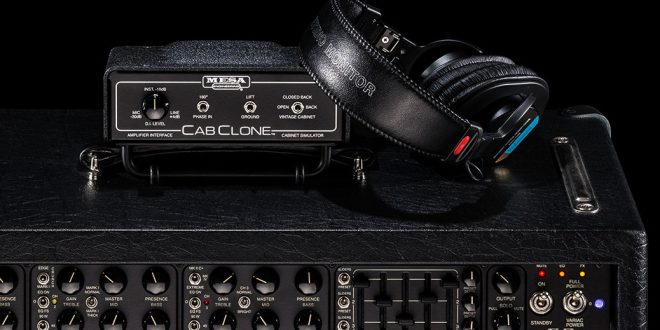
Il CabClone is a cabinet simulator which allows you to connect the amp, head or combo, to a mixer or sound card without using the speaker.

Technical considerations
The front panel is equipped with an adjustable call output DI (OUTPUT), which accommodates a wide range of target input requirements, from MIC (-30dB) to LEVER INSTRUMENTL (-10dB) to Pro LINE LEVEL (+ 4DB), including any point in between. This regulator allows you to manage the signal strength with maximum precision for any type of recording or live environment. This product is therefore highly professional because it allows maximum customization for every situation.
On the far right of the front panel is a switch VOICES, which offers three configurations, among the best known with the circuitry of the cabinet itself for the type of cones that will then be simulated.
The top position CLOSED BACK delves into the mid-range and beyond the upper harmonic region, simulating the response of a cabinet 4 × 12 with 60 watt speakers. This answer is often preferable for a rhythmic sound tightly saturated or loaded with drive and a great sound diffusion in terms of volume and thickness.

The central location OPENBACK with the absence of the back cover it allows the upper harmonics to shine and provide a more open and three-dimensional sound with a slightly accentuated upper end. This position works well for clean sound and rhythmic applications where a brighter, “faster” response is preferable.
Assorurale's position VINTAGE CABINET is the darkest, most compressed choice and offers the best response for soloespecially when using higher gain sounds. This setting will keep the sound present and round and devoid of buzzy sound.
These three voicing positions give the ability to fine tune CabClone's response for almost any tone type.
CabClone's front panel controls are simple yet powerful tools to control the sound of your guitar amp and bring it directly to the console with minimal effort and without “background noise”.
Sul back panel there are several possibilities of interfacing.
Starting from the left we find theINPUT and a jack socket to connect theOUTPUT SPEAKERS amplifier.
For the best tone level results, and to avoid damage to the amplifier's output transformer due to an impedance difference, it is always best to match the amplifier's output impedance to a CabClone wired for that amplifier. impedance.
The three shielded speakers in the center of the rear panel indicate the installed impedance.

It is important to make sure that the CabClone has the IMPEDANCE BOX set for heavy use and matched to the impedance of your favorite SPEAKER OUTPUT jack on the amplifier. Correct match will ensure the best sonic results and avoid the risk (possible with some amplifiers) of shortening the life of the Output Tube and / or damaging the output transformer.
Next to it is the socket THROUGH, which offers the possibility of having a live speaker on your amplifier while the DIRECT OUT signal is routed to the console and the CabClone Direct circuitry is used to capture the sound.
Using this configuration it is also possible to amplify the live speaker, giving the possibility to choose the balanced output of the CabClone, the Mic or both, thus giving the possibility to harmonize the two outputs (in real time or at a later time) in a session mixing.
The THRU socket is of the switched type and, by inserting a ¼ jack (using an unshielded speaker cable), it automatically cuts down the internal load resistance, so that your amplifier sees the real impedance load of the selected cabinet.
Side note for those who play at home: the headphone output will exclude the XLR, the balanced DIRECT OUT microphone jack.
Sound Considerations
The CabClone simulates a microphone speaker, but, unlike other similar products on the market, it manages to maintain a dynamism and reactivity that give the listener and above all the guitarist the sensation of hearing a real speaker that pushes the sound of the amp. .
The presence of the "dummy load”, The“ dummy load ”that allows you to simulate the direct signal of an amplifier up to 150Wit also allows to avoid the presence of the physical cone, which always risks being exposed to more or less serious problems if incorrectly calibrated.
As mentioned above, there are three simulation modes:
* To get a more aggressive sound it is necessary to simulate the old cabinet 4 × 12 with cones V30, with the "Closed back" mode;
* If you want a cleaner sound both on instruments and on rhythms you can use the “Open back” mode;
* For a warm sound e dark, preferable on melodic lines and solos, the choice falls on the "Vintage cabinet" mode.
Field considerations
I have had the option of using the CabClone both live, and studio, and the feeling I got is that of a speaker miked with a Shure Sm57 (the standard microphone for sound engineers and guitarists): in both experiences we can assume a mix of the miked sound with the simulated one, but for some time in the studio the 4 × 12 cabinet has not been used anymore. For reasons of practicality, speed and without sacrificing good quality, the engineers I work with prefer CabClone. I used the simulator with multiple heads (Marshall, Fender, DV Mark), and the amp sound was never compromised. However, it is important to remember not to use the CabClone as a power attenuator or worse as a Di
Conclusions
What the CabClone lacks is the "air displacement", that moved by the speaker of a 4 × 12 that I personally like very much. On the market today there are many products that simulate various types of speakers, of ampli and also of microphones, but in my opinion they give back a sound that is too "digitized": the home product "Kitchen"Instead it doesn't seem to me to give that feeling of" fake ". Logically (like everything I like in the guitar world) the price of the product is perhaps a little high, although justified by its level.
Pro:
* High-level recording sound
* Extreme practicality
* Very small footprint
Cons:
* Only three simulations can be a bit too basic for some user groups
* The price is quite above average: given the fairly limited number of options, it suffers from competition from others.
USEFUL NEWS:
Model: Mesa Boogie Cab Clone
Recommended retail price: € 340,00
Italian distributor: Mogar Music SRL
Official website: www.mesaboogie.com