


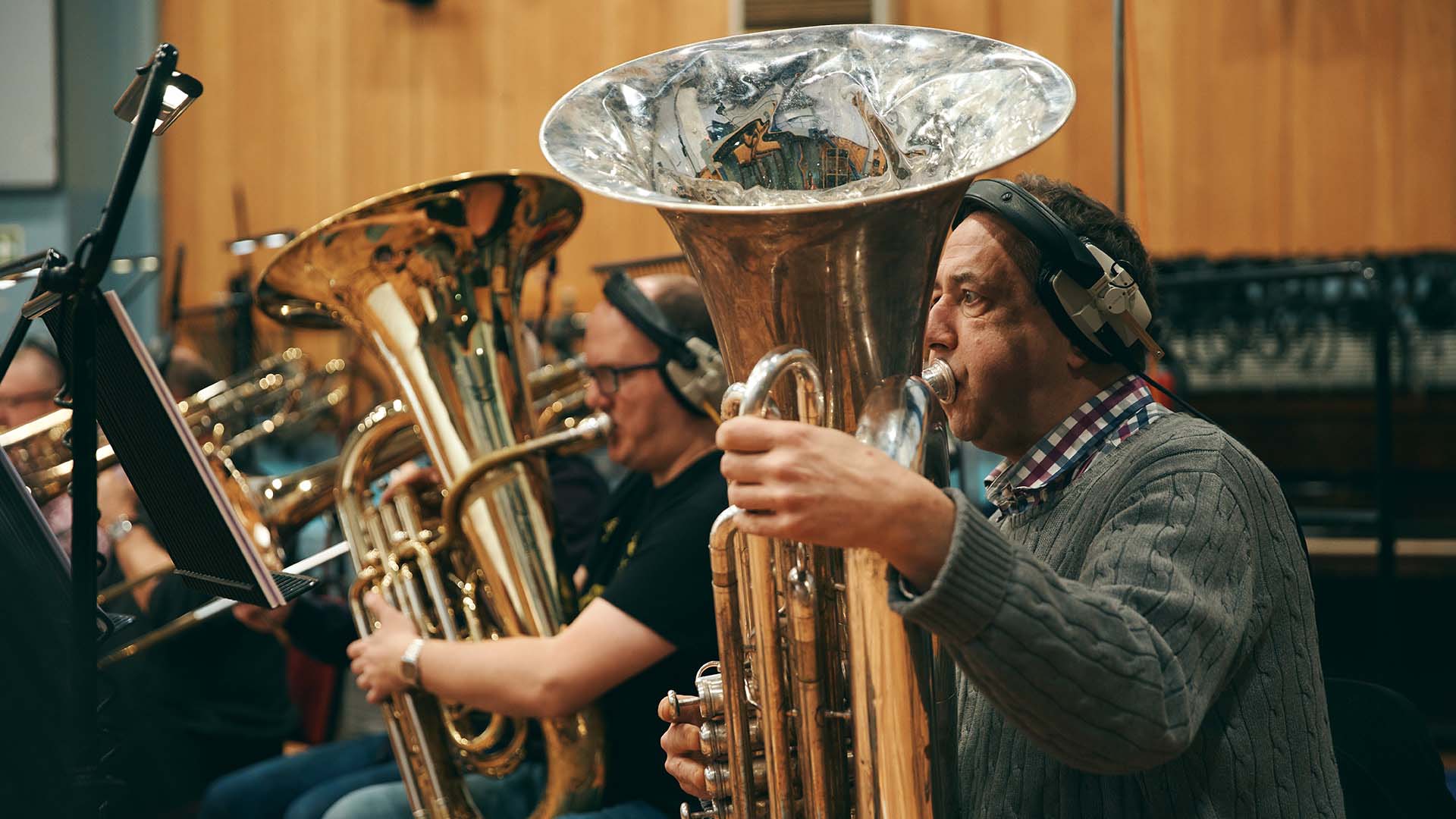
Grand Brass is a horn and tuba sound library, available as a standalone library or as an addition to Abbey Road One Orchestral Foundations.
Grand Brass captures the performance of four horns, supported by a tuba playing an octave below. There are articulations such as legato, long sound, staccato, sostenuto, as well as short, medium and long crescendo sounds. The section was also combined with an ensemble of ten cellos.

Joints
We find incisive brass sounds and a very agile staccato, with notes ranging from a soft sound to heavier sounds. With the plugin interface you can see the octave symbol which indicates that the preset has the horn and tuba playing at the octave; therefore, if the horns are all on the top notes then the tuba plays an octave below. This option allows you to temporarily match sounds and gives you access to this very common type of pre-recorded orchestration. The sound of the four horns and the tuba was recorded with the passages between the notes (legato), with the very characteristic sound of the tuba changing the notes, i.e. when the pistons of the instrument are pressed so that the flow of air is stop and then restart. In addition to the legate, the version with cellos is available. There is a preset with a range of three octaves and a dynamic from pianissimo to fortissimo. Finally, there are the presets with the instruments recorded in crescendo (Swell), in three variations for a very characteristic effect and impact of brass.
Microphones
You can choose between different types of microphones for the presets. There are the now familiar Close, Tree (Decca), Ambient and OutTrigger signals. Note two Pop signals, a “close” type when you want a sound that really “hits” in the face and a “room” type to have the sound of the room behind that punchy sound. For the Tree option, there are two variations one of which is slightly more directional and the other is more omnidirectional. The “Ambient” preset uses more distant mics, while the Outriggers are useful for a sound with extra space. Finally, we have the “spill” mix which uses all of the orchestral microphones to add 3d realism to the sound.
So very schematically
MIX 1 - A complete room mix by Simon Rhodes, consisting of a Decca Tree and Outrigger with a curated blend of commercials. Use for lush and rich passages.
MIX 2 - A tighter full mix curated by Simon Rhodes, formed by a second Decca Tree and Outrigger with a curated blend of commercials. To be used for faster and more detailed sounds.
VINTAGE 1 - A unique pair of RM1B microphones paired with some classic ribbon microphones to form a vintage stage sound.
VINTAGE 2 A pair of classic ribbon microphones, positioned by the conductor for vintage stage sound.
POP CLOSE - A mix of spot microphones, with a pan in the center to give a flexible image that is not limited to the orchestral layout.
POP ROOM - A dedicated pair of rooms, positioned to centrally represent the source - use in combination with Pop Close.
CLOSE All spot mics added together for the instruments played.
TREE 1 A Decca tree made up of Abbey Road's finest trio of classic omnidirectional tube microphones - the foundation of rich sound.
TREE 2 - A narrower and closer Decca tree. More suitable for fast and detailed materials.
AMBIENT - Two omnidirectional microphones positioned towards the back of the room, higher than the Out triggers, the result is a nice room atmosphere. Great for use in a 5.1 surround mix or to add more space to a stereo mix.
OUTRIGGERS Two omnidirectional microphones positioned halfway between the orchestra. To be coupled with one of the two trees to hear a wider image.
SPILL - TO summation of spot mics from unplayed sections, useful for adding realism
EXECUTIVE TECHNIQUES
Legato
The long notes were recorded in octaves as normal sustained notes, for use as a basic style with or without vibrato. For Legato we mean that particular articulation of the virtual instrument obtained by playing two notes continuously (without sound interruption) between them. This type of technique allows you to add a lot of realism to musical phrases and to get it you need to play monophonically (i.e. one note at a time). To “activate” the intermediate sounds, you need to make sure you hold down the first note while pressing the second note key. By overlapping the notes in this way, the plugin engine will understand that you want a "tied transition" between the notes. With the company Control Change midi # 1 we can manage the dynamics of the sounds, which is divided as follows :
Pianissimo (pp) - (0 - 20)
Medium strong (mf) - (21-64)
Fortissimo (ff) - (65 - 127)
As for the velocity of the samples, it is related to the velocity of the note:
under 99 is played at normal speed, above 100 are played at a faster speed (about 40% faster).
Staccato
Staccato in notation refers to a “shortened and detached” style of sound. In the case of samples, this usually refers to a single but defined short note. Recorded in octaves.
Tenuto
A short 'hold' on the note for its entire duration or even slightly longer 'and implies some form of accent.
Swell
From the Piano to Forte. There are three different swell lengths in this library.
Conclusions
Performed in the unmistakable acoustics of Abbey Road Studio One, Grand Brass adds even more depth to the orchestral range of Abbey Road One. Composers from Gustav Holst a John Williams they used the idiomatic pairing of brass and strings for their characteristic soft and rich timbre, to utilize the sounds in the “cantabile” range of these instruments.

The type of sounds that we will find in Grand Brass is not the "aggressive" type that we often hear in many blockbusters, but a sound more for beautiful "cantabile" melodies, for this reason I think the adjective "Grand" has been added. The preset extensions have been specially calibrated to provide everything orchestrated and create moving, majestic and epoch-making melodic lines, bringing the same sound that is heard in blockbuster movies within everyone's reach.


