

Reviewing cheap outboards is not my forte, I found that in most cases they don't have an identity of their own or, more seriously, they don't "sound". Perhaps precisely because I was biased, I “parked” Joemeek's little monophonic channel strip in a dark corner of my house for a couple of months, hoping that sooner or later they would hand the article over to another colleague. About three months ago, however, a friend asked me to borrow a PRE with phantom to insert on his card for a “on the fly” registration. “Antonio, I don't need anything professional… it's just an audition”. Here is the opportunity !!! I make a good impression by lending him a channel strip, and at the same time I listen to it and review it. When we say two birds with a cable….
Prologue:
The possibilities offered by new audio processing technologies represent an unimaginable concept up to the last twenty years. Despite the massive evolution, some still seem not fully satisfied. Many musicians, producers and sound engineers feel the lack, in the pure digital domain, of that charisma and that unmistakable character that remains the prerogative of classic analog devices. In addition to simple management, these devices offered a typical sound that is very fashionable today. The phenomenon does not only concern outboards, but also musical instruments, to have evidence of this it is enough to listen to the current HITs that dominate the charts around the world. Unfortunately, however, these “gems”, from the 60s and 70s, are available in limited numbers, often characterized by prohibitive prices and the difficulty in finding original spare parts. "Joe Meek”Is the name of a British sound engineer who produced many pop albums in England in the XNUMXs. Joemeek is also the name of a new series of products whose design and circuitry evokes memories linked to long gone times in electronics applied to music. The parent company, however, has shown a strong commercial intuition, knowing that it belongs to a now globalized market, it wanted to provide, with its entire line of products, a good quality-price ratio, managing to maintain a sufficient distance from the "ruthless" competition .
Audio chain:
The test was carried out by connecting the sound sources using a Klotz cable directly on the ThreeQ, the signal is then sent to an analog input on the board Motu 2408 MK3; Everything is monitored by two pairs of speakers, the PMC model TB2S-A ; as already said on several occasions I find these monitors very precise and linear especially on the medium frequencies, to then have a better response in the low frequency range I have relied on Genelec 1032 which mount a 10 inch cone. Later I wanted to carry out a real road test: Mackie MS 1204 VLZ Pro mixer and Mackie SRM450 and FBT Maxx 4A speakers as speakers. I have used many microphones both studio and live, TLM 103 Neumann, Akg C414, Rode NT2A, Shure SM58 and SM57. As for guitars and basses it is useless to make a list, I used everything that happened in the studio, from a very old artisan bass, which was struggling to keep the tuning, to a standard Gibson model Les Paul guitar.
Description:
 The ThreeQ comes in a simple and small cardboard box (Fig.1) with the instrument in question on the outside. Inside we find the ThreeQ, a manual in English, the warranty and alas! An external power supply of 12 VA. At first glance, the most obvious aesthetic feature is undoubtedly the green front panel (Fig.2 ) which in this production goes more towards the emerald green; the line appears much less angular and more rounded in general, the business card is: “We know what we were doing, and we know how to do today what we did”. In principle, the Joemeek ThreeQ pro channel includes, in a single 1/2 rack unit module, three functional groups: microphone and line amplifier, compressor and equalizer.
On the front panel, looking from left to right, we find: at the bottom the "LINE" button complete with LEDs that adapts line signals, "PREAMP GAIN" which is controlled by an Alpha 403 10c5K rotary potentiometer with a micro-step calibration with a value from a minimum of 10 dB to a maximum of 60 dB complete with "led peak". Continuing we identify the compression section "OPTICAL COMPRESSOR"Managed by 3 rotary potentiometers (the first 2 Alpha 4E3 while the third Alpha 5D2), the first "COMPRESS", followed by "ATTACK" and "RELEASE". (Fig.3)

The internal components of the compressor subject of our test respond to a somewhat different logic compared to commonly used devices. The latter are usually based on the technique of VCA in which a voltage controlled regulating amplifier is responsible for compressing the audio material. Joemeek devices, on the other hand, offer compression on a base photoelectric with which the designers wanted to pay homage to the tradition of the 60s. The “compress” knob adjusts the amount of compression of the audio material. From this point of view, its function roughly corresponds to the “Treshold” value of VCA-based compressors. Since photoelectric compressors do not have any defined treshold point, the process is structured as follows: “compress” enhances the signal that is conducted to the control unit; the compression takes effect smoothly and varies according to the constitution of the material (sound spectrum and amplitude). The amount of level attenuation due to compression is always displayed by the VU meter led also of Lilliputian dimensions, but rightly proportioned with everything else.
“ATTACK” and “RELEASE” are responsible for the temporal response of the compressor. The attack time defines how much time must elapse until compression "full" as soon as the conditions for the response of the device have been reached. The final release or decay time is instead responsible for the "return" time to normal 1 to 1 amplification. The entire compression section can be activated or deactivated by means of a white switch: this allows a very convenient comparison between the processed signal and the original one. Further to the right we find a small, three-band equalizer MEEQUALIZER (Fig.4) with semi-parametric mids, low shelving aimed at 80 Hz with intervention ranging from -15Db to + 15Db, and high “shelving” aimed at 12 kHz with intervention -15dB +15 dB. The equalizer section can also be activated or deactivated with a push button. Finally we find the OUTPUT GAIN potentiometer (alpha 4 E3 with micro-snap), very useful for adapting any processed signal to the instrumentation that follows it, these can also compensate for any level losses due to compression. Finally, above on the right we find a segment formed by 9 LED meters: the first LED from left to right indicates that the device is “ON”. We specify, for the record, that the appliance does not have an ON and OFF switch. The rest of the LEDs that monitor the output signal have a “range” of -24dB to + 12dB.

Back panel:
The back panel is simple and spartan (Fig.5). Starting from left to right we find: the connector for the power cable in mini jack format that receives a voltage transformed into 12V via an external power supply, a push button switch + 4 dB or -10 dB, which is used to control the two parallel outputs 1 / 4 ″ balanced "OUTPUTS". Continuing we find a jack "MIX INPUT" useful for those who want to insert an additional signal into the THREEQ without passing it through the preamplifier. Next to it we also find an “INSERT” connector to insert external effects such as a gate or a de-esser that has the widespread tip / ring / sleeve assignment. The insert point is after the preamp. Finally we find a jack input for the LINE INPUT signal, and a MIC IMPUT microphone with XLR connector (with stop device) complete with the “48V” PHANTOM POWER button for the microphones that need it.
Joemeek under the press:
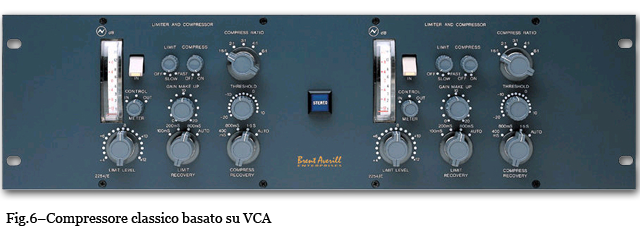
It is a device designed primarily as a microphone preamplifier, and it is for this reason that I first used it, during the tests, for the preamplification of various dynamic microphones and condenser microphones. I must say that the threeQ is able to carry out this task with skill and has the requisites to bring even the “weak level” candidates to an acceptable level. The rustle is non-existent and the sound seems pleasantly "saturated" without becoming dull. We deduce a good general quality capable of acting as an alternative to the channel of a good mixing desk. The device boasts a very low presence of noise, therefore it can be used very well for OFF MIXER recording with all the consequent benefits. The detail of the general frequency response of the sources examined is quite definitive, I noticed a notable influence on the final timbral result; the middle middle section is pleasantly colored, with a true “British sound” character. Beautiful and interesting results are obtained, and not only in the elaboration of vocal parts but also of those for guitar, bass, or of a more varied nature. The compressor section highlights a qualitative coherence equal to that of the preamp from which it is preceded even if in the end it is possible to operate only on three parameters. The compressor can be used without any problem and intervenes smoothly on the sound. If you choose the parameters intelligently, even high compression values can be achieved without negatively affecting the tone. As with all compressors, I detected an elevation of the noise in the final decay stage. It may be worthwhile to insert an expander or gate in insert to avoid this problem. If you use the MIX IN input located on the rear panel we can also use the compressor by doing without the preamplifier, which is therefore convenient for a possible mixdown phase. Who is used to working with VCA-based compressors, is certainly forced to a little practice with the Joemeek compressor in order to experience the repercussions of the operating elements on the signal. However, it does not take long to get used to the management and then immediately start testing the various possibilities of intervention, which I would define quite numerous. The setting possibilities range from very subtle compression, acoustically almost imperceptible, to very intense “pumping”. The compression is activated in a very soft way, with some settings you can see with wonder how the compression reaches remarkable levels without penalizing the liveliness of the processed signal. I clearly used the threeQ only on single sources and I have always obtained excellent results. The compressor practically does not emit any noise, I only noticed a slight amplification of this in the intermodulation pauses, which happens with all compressors. Contrary to the sonic response of VCA-based devices, (Fig.6) rather linear and often dark in the case of intense compression, the Joemeek device keeps alive the characteristics of "presence" and "liveliness" of the input. In my opinion this strength is not so much the result of an “artistic-creative” intervention by the builders but rather of an effective control of the dynamics in the acquisition phase, in order to control the excessive impetus on the part of uneducated performers. We can certainly say that the particular characteristic of the threeQ is precisely the interaction, well conceived, between preamplifier, compressor and equalizer in a very small space, a physical limitation that never goes to the detriment of the final quality. The equalization section, the last link in the chain, when used with caution offers fantastic results. The vocals get a good level of presence and clarity. With an electric bass equipped with old strings, one gets the impression that someone has instantly assembled a set of new strings. Slap artists will certainly appreciate the energetic and funky sound. Also in this case the motto “in media stat virtus” applies, be careful to properly dose the controls, a disproportionate use would generate too metallic or too swollen timbres, compromising the final result. After all, we must never forget that the risk is to destroy the formants of the original signal and to obtain a result that is not "truthful" and "clumsy". This risk is accentuated precisely after long sessions in the studio, the user tends to want to obtain a greater brilliance than necessary. In this case, it is important to have “fresh” ears and to adopt the famous motto “the less, the better”.
Conclusions:
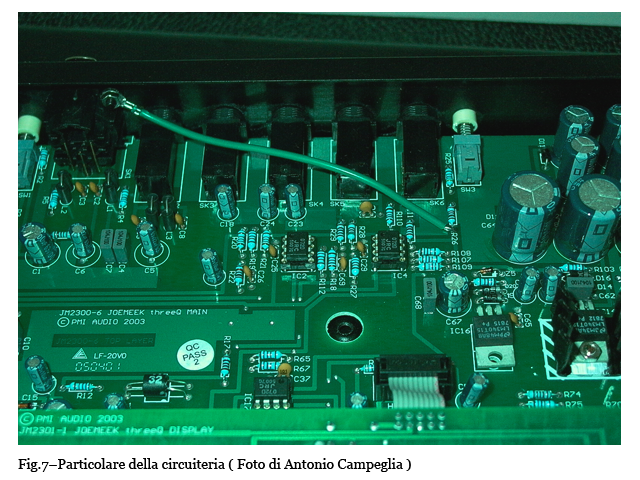
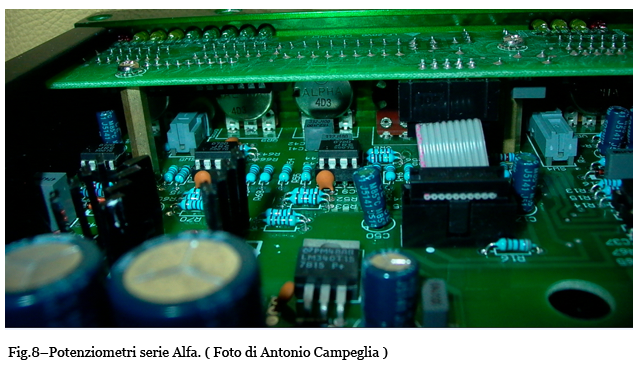
Personally, the Joemeek threeQ has been able to convince me, thanks to its sound and its functionality. It stands out for its simple and clear management. It is a very particular device capable of producing a decidedly individual sound, it could appeal to many musicians for both live and studio use. Among the three sections of our channel strip: pre, compressor and equalizer, I especially liked the preamp section, it sounds really good, much better than more famous machines. The instrument performed delightfully both in the studio and live. Its British sound was nice, even on the PMC TB2S-A and GENELEC 1032 which are very transparent and revealing speakers. The processed sound evokes the "vintage", purified from the typical problems of the period, such as the notable presence of rustle and so on. Who can accept the compromise of a slightly limited regulation compared to the older brothers of the same house (and I believe that this compromise can be made) and has no aversion to external power supplies, will get a good and flexible machine for an adequate sum, including small preamp, compressor and equalizer. Its internal circuitry is linear and clean (Fig.7). I really appreciated the accuracy in differentiating the potentiometers from the type of work that go into the audio path. Even if the instrument is built is "Made in China" they have all been well calibrated and well made, (Fig.8) and are placed at the right distance without interfering with each other. But let's talk about the aesthetic profile, even the eye wants its part. How can you not notice these fascinating green boxes ??? If one day you decide not to use it anymore in your studio, you can always wear a blue suit and carry it under your arm for a walk in the park. You will certainly be the center of attention. As you can see it is not always expensive to have unusual tastes !!! . After all this praise I would like to make a criticism, otherwise what review is it? The Joemeek ThreeQ has no power switch, certainly not a tragic thing, but still a detail that must be considered.
USEFUL INFORMATION:
Producer: JoemeeK
Model: ThreeQ
Website: www.joemeek.com
Distributor: www.feel.it
Price: Euro 210 + VAT