

We will examine various software core loopstations for commercial or free distribution below. The products around are not few and I had to use a single criterion ... that I liked them or at least that they offered something unique! Since the word "loopstation" lately also refers to evolved and DJ-friendly midi / audio sequencers that start pre-recorded samples in real time, I start by saying that my choice went to products that can be used live, with the possibility of audio input and where the musician / singer is the main part. Many of the software of this type offer the possibility of connecting to a dedicated pedal and / or midi. In these cases the hardware part, the pedal board, will be better analyzed in the second part of this article, the one that speaks precisely of the hardware loopstations.
Everyday looper:
The first software I want to talk about is a very original loopstation that runs on I-phone. This market is constantly growing and is not to be underestimated as many manufacturers are starting to take it seriously consideration of the Apple mobile platform and to produce quality hardware and software. I have examined a dozen projects for I-phone this is the only one that I considered worthy of note. The general problem with this type of device is that most of the time programmers forget that they are writing for the small space of a mobile / Ipad / Iphone / Ipod and make life practically impossible for the musician. We are talking, therefore, of a software that seems really designed for the device on which it runs and that takes into account the available space using it to the maximum. Everything is controlled via touch-screen, using various combinations of touch: for example, the touch of a finger on the track starts the recording, the touch with 2 fingers pauses, with 3 fingers it is the stop…. There are no invisible keys, no hidden functions. Everything is finger-friendly here.
This proceeds with 4 simultaneous tracks. Once the first one has been recorded, all the others will have the same length and each recording, once set, will begin at the end of the current phrase (or immediately, with a double click).
Loopstation software: Two important elements:
The first is that all recording functions do not start with the touch of the finger but with its release. It seems trivial but it is a trick that significantly reduces the number of incorrect clicks. Once you put your finger in position you release and the function starts.
The second, truly amazing, is the mix of the tracks in real time! Just drag one track onto another to get the mix and "free" them. The result is a practically "infinite" looper and just as you are playing. Always in real time we can adjust the volume of the track or delete it, simply by sliding one or two fingertips and without opening any menu. If you turn up your nose in front of these pocket applications, I point out a discreet audio cleanliness, the indisputable practicality, less than 1ms of latency. The only one  limit is the use of the internal microphone which obviously introduces ambient noise. However, if instead we attach an Irig adapter to the I-phone for the audio input and output of the system, we get a really interesting complete system with the possibility of using our instrumentation. The other limit is somewhat that of all software of this type, that is the necessary activation through the hands: for those who play and have their fingers busy it is a problem that could be solved only with a pedal board. Other functions to set that are worth mentioning: the metronome (occupies a track), quantization, the ability to "arm" the track before starting recording (a first click turns it on and a second starts it), an audio limiter, the microphone passtrough that allows you to output the input audio, the copy-paste of the tracks between various applications (Sonoma Mapi 1.1). The created files can be saved and reloaded at any time. To exchange the tracks with a PC just turn on the integrated wireless server and - through a simple browser - let's go to view all the saved tracks, and then download them individually in wave format 44/16
Technical limitations: the maximum length of a track is about 45 seconds and it is impossible to overdub on the same loop, you must always use a new track.
USEFUL NEWS:
Platform: Iphone / Ipad / Ipod
Version reviewed: 1.2
Price: 4,00 €
Tracks: 4
Undo: No.
Programmer: Mancing Dolecules
Where to buy: Apple Application store - Itunes
Related Sites: mancingdolecules.com
AMBILOOP:
In the panorama of the Ambiloop loopstation it's a really cool software. It is among the few that, in addition to offering 8-track recording, has a even effects like Reverbs, Filters (fully programmable) and Delay. These functions make it versatile and, also evaluated the user-friendly graphics, with an immeasurable quality-price ratio (also because it's free!).
There are 3 recording methods:
- registration with fixed time;
- recording with preset number of beats;
- manual recording with setting of a maximum time.
Each of the 8 tracks has an effect send, a SOLO, a Reverse, a MUTE and the ability to send the signal to a mixer channel, a SLOW key that halves its speed in real time. Ambiloop also has a mixer that adjusts the overall effect, 2 AB channels with separate volumes A and B or A + B.
Through the midi we can assign the keys to an external pedal making the product truly effective.
It is also possible to save the configuration and recall it at any time.
A bug to report: Ambiloop remains in memory even after closing and remains among the active processes (at least in my Windows Vista Business 32 system)
It has no autostart, so the system starts with or without audio when the Record button is pressed. The input can be mono or stereo.
Additional info
Platform: Windows
Version reviewed: 1.73
Price: FREE
Tracks: 8
Undo: si
Redo: si
Programmer: Chris McDonalds
Related Sites: ambiloop. com
MOBIUS:
Within the software loop station it is a historical product, so I cannot fail to mention it. I begin by saying that it is  graphically awful. Nevertheless, it must be acknowledged that it has been on the market since 2005 with 8 tracks in recording, a remarkable range of functions, the possibility of truly painstaking midi assignments and extreme customizations. It also works as a VST plug and therefore we can use it within advanced sequencers such as Cubase or similar: not bad for a free product. The functions offered only all those expected from a software loopstation, plus a series of variations on the theme . For geeks with extreme customization needs, however, it is the right product. I mention some of the instrument's potential, without claiming to be exhaustive: you can add and remove keys, record on multiple tracks at the same time, copy loops, add external audio files, customize individual tracks, use the PC keyboard as a controller or midi messages from external pedals , parameterize different plug-ins, slow down loops, program the passage from one loop to another… In short, it is not exactly a plug & play product, but it has more than what an average musician asks for.
USEFUL NEWS:
Platform: Windows / Mac
Version examined: 1.42
Price: FREE
Tracks: 8
Undo: si
Redo: No.
Programmer: Jeffrey S. Larson
Related Sites: www.circularlabs.com
ABLETON LIVE:
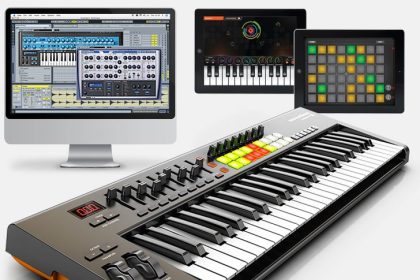
Ableton Live is an audio / midi sequencer with various features, the loopstation - or rather the looper - is just one of the many audio plug-ins that we can add to the tracks.
I start by saying that it is not my ideal product because if we look for one Live loopstation I find it useless to take the whole suite with me. I can't p I did not appreciate the ease of use, the integration with dedicated controllers and midi, the additional possibilities of using the loopstation within a system that, if necessary, can become an orchestra with a thousand possibilities. The loopstation is essential: one click to record, one click to overdub, one click to play, double click to stop. It is possible to set the number of beats to record or wait for the start / stop key to be pressed, without worrying about the time. Being a looper, within a much more extensive recording system, quantization and activation is available at the same time as song play. The speed control is interesting, which allows you to vary the tempo of the track recorded in real time. The equally interesting thing is that it exploits the power of the whole suite, the simplicity of the midi assignments and, moreover, the possibility of controlling the loopstation even with a simple sustain pedal without necessarily having to resort to a midi pedal. When we're done just drag the track into the project to get the mixdown of the recorded layers.
Information:
Platform: Windows / Mac
Version reviewed: 8.0.5
Price: 479,00 in the Suite version and 399,00 in the standard version
Tracks: infinite (like Live tracks)
Undo: si
Redo: No.
Programmer: Ableton
Related Sites: Apple product site
GUITAR RIGS:
Guitar Rig was not born as a loopstation, but as a software multi-effect for guitarists. The integrated loopstation however, it is of quality and thanks to the dedicated hardware it is particularly useful. Obviously, everything also works with a midi pedalboard type Behringer 1010 or similar. Personally I find it the ideal product, because it is possible to combine loop effects with the simple touch of the pedal. The dedicated pedal board also acts as a 2-channel and midi sound card, so I consider it a system that optimizes space and performance. We will leave out the effects, quality (not just for guitarists), and we will focus on loopstation software.  The Gutar Rig rack is modular, so we can choose where to put the effects and the loop by memorizing positions and configurations. Until version 3 it was possible to enter a number of arbitrary loopstation, but in reality it did not help much because they were not synchronized: it was possible, however, to obtain particularly interesting effects by activating several loops at the same time, cascading them and interspersing them with the effects. As a beta tester of version 4 I made a personal "protest" against Native Instruments trying not to make them remove this possibility, but in the end they won: the system became easily unstable with more loopstations and therefore they rejected the idea. What I like most about this product is the ease of use, no settings to be made, the recording starts with the REC key (which, pressed again, goes to PLAY and then again to OVERDUB). Double click clears the track. In short, it is foot-sized and reads the "double click" function allowing you to assign multiple functions to the same key. The loopstation is single-channel with multiple layers: an indisputable limitation, yet with REDO and UNDO you can do many things in real time. I also want to mention the function Multiply overdub, which allows you to extend a loop and play on it. So, for example, if we have recorded 4 bars and we need 8, just continue recording with the multiply on and we will have as many bars as we need without having to play them again. It is possible to move the loop module by placing it before and after the effects in order to record them or exclude them. The Loop A / B function switches between current loopstation (A) to a second (B) allowing more articulated structures such as A B A etc. You can save on disk, separately, the levels, the mix of the whole work and the configuration in proprietary format. There is an auto start that allows the start of recording only in the presence of an audio signal. A feature not to be underestimated is the possibility that Guitar Rig offers to be used as a VST plug within compatible systems (Cubase & c.)
Platform: Windows / Mac
Version reviewed: 4.1.1
Price: 399,00 with dedicated pedal
Tracks: 1 (stereo)
Undo: si
Redo: si
Programmer: Native instruments
Related Sites: www.midimusic.it
Fabio Pesce