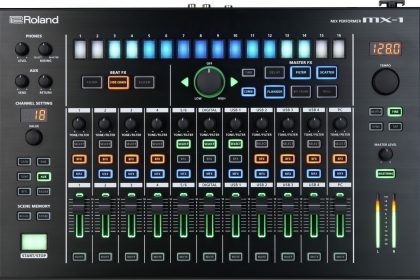


After a long wait, what could be considered the evolution (even in the price ...) of the small and compact System 1 arrives from "mother" Roland. In reality, several things suggest a new model implemented: the most evident (besides, of course, al name) are the general appearance of the instrument, and the quantity and arrangement of controls on the panel.
Among the new features of the 4 octave keyboard, of standard size and excursion, sensitive to velocity (but not to aftertouch), there are polyphony, which passes from 4 ad 8 entries, and the ability to load plug-outs, which goes from 1 to 3. Yep, plugin... but what is it? In very short words it is a plug-in (downloadable for a fee from the site Roland) which works on normal DAWs but, if necessary, can be sent to System 8 as a plug-out / synth, in addition to the native System 8 engine, with the possibility of using it as a hardware synth, so without the need for a computer.

Il System 8 has 3 virtual slots available, on which a plug-out can be loaded for each. We will then have the System 8 synthesis engine, the most precise emulation of the glorious ever seen so far Jupiter 8 and that of June 106 (which in this case even gains 2 polyphony voices). Any emulation can memorize 64 patch, and there is also the Performance mode, which allows you to play (in layer or split) 2 different patches: in this case the polyphony becomes 4 for the upper sound and 4 for the lower sound; the effects are independent for the 2 layers, which is personally very pleasing especially for live use; in the synth can be stored 64 performance. It is interesting to note that, in performance mode, we can also use 2 different plug-outs, for example a Juno 106 for the pads and a System 100 for the lead part. Needless to say, as for the little ones Shop, the replicas were made respecting in all respects the original models and the limitations of the time, so even here we will have - for example - the famous "rustling" chorus of the June 106, with the difference that, if for the Boutiques the background noise was adjustable on 2 levels, here it can be dosed continuously. The keyboard dynamics can be assigned to both the volume control and the filter control even in plug-out emulations that did not originally foresee this possibility. Great I'd say!

I will not go into the description of all the features of the System 8 synthesis engine because they are identical to those already found on the System 1. I only emphasize that, with an update made some time ago, the two oscillators have added waveforms of type (Noise Saw), (Logic Operation), S (FM), (FM + Sync), (Vowel), (Cowbell) . The only difference with the System 1 proprietary synthesis engine (apart from polyphony) is the suboscillator, which in System 8 can be freely tuned and out of tune with respect to the main oscillators. Furthermore, two waveforms are selectable: triangular and sinusoidal.
Effects Section
The section "effects”Has been significantly implemented: they are now present three units which can perform different tasks. The first concerns effects of distortions e bitcrusher, the second delay/modulations, the third reverberations. The main parameters are all accessible directly from the panel and, with the new firmware update, others have been added to the menu, giving the possibility to further refine the sound. Effects (delay / modulations and reverb only) are also applicable to an input signal and these settings can be memorized for each performance. The audio inputs are also used by the Vocoders present on the synth.
The synth doubles as a sound / midi card, which I have personally tested and works really well and with little latency. By putting on a System 8 table (which also weighs very little) with a laptop, we will have a mobile creative station ready for use.
The sound
As for the sound, I must say it really impressed me for power e dynamic, envelope speed, sounds very well defined and organic; I have personally compared the supersaw of System 8 with that of V-Synth XT and they appear to me truly indistinguishable, which was not the case with the Roland JDXA. The latter is however an excellent companion for the System 8, being the two synths in some ways complementary. System 8 pushes really hard on bassi and on highest standards; it is almost impossible to perceive noise of aliasing given the high resolution at which the internal synthesis engine runs (higher than the Boutiques). Using the plug-out of the Roland Promars, you almost forget you are playing a digital synth, but the real show is the plugin of Roland System 100, a semi-modular synth that has been faithfully reproduced, also giving the possibility to connect the various modules freely between them.

ACB, don't call them Virtual Analog.
System 8 (like System 1 and many Boutiques) implements a new Roland technology called ACB (Aaddiction Ccircuit Behavior): unlike synths in analog virtual synthesis (which tries to imitate the behavior of the analog system in a global perspective), the ACB is a complex mathematical model that simulates the behavior of individual electronic components (and their interactions) which constitute the analog synthesizer to be replicated. That's why these synths don't have as many voices of polyphony as a regular VA synth. This also applies to the latest Roland novelty: the Roland Cloud, a subscription service (you pay $ 20 per month per hour). By subscribing and downloading a Roland server (which must always remain running and with the computer connected to the internet), you can take advantage of various 64-bit virtual synth plug-ins (latest addition even the legendary D50) and synths with really well done sample libraries that also include various acoustic instruments.
However, a consideration should be made: I personally tried some "heavy" plug-ins in ACB and I must say that the consumption in terms of resources CPU it is really high. After loading System 8 (yes, now it also exists in Roland Cloud Plugin version), Jupiter 8 and Juno 106, my trusty Cubase began to go into difficulty: only 3 synths and you began to hear various clicks, while the use of resources had maximum peaks never seen.
Another aspect not to be underestimated is the user interface. In the case of the System 8 it is really well done: each parameter has its own relative control, allowing quickly the creation and modification of the sound. Creating new sounds in this way - by touching and feeling the machine - gives me a lot of satisfaction every time! Sometimes it comes out of habit, but I favor the hardware approach to a synth whenever possible. THE VST now they sound like hardware, but I prefer them when there is no corresponding hardware (I bring the very good Omnisphere of Spectrasonics as an example).
What is missing?
Honestly I would have liked aftertouch to add further expression to the sound.
Also I would have appreciated that by entering the sd card sounds, the synth recognized the card as a new bank. In fact, with the current operating system it is not possible, and this also happened on old synths Roland Jx8P, SuperJX10. Already in the golden age, inserting a memory card M-16C o M-512E, with a switch you could choose whether to use the internal or external desks.
Despite these small remarks, overall the product is passed with flying colors for me.
USEFUL INFORMATION
Producer: Roland
Distributor: Roland Italy
Model: System-8
Advised price: 1.400,00 Euro including VAT
Good music to all
Robert Honey