



Make Music changes policy. It is enough to produce annual versions of the software (sometimes very similar to each other). With Finale 2014 a new mentality is born: expand its features, solve the small internal bugs that the software has been dragging on for years and provide continuous free updates to offer a product increasingly linked to the life of the musician and less to that of the programmer ...
Of course, for those who come from particularly old versions of the software (for example 2005 - 2007 etc ...) the "generational" leap is certainly notable (as happens in all software, not just the musical ones). But once they are married, the advantages are many; you just need a little patience and don't let yourself be overcome by nostalgia. After all, as you know very well, the world of music technology is constantly running and keeping up is one of our obligations (if we want to be part of it).
Final 2014D is therefore now perfect? No. Perfectable, as always. The multitude of requests, of different types of musical writings, of notational needs and of different ensembles, inevitably gives us a picture of the kaleidoscopic situation, always in evolution, just as the music itself is in evolution (not to mention the operating systems … “The captain” of Apple looks more and more like a captain of doom nowadays!)
Here, briefly, the main news of version D:
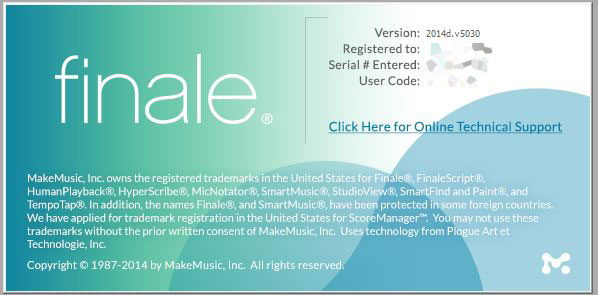
* Finale finally listens to the advice of the musicians. When installing the update D you will be asked to join the final improvement (optional). It is not a sterile request. It really works and the software implementation starts from this worldwide analysis. Already some functions of version D have been fixed and reintroduced thanks to the constant monitoring of the use of the software by users.
Here is the window with the formal request for Make Music (request absolutely respectful of yours privacy and in particular your work, your piece of music. Make Music, through your consent, will only analyze how you use the software's functions and windows, obviously not what you are writing nor your personal data) (Fig. 1).

* Here is the first great fruit of the interaction between musicians and programmers: in version D they return to Windows, located in the Windows menu, the File, Edit, View and Configure palettes and their customization possibilities. Palettes featured in Final 2012 and, for “non-musical” choices, they stupidly disappeared in the previous versions of 2014. Here they are, expanded and reintroduced (Fig.2 and 3).


* In the program options, always at the request of users, under voice Palettes and Backgrounds the possibility of enlarging the size of the icons has been added: this to compensate for the exclusion (in my opinion right) of the crazy customization that until the final 2012 saw the possibility of changing (with results in my opinion incomprehensible) the design and the color of the icons themselves (Fig. 4).

* Even the intelligent forms receive a further small but significant improvement: after the "handles" of the crescendo and diminuendo which certainly now allow the musician a more precise placement of the score in the score, it is possible to "link" these forms to the measure or note and link them to the pulse or not. This allows interventions in the score that guarantee maximum freedom of writing but also great practicality (Fig. 5).

Next steps
- In the coming months Make Music will release a new update of Finale 2014: it will be called 2014.5. Announcements? Sure. New features, small bug fixes etc ...
A bath of humility by the parent company Make Music (and its localizers) which, aware of the fierce competition, is refining and improving the software as much as possible, starting with the musicians and for the musicians.
- The recent acquisition by the American giant of the French company is also proceeding in the same direction of humble and careful technological innovation Weezic, specialized in notational software for teaching, live, tablets, etc.
- One of the latest Make Music projects also travels in the direction of innovation: the creation of one Music Notation Community Group.
Community essentially based on the development and constant updating of the specifications of the universal communication format between notational software (Music XML) he was born in SMuFL (Standard Music Fhave Llayout).
Conclusions
We are therefore, in my opinion, facing a real turning point, not only for Finale but for all notational and musical software in general.
However, despite the many facets or temporary difficulties, we all agree that music technology has now become indispensable in the life of every musician (even for the most conservative).
The real challenge of these years will therefore not be to live (or coexist) with music technology but to put technology itself at our service more and more (through implementations and simplifications) and not vice versa.
the next
Beppe Bornaghi