

Should the smartphone be turned off at the theater? In this case absolutely not!
Zafochi, a work written by Raffaele Cardone (Multi-instrumentalist of Marenia and creator of Bidonvillarik will be performed on 20 January 2018 at the Vitale auditorium of the Avellino Conservatory.
We met Raffaele to ask him some questions while he was recording a choir of children in the Illimitarte studios.
Unlimit you is a Musical Cultural Association that brings together young people in the North Naples area and for some years has also been equipped with recording studios and digital distribution of the works produced by the young members.
A.Campeglia: What does "Zafochi" mean?
R. Cardone: Zafochi, in Amharic (Ethiopian language ed) means Trees. I gave this name for a personal ecological protest against the devastation of the planet by man. In fact Zafochi is a prayer and a warning, it implicitly means please, do not continue to hurt me, otherwise I will have to defend myself.
AC: You are graduated in electronic music, technical branch of sound, and in recording room technician but your background is rich in other studies (Diploma in guitar at the historic University of Music in Rome ed) and collaborations that led you to the Times, and many world media, can you tell us how you composed your work and above all how it will be made live also from a technical point of view?
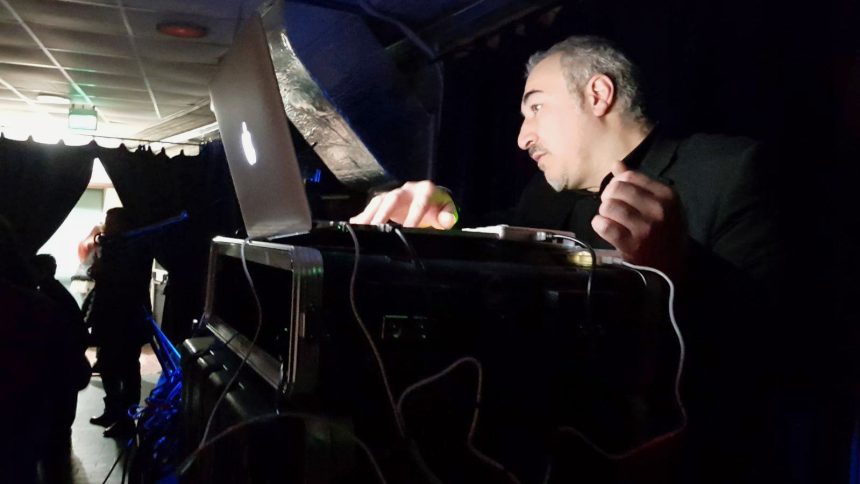
RC: Zafochi is a rare case of stratified work. To understand how it will be performed you have to imagine 6 pianos on stage connected to a digital multitrack system through simple piezoelectric Korg. The six piezoelectrics are sent to a DiGiCo mixer with whom I manage the quadraphony and part of the signal reprocessing. By connection USB the 6 signals are sent to the Mac and with Audio API (Management of the preset sound bands residing in a virtual server and managed with simple HTML5 and Firefox) and DAW, where the processing of the signals captured by the piezos and the spatialization in real time takes place (control with a Korg nanoKONTROL2 and a Vestax Pad One), and return to DiGiCo. In summary, I follow the score performed by the 6 pianists (who have the click in their headphones because they are synchronized with each other, with my acousmatic bands, with the video and with the effects (granularizers, harmonizers, delay lines, and some plug-ins made by me with Max/MSP filters in different configurations, etc) in real time.
AC: What were the critical issues in the writing of the work?
RC: It was a long time that I wanted to write something that would put together several aspects, those of the total disintegration of the tonal, harmonic, melodic and rhythmic language, the electronics, and the risk even during reading. I also asked the pianists to read the score vertically, imagining a sap that from the roots reaches the "leaves", also crossing unlikely shapes, but always following one of the 4 mathematics involved (geometry, arithmetic, algebra, and analysis ed). And I wanted the sound seed to be precisely that mix of frequency superimpositions captured by piezoelectrics, reworked and used in quadraphony from the public.
AC: In Zafochi, therefore, the audience in the hall listens at the same time to the acoustic sound of the pianos and its quadraphonic reworking, but there are also preset sound bands, how did you make them?
RC: In the illimitarte studios in Villaricca and in those of the Marenia in Copenhagen I made several pre-established sound bands. Many artists took part, Maria Ylenia Trozzolo on vocals, Vittorio Bruno, on ethnic percussion, Nicola Orabona on Drums, Melissa Scaricati at Carillons,
Angela Panico on the narrator, and the children of “Il Cassetto di Cecilia”, all certain that the result would have been really unexpected!

AC: The work also has a binaural part enjoyed by the audience through internet streaming. How did you make it?
RC: I've always liked the binaural world. I've actually been passionate about it ever since I heard it in Pink Floyd many years ago. For hours I listened to the record again and tried to imagine a solution (which I would not have found without studying) on how it was possible to put a sound in a three-dimensional space. In fact, it still is complex today and this is not the time to give a lesson on autocorrelation, differences in amplitude and phase of a signal and how the ear is a fascinating organ. What is important to know is that there is a database of "characteristics" of the various "transfer functions" of the head (HRTF) to be taken into account and with which the signal is convolved (I used an average sized head of an adult based simply on an empirical meter, otherwise I would have had to "measure" the head of each spectator and entrust him with a Raspberry Pi with a pair of headphones - and it may not necessarily be with python3 in the future).
Considering that the high frequencies are directives I used an algorithm to simulate this directivity and spacing the sounds in time (inter-aural distance), giving them different levels, combined with the fact that if I want to place a sound behind the head it will be "masked" by the natural filter low pass which is the auditory pavilion, for the azimuth it is a done thing. For the elevation it is much more complex but the grooves of the auditory pavilion help us, which bring us the signal reflected from the floor and ceiling in a time x. The original signal superimposed on itself spaced in time will result in a third signal that will have "holes" in the frequency mantle and will always be in the same place according to the delay time. Here is revealed the mystery of the gods combfilters (comb filters ed).
In short, if they delete this part of the interview and you will never read it, know that I will never condemn Age Of Audio for doing it!
AC: How does audio streaming work and what part does it play in Zafochi?
RC: Illimitarte server hosts the work and I put a QR code leading to the file. Depending on the compatibility of the browser used, listeners will have Autoplay or not. They will be able to start the binaural part simply by framing the QR code that they will find in their place. The audience must wear headphones (Beware of L e R! Otherwise we will not have the desired effect!)
AC.: Why did you decide to perform your opera at the Cimarosa Conservatory in Avellino?
RC: I studied for both the three and two years at the Cimarosa Conservatory. I had a lot of fun and I was fine. I met wonderful people there. And when M ° Carmela Palumbo involved me in this adventure without thinking twice, I said to her: "I have the title, Trees!".
And then I immediately imagined the whole work. I needed expert pianists, who did not judge the work for its writing in the score (I assure you it's really crazy!) But who performed it without prejudice and I found a winning team! Ivana Altieri, Carmela Palumbo, Maria Olimpia D'Urso, Vincenzo Fortunato, Marco Bruno and Luigi Gagliardi who will direct the staff, have trusted me and with their great professionalism and sensitivity they have transformed my follies into that dialogue I had in mind between man and nature.
It is our duty to thank the Conservatory of Avellino “Domenico Cimarosa, in the person of the Director il M ° Carmelo Columbro, President Dr. Luca Cipriani, Maestro Massimo Aluzzi and the Electronic Music School: Sound Technician, without which it would have been impossible to achieve all this!
More Info: www.raffaelecardone.it
Does the movie fit in the theater? In this case, absolutely not!
Zafochi, a work written by Raffaele Cardone (multi-instrumentalist of the Marenia and creator of the Bidonvillarik) was performed on 20 January 2018 in the Vitale auditorium of the Avellino conservatory.
We asked Raffaele to answer some questions, while we received a choir of children at the Illimitarte studio.
Illimitarte is a Cultural Musical Association that brings together young people from the northern area of the province of Naples and that for a few years has been equipped with a digital recording and distribution studio for the works produced by the young members.
A.Campeglia: What does “Zafochi” mean?
R. Cardone: Zafochi, in Amharic (Ethiopian language) means trees. Put this name to the work for a personal ecological protest against the destruction of our planet by the human being. Indeed, Zafochi is an oration and at the same time a record-holder that makes us the earth, cases as one might decide: ¡Os lo ruego, no sigáis hiriéndome, de otro modo tendré que defenderme!
AC: You are licensed in Electronic Music at the Conservatory, in the fields of Sound Technician and Recording Studio Technician, but you have a long history in other studios (Diploma in Guitar at the historic University of Music of Rome) and have collaborated with those who have led you to It appears in the Times magazine and in many other communication mediums, what do you think about how you created your work and how is everything done directly from the technical point of view?
RC: Zafochi is a rare case of stratified work. To understand how it is performed you need to imagine six pianos in the scenario, connected to a digital multitrack system with Korg piezoelectric sensors. The six piezoelectric ones are sent to a DiGiCo audio mixer with which I take care of the headphone and part of the signal reprocessing. Through a USB connection the six signals are sent to the Mac and with Audio API (Manager of predetermined sound bands in a virtual server managed with an HTML5 and Firefox user) and DAW produces the process of the signals captured by the piezoelectrics and the spacialization in real time (I control it with a Korg nanoKONTROL2 and a Vestax Pad-One), finally came to DiGiCo. In a few words, I see the score performed by the six pianists in real time (the pianists have the signal in their earphones because they are synchronized between them and with other elements: my acoustic bands, the video and the granular and harmonizing effects, the back effects, some plug-ins for me with Max/MSP and filters of different configurations).
AC: What were the difficulties during the composition of the work?
RC: From now on I wanted to write something that had various aspects: the breakdown of the tonal, harmonic, melodic and rhythmic language, the electronics and also what I can do during reading. I asked the pianists to read the score vertically, imagining the wisdom of the roots until the “hojas”, crossing also unusual forms, but always following one of the four mathematics involved (geometría, aritmética, algebra and análisis). We also wanted to know that the sound was exactly the mix of the frequently used Yuxtapositions captured by piezoelectrics, reworked and enjoyed on the cell phone by the public.
AC.: In the work Zafochi allows the public to simultaneously hear the acoustic sound of the pianos and their quadraphonic reprocessing, but there are also some predetermined sound bands, how do you create them?
RC: In the recording studios of Illimitarte in Villaricca and in the Marenia studios in Copenhagen, various predetermined sound bands are created. Many artists participated: Maria Ylenia Trozzolo on the voices, Vittorio Bruno on the tambores, Nicola Orabona on the drums, Melissa Ricercati on the music boxes, Angela Panico reciting on part of the children of “Il Cassetto di Cecilia”. Everyone was sure that the result was truly amazing!
AC: The work also has a binaural part that viewers can hear by returning to the internet on their mobiles. How did you do this part?
RC: I have always enjoyed the binaural world. Actually, I'm interested in seeing Pink Floyd. During the hours I listened to the records and tried to imagine (something I had never encountered before studying) what it would be like to place a dream in a three-dimensional space. Indeed, it is something very complete, but it is not the moment of a class of autocorrelation, of differences in frequency, of sound signal or of how the body is a fascinating organ. The important thing is to know that there is a data base of "characteristics" of the various "transfer functions" with which a person connects the sound in his head (I use the head of the average size of an adult based simply on an empirical criterion, in another way he carefully "meditates" the heads of each one of the viewers and give her a Raspberry Pi with two headphones – and there's no guarantee that she won't do it with Python3).
Bearing in mind that the high frequencies are directed, we used an algorithm to simulate this direction and distance the sounds over time (interaural distance), giving different levels, so that if we want to position a sound behind the head of the viewer it will be “camouflaged” by the natural filter of the moment what is the auditory conduct. For elevation it is much more difficult, but it helps us to have the same shape of the auditory conduct which causes the signal to be reflected through the floor and through the phone at a time. The original signal superposed to one and the same time will tend as a result to a third signal which will tend to be one of the “hues” in the common mantle and will always be in the same place following the retreat time. Here the accuracy of the combfilters is deciphered. Well, if you go and read this part of the interview and don't read it again, you know that I don't want to condense it to the Age of Audio to have it here!
AC: How does streaming audio work and what part does it play in Zafochi?
RC: The Illimitarte server accepts the work and can place a QR code that takes you directly to the archive. According to the compatibility of the installed server, viewers will choose Audioplay or not. You can use the binaural part simply by scanning the QR code that you will find on your site. The public will tend to wear earphones. (Attention with the L and R earphones or not will achieve the desired effect!)
AC: Why did you decide to do your work at the Cimarosa Conservatory in Avellino?
RC: Studied at the Cimarosa Conservatory. I enjoyed it a lot and studied well. I met wonderful people there. And when maestro Carmelo Palumbo took me on this adventure, I told her without thinking about it twice: 'I have the title, trees!'
And after that, I thought about the whole job. Professional pianists are needed who do not undertake the work to write the score (I assure you that it is truly a song!), until they perform it without expertise and meet a perfect team: Ivana Altieri, Carmela Palumbo, Maria Olimpia D'Urso, Vincenzo Fortunato, Marco Bruno and Luigi Gagliardi who conduct the musicians. They believed in me and with their great professionalism and sensitivity they transformed my thoughts in the dialogue between men and the naturalness that I had in my head.
I must thank the Avellino Conservatory “Domenico Cimarosa”, the maestro Carmelo Columbro, the President Dr. Luca Cipriani, the maestro Massimo Aluzzi and the electronic music school: “Sound Technician”. Without them, it was now impossible to achieve all this.