


I have never loved using channel strips in the studio, I have always considered them as instruments suitable for live, this is the reason why I have always refused to carry out tests on these types of products; the very thought of manipulating the EQ section while recording makes me shiver.
But, one beautiful day in June, the courier gives me a surprise: the delivery of a fairly substantial package containing the UA LA-610. I was not expecting anything of the kind, at first I thought of a gift from some admirers, but then, returning with my feet on the ground, I thought it appropriate to call the company distributing the product which gave me confirmation of an erroneous shipment. Having cleared up the misunderstanding, I ask the manager the courtesy of being able to use the product for a few days, a courtesy that is granted to me without any problem. By now the damage is done, you will observe how the prevented "repulsion" for an object can turn into a fascinating and progressive discovery of its potential, new product, new test, further task that adds to the already enormous amount of chores that I have to attend to ...

LA-610 as it looks
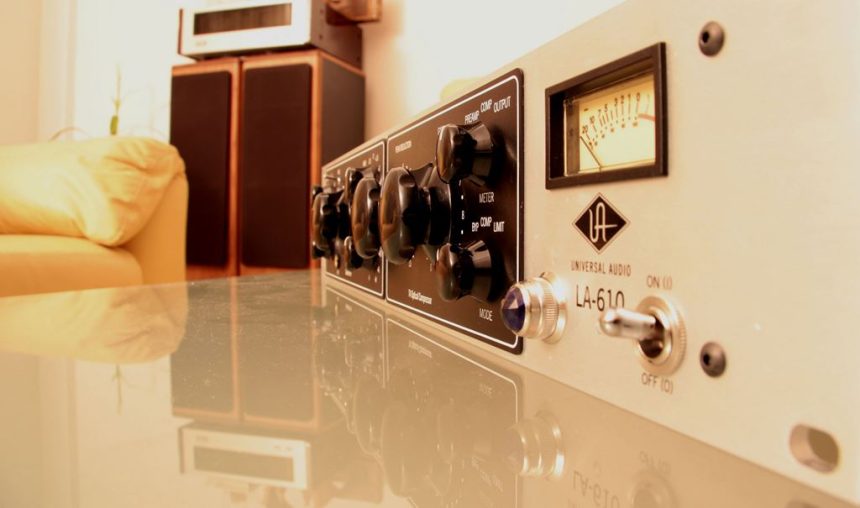
For this test the microphone on duty was connected to the LA-610 channel using a Klotz cable, the output was connected directly to a converter Gloss 88192 with resolution 24 bit/192 KHz, monitoring is entrusted to two pairs of loudspeakers: the PMC model AML1 with 6.5-inch “woofers” (for standard close-up listening) and a pair of Genelec 1032 with 10 '' cone, for better response in the low frequency range. The range of microphones that I had available in the studio was quite varied, from classic U87, until Shure SM58. The machine is mono, in "standard rack" format (two units) in metallic gray color (Fig.1). Like all the "outboards" of the house it maintains its retro style with rotating sliders of great visual impact, well spaced and with a very pleasant and linear stroke that after many hours of work give the impression of being an extension of our new limb that allows us to simultaneously blend and sculpt the sound we are processing.

Starting from left to right we find the first of the two sections which is dedicated to the preamp stage and then to the equalization. The PRE features a Gain selector in 5 dB steps (-10 to +10), while the bottom second is a impedance selector. Continuing, we find three "switches", the first from top to bottom is a selector of "pathWhich, strangely, is a -15 dB instead of the usual -20dB, the second is for thepolarity reversalthe last one is used to turn the power on or off Phantom (+ 48V). Finally we find an Input Hi-Z for recording all those instruments which have a very low impedance. As the last stage of the preamp section we find a generous knob that manages the general level of the preamp stage Tube Mic Pre, by appropriately dosing the three sliders that manage the gain, we can obtain a very wide sound palette that allows us to obtain very neutral sounds up to being exaggeratedly rich in harmonics and very characterizing. The equalization section is reduced to the essentials, two “switches”, the first controls the high frequencies and you can intervene on the 4.5, 7 e 10kHz, while the second those low on 70,100 e 200 Hz. The next two knobs allow to obtain a total of the two “shelving” curves, one for the highs and one for the low ones, with positive or negative frequency and “gain” control. The second section is the one that perhaps attracts the engineers the most, the compressor. In this case we speak of a "mister" compressor as it is a revised version of the famous LA-2A (Fig.2).

The PEAK READUCTION knob controls the degree of compression, while the GAIN determines the amplification after compression. As for the last two potentiometers, the first "METER" allows you to decide which source to display from the "Vu Meter", PREAMP, COMP or OUTPUT, while the second selector at the bottom allows you to manage the 610 in BYPASS, COMP (compressor) mode o LIMIT (limiter). Finally on the right we find a nice "Vu Meter" style "vintage" backlit with a light at the bottom and an ON / OFF selector. After having seen and illustrated the Front Pannel, we see the Back (Fig.3). Here I actually have a bitter surprise. I didn't expect it to have standard digital I / O or even optional, but I wanted at least the three sections to be divided, instead we find the classic connection for the power cable, LINE OUTPUT, LINE INPUT and MIC INPUT all three in XLR format .

Tackling Syndrome
If by chance they mistakenly send you a machine of this caliber, my advice is to send it back immediately, otherwise you would inevitably risk an acute phase of "tweaking", with subsequent and not unlikely addiction syndromes. I believe that most of the great musical successes are not only the result of a study at the table between lyricist, singer and musicians, in fact no less important is the "modus", that is the way in which the idea and emotions are impressed on a support, the only and true link with the final listener. The trend, in recent years, is to record voices and instruments with very colorful "channel strips", almost always tube (Fig.4), which can be used not only on the preamplifier section, but also on the equalization bands, in order to obtain changes in the sound, often radical; as if that were not enough, we tend to use the compression section not as a “limiter” but as a tool to give that classic “hit” to the final timbre.

This operational logic is often the result of an unconscious emulative fashion, we want to obtain "that" "sound" at all costs, precisely because "that" "sound" is well integrated into "that" particular song which in turn evokes atmospheres "Trendy". Obviously you pay the price, you often find yourself having to disguise and distort the original timbre. Do you think I have known people who when they heard the sound of an original vintage Fender piano exclaimed “But there are too many mids !!!, let's use a VST!”. This is not to say that many technical devices do not lead to the creation of a good sound, but we must never forget that it is also the imperfections and the nuances that make the emotions of the music tangible. This explains my non-visceral love for “channel strips”, even if I must admit that sometimes they are really useful; it is not pleasant to spend hours and hours for the perfect recovery of an acoustic instrument and then miserably realize that the sound in the "mix" does not work.
Male Voice
Let's start with a male voice, it is a baritone-tenor register, the timbre is warm and enveloping but at times it can also be gritty; the recovery was carried out by connecting the LA-610 to a NEUMANN TLM 103 microphone. It is a very versatile, silent and silky microphone, however, having no HP filter available, I prefer to place it upside down, I use an "anti-pop" screen and have the singer positioned just over two palms from the device (Fig.5); in short, small tricks to avoid unwanted explosive consonants. After a quick input setting, using the appropriate "vu meter", I move on to the equalization section. I set the bass to 70 Hz frequency, and reduce it by about 3 db, (about two clicks on the related knob); as for the treble, on the other hand, after setting the frequency at 10 kHz, I go down to -1,5 db, then only one click on the appropriate knob. At this point I move on to the compressor section: I turn the generous T4 knob to observe the various dynamic changes; I point out that this intervention can always be monitored with the same "vu meter", by means of the "switch" knob.

After listening to the compressor's intervention in “LIMITER” mode, I opted for the “COMP” option precisely because it has great musicality and exceptional transparency. The only problem that arose was the "repechage" in recording the headphone return. So I proposed to the performer to lower the volume or change the AKG K141 studio (Fig.6) with a possible closed model; we ultimately opted for the first solution. The overall result was euphoric to say the least. The tone returned was warm, enveloping, silky and controlled throughout the performance. Certainly one of the most beautiful machines I have had available. In detail, I can say that the preamplifier is equipped with sufficient "headroom", detail and transient speed, pleasantly airy on the high part of the spectrum around 8000 Hz, just where the infamous "S" reside, which never, as in this case, they were musical and never annoying. As for the equalizer section, however, paradoxically, the question is not about what is there but what is not there. The two fixed-frequency filters are wonderful, I am speaking in particular of the 10.000 Hz: on the acute part all the airiness typical of American engravings is given to any timbre, an opening that does not strengthen the "S" but, as if by magic , gives ample breath in total absence of harshness. Unfortunately, however, there is no HP filter, perhaps rotary, to clean any “rumble” that may occur with NEUMANN type microphones, very generous on the lower part of the spectrum; however, there is a “shelving” section, even if it could be not very effective in the recording phase, especially in the case of poorly disciplined performers. Strangely there was no need to intervene, at least for this test, on central average filters (among other things not present on the device) because the tone in general was already smooth on these, don't get me wrong, from the spectrum there are no "holes ”, There is full respect for the formants. Finally we can add that with the right output knob it is possible with satisfaction to recover all the audio material limited by the action of the compressor, the resulting signal can be directed to the digital multitrack with all the vigor and energy acquired, remember that even the output can be monitored. Wishing to conclude with this test, I can say that the machine can provide that heat that all digital cameras on the market need, both used in the home and in professional recording, by now you know very well that the big difference is made by converters. One last thing to add: in my humble opinion, if any machine (as well as DSPs) sounds good on vocals, it can sound good on everything.
Electric bass
Another interesting test concerned the DI section in particular. In this case, in order to better ascertain the goodness of the circuitry, I thought of using an instrument characterized by a low output boost, such as the Fender Jazz Bass. Precisely what is available is a model of '68, customized without fret (fretless). The surprise is that it was enough only to open the audio to notice how the result was already professional, in full respect of the original tone. In the accompaniment, the instrument has shown little incisiveness in the attacks, a phenomenon certainly correlated to the absence of the keys; in Pastorius-style phrasing (Fig.7), on the other hand, I can say that it is really difficult to find something more beautiful around than what I have heard. The great credit certainly goes to the talented musician too, but the U610 proved to be an excellent shoulder. In addition to the preamplifier, the compressor was also used, thanks to which it was possible to achieve excellent control of the dynamics in full transparency, trapped in a well-defined range, without that ugly pumping effect that characterizes low quality compressors, especially when pushed to the limit. To perceive the process in a more evident way I tinkered with exaggeration, but in any way I set the parameters, the result produced was never destructive. However, the advice remains the same: the right balance without exaggerating. The real sound engineer, in my opinion, is the one who doses the interventions in a wise and thrifty way, able to grasp even the smallest of variations.
Sax
The saxophonist who lent himself to the test brought with him a baritone sax and an alto, two instruments with a completely different tone, even if belonging to the same family, in practice we asked the LA-610 to show us what it is capable of doing. when it comes to grasping different nuances. The microphone used is a Sennheiser 441 (Fig.8), the classic biscuit: it is a dynamic with a very wide frequency response, comparable to that of a good condenser microphone. It is definitely my favorite on brass. As for the baritone sax, the preamp has managed to capture all the tonal depth and the scratchy characteristic of this instrument; all the expressiveness, including malice, was reproduced with great naturalness and this without ever sending the entry stage into crisis. Here too the LA-610 confirms its high potential for "headroom". The equalizer at this stage was not affected, we only used the compressor which was transparent and effective. As for the alto saxophone, on the other hand, the LA-610 has managed to give a little more tonal width, with round mids and never “ciaramellati”, a drawback that can often occur in recordings of this type of instrument. I recommend that the performer avoid spasmodic movements. The alto sax, as well as the tenor, emit the voice mainly from the bell and not from the body, consequently their “off axis” positioning could generate a fuzzy and subtle tonal result. Also in this case the compressor did its job very well without darkening the preamplified signal, even here the EQ remained OFF. Speaking of the equalizer, I always suggest not to insist too much with the scalpel if the desired result is not achieved, I strongly recommend not to waste any more time and arrange to rearrange the microphone, or replace it (obviously also make sure that the musician and the instrument are all height of performance .. :-)). In any case, consider that the EQ present on the LA-610 is very particular, it performs at its best on certain timbres; in the previous test, that of the voice, he behaved wonderfully, wisely enhancing the talents of the singer in question, also the performance for the sax, baritone, alto and tenor shooting was decidedly good.

Acoustic guitar
 The acoustic guitar used for this test is a beautiful Canadian handcrafted Simon and Patrick. In acoustic this instrument gives a high class sound without resembling a Marti at all and is equipped with a very personal voice, very versatile and pleasantly effective. The microphone used for this test is the new AKG c414, positioned about 30 cm away, precisely between the sound hole and the neck (Fig.9). The preamplifier was able to immediately grasp both the timbric freshness of the attack of the pick on the strings, and the sound coming from the harmonic plane, providing a ready-to-use result, all with the full complicity of the equalizer that in this case was used. only on the bass to reduce a bit of "uhm" coming from the speaker (3dB on 70Hz); the compressor has managed very well and always with maximum transparency, to glue the "take" without compromising the typical touch of freshness that can revive or come out of a good "mix".
Live use
Just during the writing of this article I was lucky enough to meet a dear friend again, a very good sound engineer, specialized in theatrical performances and "musicals". Obviously I thought of seizing the opportunity by asking him the courtesy of setting a date to carry out a "test" of the product, perhaps using the voice of the main interpreter of his show; after a moment of perplexity, luckily he accepted. I realize that when the tour has already started it can become very dangerous to experiment with new solutions, usually an alternative is sought only when it is necessary to optimize an unsatisfactory result; by virtue of mutual esteem, we decided to take some risks, although in fact I felt a good deal of curiosity when my friend heard that it was Universal Audio. After a short phone call to the "starring", we met in the theater a couple of hours earlier, just to perform some rehearsals, thus minimizing the potential risks. Do you know the saying that advises not to change the old way for the new one? Good! This time, pardon the pun, the saying has been contradicted. Inserted our machine in the channel "insert" of a fabulous MIDAS XL 3 mixer (Fig.10) we immediately, and with great operational simplicity, heard the voice (it was a suspended Nexò system) in a full-bodied and intelligible way, the effect was perceptible in any point of the theater to such an extent that the actor-singer himself felt the pleasant difference. Specifying the quality of his equipment, the bench preamplifier, the filter section, the engineer confessed that only with very few machines he could enjoy such a significant improvement. In addition to the preamplifier, the compressor was also considered transparent and capable of containing the various dynamic changes. From the judgments collected, LA-160 has been able to support the chiaroscuro of the acting with great personality, including television-proof whispers. In this specific case, however, the engineer decided to use the filters of his mixer considered more complete and suitable for controlling the lower part of the spectrum, specific filters, with the task of cleaning up all the UHM of the stage; the DPA overhead condenser microphone (Fig.11), in practice it acted with a "roll-off" up to 180Hz leaving the rest of the EQ in "flat". Having passed the live rehearsal with great ease, with equal ease I was able to free myself from pressure from the singer, who would have liked to use it also for the following show. I'm SORRY


Final conclusions
The LA-610 really made me think again about the effectiveness of the “channel strips”. Unfortunately most users are not lucky enough to have very important converters such as Universal Audio, Prism Sound, Wess etc; precisely for this reason, a machine like the LA-610 can, or must, find a place in your audio “setup”, like a “food warmer” tested for use on vocals and string instruments, such as guitars and bass; obviously this does not remove any “experimental” and creative use on the most disparate sound sources, the only limit is in your taste. Even the outward appearance manages to impress and arouse curiosity. Transparency, silence and incisive character, always detailed, are his best weapons. To all this is added a really interesting value for money, the machine is not extremely prohibitive and is very professional. The versatility and ease of use are remarkable. It would have been exceptional to find on the generous display a rotary HP filter, a "de-esser" and attack controls on the compressor section, in fact, in the presence of sounds with extremely fast transients, the T4 compressor on board the LA-610 it has proved not very malleable, due to preset settings at slow values. As far as the “routing” is concerned, it would have been useful to be able to isolate the different sections during the mixing phase, think for example of using the compressor or the EQ alone on the “insert”. Certainly such a frankness would have significantly increased the final cost ... Another note to make on the EQ is that, even if it is not complete, the few available controls are highly musical, in particular on the voices and on the percussion it manages to give all the desired liveliness. At this point many readers will wonder why I didn't add, as I usually do, a dedicated and in-depth paragraph on its circuitry, or on the choice of its individual elements. In truth, the car struck me so positively that I preferred to exploit almost all the space that was allowed for the various tests.
LA-610 from the inside
I just want to spend a few lines on the circuitry, even if there would be an article to do just to understand how the machine was conceived and the reason for this particular “sound”. The instrument is assembled entirely by hand and the path of its signal is entirely analog, not suffering any "interference" from operational circuits. I think this is one of the few situations where I have "felt" a combination of all three stages, Pre, EQ and Compression, coexist and integrate perfectly while all three are tube in nature. They proved to be a real united and happy family and when it processes a signal, all this harmony can be felt both on the skin and with the "ears". I would like to conclude with a thank you to my sound engineer friend Luigi Circiello (Fig.12) which allowed me to continue using his LA-610 for my tests, since the one at my disposal was returned to the distributor after about two weeks. Luigi, in addition to lending me his voice and making his studio available, gave me lots of advice on how to best use this little gem.

USEFUL INFORMATION:
Producer: Universal Audio
Model: THE 610
Website: Www.uaudio.com


