



It is difficult to write about a sound, and this is the reason why the reviews that talk about musical instruments are very complex: you have to listen to sounds through words, in a sort of dialectical synaesthesia that is very difficult to implement.
The guitars on test today, then, are full of historical appeal and discreet collecting charm, and here it is that talking about them in a lucid and objective way becomes even more difficult.
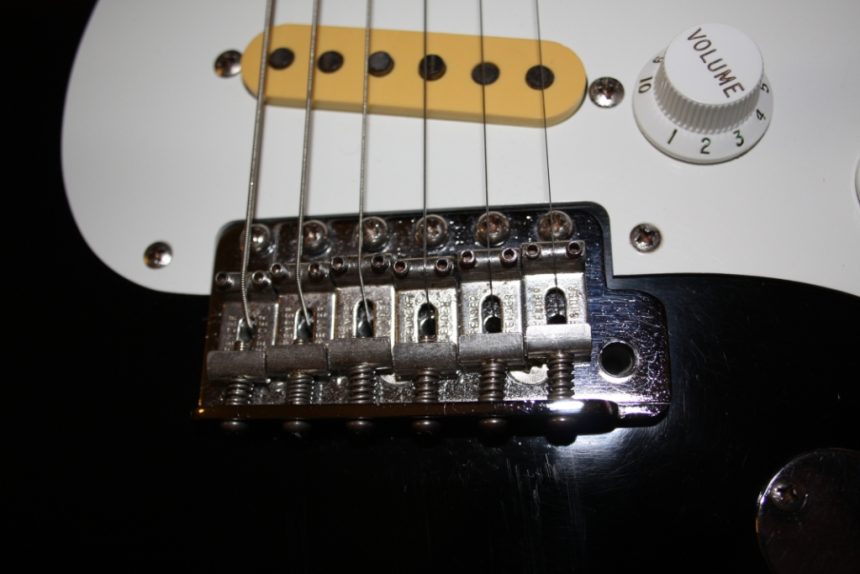
The first is one Strat JV from the very early period “Squier logo”, coming from England and in a rare and attractive custom “Black” color, which combined with the completely maple neck gives it a decidedly Claptonian look. The guitar is completely original, even his own molded houses in leather is exactly what was supplied at the time with the guitar (today really hard to find), welds, potentiometers, pick ups, everything has remained as it was then, except the color of the neck, which over time and the sunlight has acquired a spectacular amber color, and of the covers of the pick ups, which over the years, reacting with the wax used to paraffin the coils of the latter, have become a pale ocher

.
The first thing to catch your eye as soon as you pick up one of these models is the correctness of the proportions: the body has a realistic and well-shaped contour, the neck has a delightful soft V profile, the headstock is the right size and all the hardware is aesthetically and functionally flawless.
The circuit, despite the years, still works very well, and only needed a cleaning of the contacts with a special spray. A little curiosity: this instrument, coherently with the model it is inspired by (the Stratocasters of the '56/ '58), has a three-position selector, so to select the intermediate positions it is necessary to lock the selector in the center, a bit like they did in the beginning also Mark Knopfler ed Eric Clapton.
Attached to the amplifier it does not disappoint: the sound of gray bobbins (the same ones that at the time fitted the first Fullerton reissues) is definitely "from Stratocaster", in particular the bridge pick up is never acid - as sometimes happens - but always present and defined, the central pick up is definitely usable, although it is not historically the most used pick up in the Stratocaster, while with the one at the neck the Blues rings at your door to join in playing with you. A special mention goes to the intermediate positions: it will be the difficulty of catching them with the three-position selector, the pick ups will be particularly lucky, but they sound incredible, with the right "quack" but never boxed, one would want to rattle off licks with a pick and fingers for days, guaranteed!
Summing up I would say that this JV is a really well done and well sounding guitar, and even without making out of place generalizations, I can say that a bit of all the 82 JVs that have come to my hands were thoroughbred instruments.
Fender JV Telecaster
The history of telecaster instead it is different: the sample being tested comes from Japan, it was therefore taken from his home, and it always belongs to the very first production of '82. Pick up gray bobbins here too, and also in this case, the guitar is completely original down to the last screw and includes the original case of the time.

This instrument has certainly been played more than the Stratocaster, the neck in fact has several checking marks on the fretboard, demonstrating its great and intensive use. In this case, the first detail that catches the eye is the effect of the light on the paint both of the body and of the neck: the color has changed a lot, making the instrument a deep ocher color, very nice to see. Also in this case the fidelity of the hardware amazes: never seen such beautiful dome knobs, and also the bridge is very beautiful and well made. Even the screws are consistent with the era, showing the typical slotted head and not the more modern cross head. Incredible!
The only sore point of this beast in ash is the weight: four kilos for a telecaster is a lot, but hearing it play repays the back pain at the end of the concert!

Even here, when switched on, no surprises: the electrical part works wonderfully, no crack or unexpected events whatsoever, everything does its duty and the sound is truly spectacular: especially the bridge pick up amazes, as it is not the usual pick. up Tele with timpani-splitting highs but, even without losing the classic twang, it is incredibly balanced and powerful, with a definition for each string to leave you breathless. The neck pick up is equally well sounding: just think that a well-known Italian jazz player uses a Telecaster JV for his songs, and the sound is very respectable.
Ultimately beautiful guitars, these JVs, often penalized by invasive modifications or irreversible damage, but which, if original and in excellent condition, can surprise.
Small note on prices: the prices are constantly rising, for original specimens with original case, prices start at no less than 1.200 €. Are so many? I don't know, but to judge the quality of these instruments I leave you an emblematic video, which immortalizes none other than Sir George Harrison holding a Squier stratocaster JV (St-57, to be precise), underlining that the video is from 87, so before JV fashion, before vintage at all costs, before the victory of appearance over substance.
Good music to all.


