


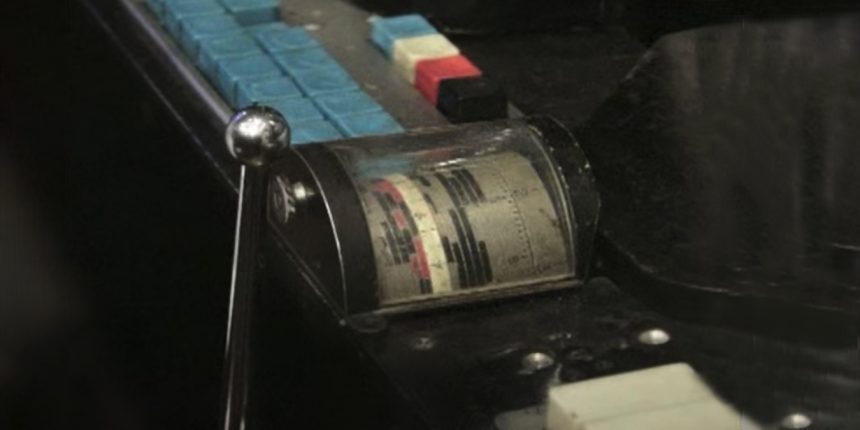
Today we are talking about something unique of its kind, a truly particular object, that is the ANS synthesizer developed starting from 1937 and completed in 1958, with a patent in the following year by Evgeny Murzin.
The name is formed by the composer's initials Alexander Nikolayevich Scriabin, to whom the machine was dedicated. L' ANS is a microtonal photoelectric synthesizer which is based on a visualization and printing technique on the support of an audio spectrum. In this way, 5 glass discs containing 144 tracks so that they can generate 720 modulated light beams at different frequencies, spaced apart 16,67 cent between them, and able to cover an extension of 10 octaves.
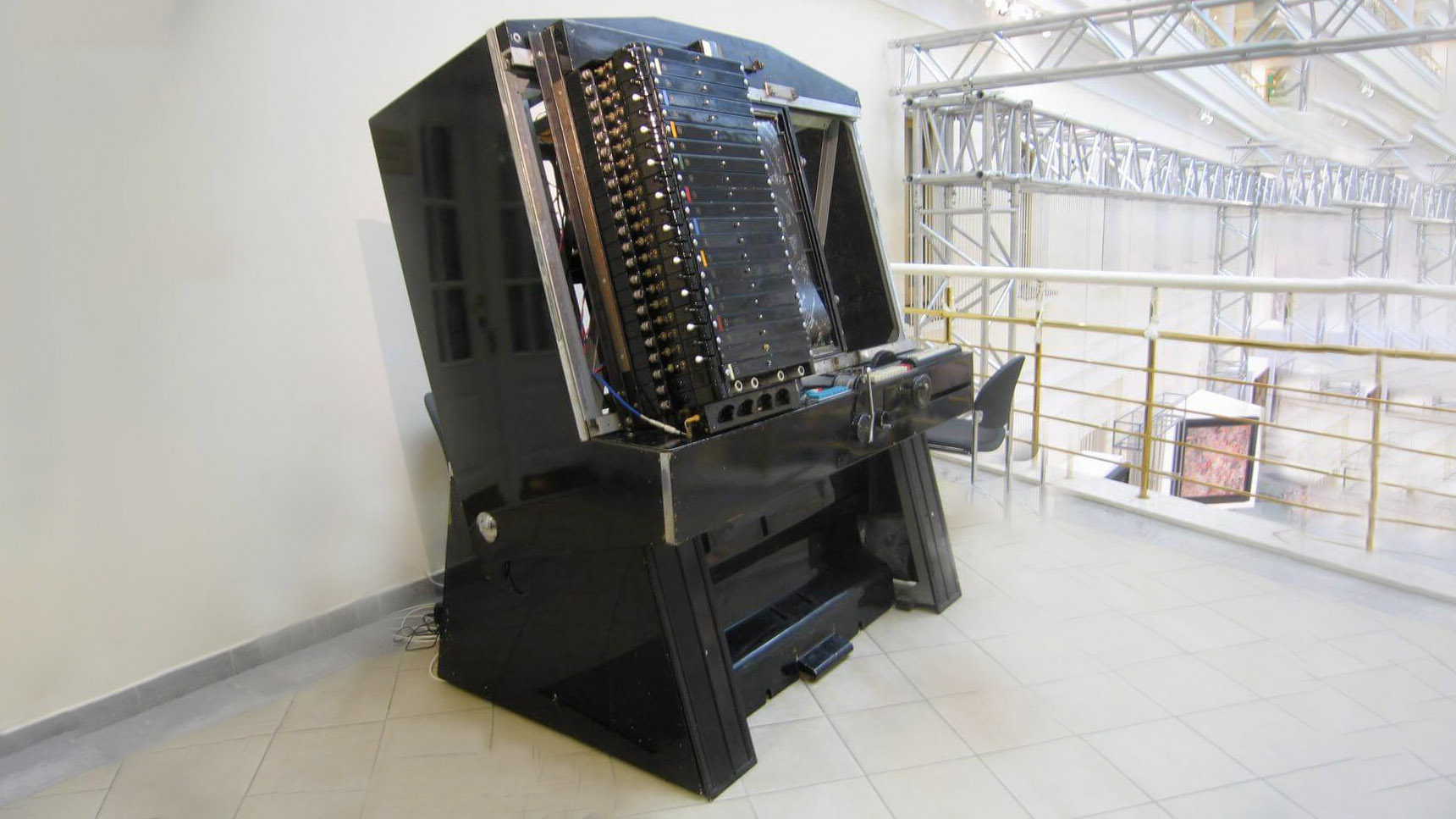
These light beams are made to pass through a glass plate which can be opacified by means of a particular plasticine on which one can write or draw; then a movable arm, on which optical sensors are mounted, scans the plate and allows, by means of the sensors, the detection of flashes not attenuated by the plate which will be added electronically, amplified and reproduced by a loudspeaker. If you make the plate let through all 720 light beams at the same time, the instrument will reproduce the entire sound spectrum made up of 720 unique sound waves. The tuning of the synthesizer is 72 sounds per octave allowing you to approach a natural pitch. It is important to point out that the ANS has no keyboard, so each song needs to be prepared in advance to be then automatically played almost like a sequencer. Among the curiosities related to this instrument it must be said that over the years '60 '70 del '900 was used to compose soundtracks for feature films such as Solaris di Andrei Tarkovskyj.

In the 2000s, on the other hand, artists such as: Coil, an English experimental music band and, the Italian musician Bad Sector, have made extensive use of ANS in their compositions; finally we point out that the only instrument made by Murzin is found in Glinka State Central Museum of Musical Culture of Moscow. Based on this principle, in 2013 the Russian programmer Alexander Zolotov made a virtual emulation called Virtual ANS, just in homage to the historic synthesizer, in which it is possible to design the sound through a drawing area where on the horizontal axis we find the time and on the vertical one the intonation or import sound files, but also process sounds starting from an image .

In the video below you can see how it works.
Paolo Alessandro Andrea Cherubini Barberini


