

On the review of this product, this time we took a little more time, because frankly there was no similar equipment on the market, we had to study it thoroughly enough to actually understand the concept..
What are we talking about? Dell ' Heritage Audio Motorcity Equalizer, a product that we never expected could come out of the Spanish company, which has so far been involved in making gods Snow clones of high quality (even if defining them clones is a bit simplistic), being a very special machine that we first tested in Italy.
First Approach
The first question you will have asked yourself (and that we have also asked ourselves….) Was: “Ok, great, an equalizer… but, Motorcity? And why on earth? Do they use it by chance in Formula 1 to make Ferraris go better? " None of this of course. We have to go back a little over the years to understand the genesis of this machine.
Back to the past
Precisely at 1959, when Berry Gordy founded in Detroit (American motor capital) the Motown Records, pillar of the recording industry of the 60s and 70s which, in addition to giving life to the successes of personalities of the caliber of Stevie Wonder, Diana Ross, Marvin Gaye, Jackson 5 with Michael Jackson and many others, he created a real sound as far as the drunk andR'n'B.

Over the years we have always talked about the sound of Motown and this particular sound was not given only by the type of tracks produced, but also by the fact that inside its own recording rooms, there were self-built equipment that could be found only and exclusively there. Indeed, Gordy's intuition was not only to channel an incredible number of talented artists, but also to hire an engineer, Mike McLean, who became head of design and maintenance for consoles, outboards and recorders. Together with theirs custom equalizers (with versions optimized for tracking/mixing e mastering), among Motown's most notable innovations was, for example, a 5-channel guitar amplifier that provided direct outputs to the control room patchbay. This provided isolation of the registration through DI but with the tonal advantages of a real guitar amplifier, common practice today, a little less over the years '60. As we understood, then, Motown was a creative forge and this new Motorcity is nothing more than a faithful copy of an equalizer created in the Years' 60 in the Motown workshops and today owned by Michael Brauer.
Heritage Audio Motorcity
Front panel
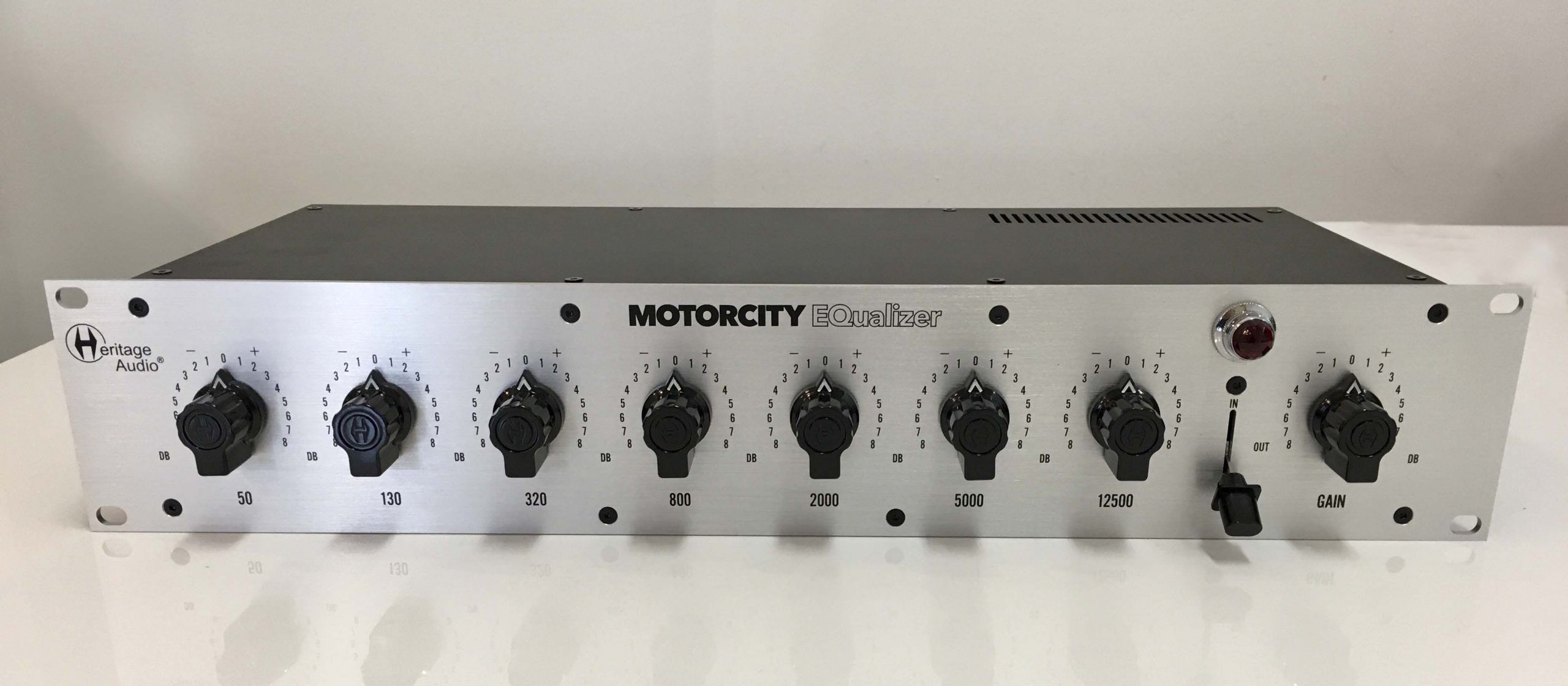
Let's talk about a 7-band passive monaural equalizer housed in a rugged 2U chassis with frequencies set to 50Hz, 130Hz, 320Hz, 800Hz , 2kHz, 5kHz e 12,5kHz. For accuracy and easy recall, each frequency is assigned its own rotary step switch, which provides 8dB cut or boost in 1dB increments with the “off” position at 12 o'clock. There is a main gain control that provides the same 8dB cut or boost, again, in 1dB increments. An in / out / off switch completes the front panel controls.
Back panel
The rear panel is equipped with XLR I / O and an input for external power.

Hardware project
As reported by Heritage Audio, the realization of this Motorcity was a real challenge, as we wanted to perfectly replicate what was the passive circuitry of the original. In fact, the Spanish company had to have some electronic components that have been out of production for years reproduced from scratch. Furthermore, not only has we concentrated on the technical aspect, even the simple realization of the Bakelite knobs was carried out ad hoc, as it is absolutely not on the market of this type.
For this work Peter Rodríguez also received support from the Black Lion Audio, which headquartered in New York, had easier access to the various technical information necessary for the implementation. According to information provided by Heritage Audio, The Motorcity uses no less than 21 inductors e 21 capacitors (3 each per band) made exclusively, comparing the values with the original Brauer equipment, with a maximum tolerance of1%.

Tis
Obviously, as you can imagine, we don't have a yardstick, having never had access to Brauer's equipment, so our test is based on the sensations that this machine, which has very little in common with the more popular eq passive, or the Pultec. The first sensation with the machine off was particular, as it was actually quite perplexing about the actual use of this contraption. We are talking about a single channel (obviously with the possibility of a stereophonic use if they have two), so we can already imagine it in the tracking phase for example, or in mixing. Moreover, having, in fact, a fixed frequency and a fairly wide bandwidth, it certainly cannot be used as a corrective eq, but it is to be used to give a different “tone” to your audio source.
For example, a drums can be made much fatter, a bass with Motorcity inserted in the recording phase acquires an incredible sound. As we know, a passive filter does not amplify any frequency, but always works on the reduction, subsequently amplifying the desired frequency. To be more clear, the increase of a certain frequency band sounds like the reduction of all the other bands, that's why the use of this machine is not to be assimilated for example to a normal 31-band eq. In fact, as mentioned, due to the large bandwidth of the filters, any modification on a band also affects the neighboring bands, which can create holes, but also some very special effects. On the midrange, which is usually the dread of all sound engineers, we have a very nice clarity and boost at the same time, creating a feeling of sharpness and saturation, which is quite peculiar. Naturally, like most of the outboards, it is on the voice that the Motorcity gives its best, giving a remarkable clarity on the very high range, softening a lot, without distorting them, what is the mid-range area, indicated with 800Hz, but which as you can hear, goes to embrace more than that band with a little cut of 2db.

Conclusion
This new Motorcity in our opinion will become a must for all those looking for that vintage sound and who are now fed up with the clones of the various pultecs, snow and so on. The Motorcity is the Motorcity, so obviously the purchase of such a car must be weighed very well, because the sound is really special and months of use will not be enough to fully understand its potential. Obviously the price for a single unit is quite high, not making it an outboard for everyone. It was probably designed for those who already have a good sound experience behind them, looking for a sound for their mix that cannot be replicated with other outboards or plugins.

Personal considerations
The more you work with this product, the more you appreciate its potential and its unique sound compared to everything offered to us by the professional outboard market. The product is very well made, just a couple of small notes regarding the aesthetic aspect: the cover of the lever off \ out \ in does not give me a great sense of stability, in fact it has flown away a couple of times. Also in my opinion for the power supply you could have opted for a slightly cheaper solution given the cost of the machine.
Several plugins inspired by this type of equalizer are currently being launched. Obviously speaking of machines (the original ones) made almost by hand, it will be difficult to find a correspondence between the various plugins and this Motorcity, until now, the only hardware on the market.
Useful Information
Product: Motorcity EQalizer
Italian distributor: Midimusic SRL
Price: 1.990,00