

After all, we all know him unconsciously, I refer in particular to the "boys" of the last century who have matured a subliminal coexistence with the classic sinusoidal hiss. In fact, starting from the 20s, every respectable horror film, every scene that should generate suspense, every monophonic synth of respect, considered its presence necessary and essential ... yet, despite the acquired familiarity, every time you have the opportunity to seeing one live is always a surprise: we're talking about the Theremin!
Theremin operation

Il Theremin is the first electronic instrument in history (Fig.1) created by the Russian inventor Lev Termen in 1919. It is basically composed of two antennas placed respectively above and to the side of a container in which all the electronics are housed. The control is carried out by moving the hands away and approaching the antennas: the height of the sound can be controlled using the upper one (positioned vertically), while the amplitude can be adjusted with the lateral one (placed horizontally). With appropriate settings (Fig.2) related to the type of wave and to some variable filters, the timbre can vary between that of a violin and that of a vocal: typical is the “waves” or “brigthness” sequence. The instrument is considered among the most difficult to play precisely because it is played without touching it.
Theremin physics
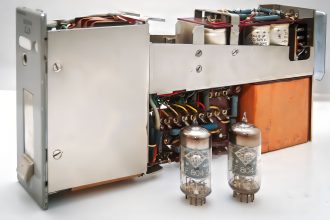
The physical principle of the Theremin is based on the beating of two waves. Two oscillators generate the same wave at a frequency above 20 kHz, which is inaudible at rest (we are in the realm of ultrasound). By connecting an antenna to the capacitor of one of the two oscillators, any mass, such as a musician's body, that enters its range of action alters the capacitor's capacitance and consequently the frequency of the wave produced. From the difference between the two frequencies (which are no longer equal) a third is born (the phenomenon is also known among musicians as the principle of the third sound). By appropriately programming the system, it is possible to contain this final wave within the audible spectrum of 20 Hz – 20 kHz, thus obtaining a sound that our ear can perceive. The volume antenna is the ground plate of a second variable capacitor. In this case, the oscillator varies the amplification circuit. The distance of the performer's hand from the antenna (Fig.3) determines the value of the capacitor and the trend of the volume curve.

Curiosity
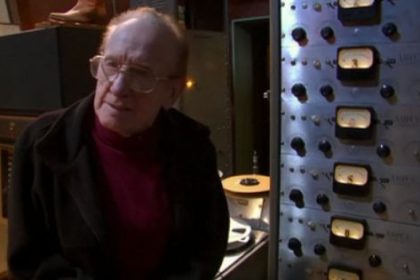
 Leon Termen (Fig.4), the creator of the Theremin, after the success of the instrument was called by all "Theremin" and is often the only name that is found in biographies. The idea of the tool came to mind a Term while doing some experiments for the army with tube amplifiers: he noticed that sometimes a whistle was produced that changed frequency by varying the distance of the hands from the tubes. Being also a musician, he sensed its usefulness and developed the idea until he came to the construction of a real musical instrument called "heterophone". In the 1957 film "The Delicate Delinquent", comedian Jerry Lewis "plays" a Theremin that was accidentally discovered in the attic. The greatest Thereminist in history, Clara Rockmore (Fig.5), was a prodigy violinist, still today the youngest student ever admitted to the St. Petersburg Conservatory (5 years). He began to study the Theremin because he was unable to continue his career as a violinist due to bone problems due to malnutrition. John Cage already in 1937 sensed the possibilities of the instrument by talking about it in one of his lectures "The Future of Music" enhancing its possibilities expressive. Paradoxically, he used it very little like all the avant-garde musicians of the 30s! After the Second World War the Theremin fell into disuse. Robert Moog (Fig.6), a high school student, began in the 50s to build circuits for Theremin and to spread the instrument again. Lenin, the Russian dictator, began studying the Theremin after seeing Termen play it in 1920. He was so enthusiastic that he ordered 600 to be distributed in the Soviet Union and paid for a trip to Termen to promote the instrument. Termen disappeared in 1938. Kidnapped by the KGB and confined together with many other scientists in a work camp in Siberia reappeared 30 years later.Soon after inventing the Theremin, with the same principle, Termen invented a burglar alarm still widespread today.In the seventies Termen began to give lessons to his very young niece Lydia Kavina (she was 9 years old) considered today the greatest living classical thereminist.

… And in Italy?
We visited the only Italian school that provides a stable annual Theremin course, the Accademia Musicale del Vallo Di Diano (Fig.7) in Sala Consilina (SA). More precisely, it is the headquarters in Teggiano (SA), where the Academy is equipped with a recording studio located in a suggestive 1500th century bishop's seminary. To illuminate our path was Fabio Pesce, computer engineer and musician by vocation. The adventure begins with an open study door, dim light, and a long stone corridor ruled by an eerie hiss. With apprehension and curiosity I follow him ...

 Fabio Pesce (Fig.8) Computer engineer and musician, graduated from the University of Pisa, he works on the creation of a music synthesis software at the Music Informatics Center of the CNUCE Institute (National University Center for Electronic Computing) of the National Research Center of Prof. Tarabella. Since 2000 he has been a “Steinberg Educational” teacher. Hardware and software consultant for recording studios and musicians of various backgrounds throughout the Italian territory; holds courses, masters and specialization in Musical Informatics. Since 2004 he has been in charge of the two-year course in musical computer science and sound engineering at the Accademia Musicale del Vallo di Diano in Sala Consilina (SA) and Teggiano (SA) to which the first stable Italian course of Theremin was added in 2008. Theremin with the best masters in the world from Lydia Kavina to Barbara Buchholz to Carolina Eyck to Randy George to Wilco Botermans and performs in various Theremin Orchestra shows with Lydia Kavina in Germany. He has played in various international festivals mainly in Germany (Without touch 2 and 3, Electronic Art Party 5) and England (SW4 and SW5). He plays classical Theremin in duo with the organist Tonino Angone and electronic music with Chris Henkel (o8o8.de ). He also has his own solo show. In 2009 he recorded the CD Vulkano with saxophonist Gaspare de Vito, Chris Henkel (synth) and Gordon Charlton (Theremin and effects) - AMV editions - and was included in the compilation "Sonic Weekend 4" and “Sonic Weekend 5” produced by White Label (UK). He plays mostly an Etherwave Pro from Moog.
Antonio Campeglia: Let's talk about your Theremin ...
Fabio Pesce: I present to you the first electronic instrument in history! The only one that can be played without any physical contact. It was 1920 when the Russian inventor Leon Termen (later called Theremin in the West) played it in front of an astonished Lenin. These are the last two models produced by Moog in recent years: a now rare Etherwave Pro, also known simply as the Epro (Fig.9), and a standard Etherwave.
HUNGRY: There would also be an Etherwave Plus, recently released ...
 FP: I know, I know, but I'm still waiting for that. It is a mixture of the two, however modified to enter the established controller market. Playing a Theremin in a classical way is too complicated for the average musician, it requires too much application and above all time. It so happened that with the death of Bob Moog in 2005 there was also a rapid drop in attention towards the Etherwave Pro. Back then it took $ 1500 for an Epro when it was still in production. Not a little if we consider that 90% of those sold were destined to become pieces of furniture or to be exploited for some vintage sound effect. Currently the Epro has become not only the most coveted model, very difficult to find, but, in the case, it takes a figure at least three times higher than the starting price. I bought this in California, it is no. 347
HUNGRY: The cost? FP: €700,00 in customs alone, I won't add anything else, it's a painful point... Returning to production, Bob Moog put his heart and soul into it, he loved the Theremin dearly, and in fact, the professional instrument existed as long as he lived. When he died, Moog pushed harder to create a lighter and cheaper instrument, the standard Etherwave with 6 octaves, less precise but more versatile. It's an understandable market logic. Compared to the previous model, they had to sacrifice the CV outputs, the headphone output and tuner, the treble and sub-bass register, the aesthetics and above all some of the linearity that made the Epro the most stable model ever. The Etherwave was designed primarily as a controller and in fact became more widespread because it embraced thereminists, sound designers and studio engineers. The CV output, headphone output and tuner reappeared on the Plus version. I don't know about the linearity, it should be played, but it should be the same as the standard version since they also sell just the upgrade.
HUNGRY: How did this passion start? Engineer and music, in short, a difficult combination.
FP: Until 1999 I lived in Pisa, where I graduated from the Faculty of Engineering. For about nine years I was a professional musician: guitar (an Ovation that I still play), keyboards and even a little voice if necessary. When I had to choose the thesis I was already very clear that I could not start designing computers or microprocessors ... so I tried to reunite with my muse in some way. He discovered that a certain Prof. Leonello Tarabella was director of the music computer laboratory at CNUCE (National University Center for Electronic Computing) within the CNR (Centro  National Research) of Pisa. I tried everything to go there and succeeded, not without difficulty. I wasn't sure what I was supposed to do (and maybe not even him) but I was there for two years, an unforgettable experience. Prof. Tarabella was (and still is) specialized in gesture control applications. Typical applications were the "imaginary piano" (Fig.10), with a pianist sitting on a stool playing a non-existent piano in front of a camera; a virtual brush that a painter simulated in the void with a visual recognition system that sent the graphic interpretation of his gestures to a giant screen (I still remember a blue error screen of a Windows 98 on a 10 square meter screen in Lucca during a show) and above all the "twin towers" born in unsuspecting times. The musician moved his hands on a rectangular tablet and infrared readers read the distance from the base of each hand and transformed the impulses into a midi signal. It was basically a kind of modern Theremin, volume and pitch. I was still working on the design of a software synthesizer of the Csound type and the like, but the seed of “without-touch” had been planted.
HUNGRY: I understood that your first Theremin is more recent than the nineties.
FP: Yes, indeed. When I left Pisa for Naples, I started working as an engineer with a capital "I." Software, hardware, projects. Then YouTube was born, and one day I saw someone playing the Theremin. When I saw it, perhaps in 2004, it seemed like Columbus's egg, and something awakened inside me. I even remembered having published an article about the Theremin during the CNUCE years, citing some historical references. It was love at first sight. Yes, because that's how it is with the Theremin. Self-respecting Thereminists, who have a visceral passion for the instrument, are a kind of small community, like motorcyclists who have purchased a Harley-Davidson. There aren't many of them around the world, and almost everyone knows each other; they have their own international mailing list, a forum, and even a Web Radio that only plays Theremin. They also hold "gatherings" in remote parts of the world. Since that day, I've never stopped playing. I bought the standard model and when I got good enough to realize I needed something better I started searching the world for an Epro.
HUNGRY: What kind of music do you play and teach?
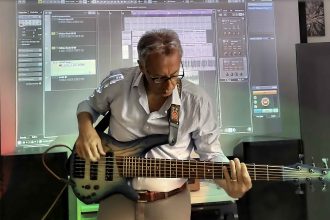
FP: I'm a bit eclectic, actually, but I prefer classical and pop music to electronic music. I say "prefer" because in Germany there's a nice tradition of old synthesizers and '80s music, so when I go to play there I often find myself in situations of pure electronic music, live experimental, electroacoustic. In Munich I have a project with Chris Henkel (Fig.11), there they know us as “o8o8”. In England I participate in various projects with the White Label, an independent English label that makes an experimental type of music. Here too we go towards improvisation but with self-built or adapted instruments. Sonic Weekend is an annual event that involves the "kidnapping" of about twenty musicians from all over the world to make a CD, more or less the genre is this (I made two). In Italy I adapt a little but I try to tend towards the classic. I have a project with the organist Tonino Angone, we make classical music and soundtracks with organ and Theremin, the result is impactful. However, I also participate in some rock and jazz situations, some studio work and I have also almost completed the preparation of a solo show with Theremin, Ewi and LoopStation, on the genre of Pamelia Kurstin (endorser Theremin of Moog which I also respect a lot) but with the use of multiple tools (Fig.12). At the Academy, however, we teach a bit of everything; it depends on the student. Most of the courses are individual, so they can be adapted. There are DJs who want to enrich their repertoire with effects, some percussionists who want to add a sound to their set, others who instead follow the classical or light route. The Theremin is now becoming popular in many genres, especially in Europe. It's a very flexible instrument and can be shaped with a few effects. We also offer small weekend courses because the Theremin requires a long, often physiological, learning curve. In some cases, it may be more productive to do more intensive sessions, allowing more time between lessons.

 HUNGRY: Don't you think that the theremista technique has fossilized over time and has nothing more creative to communicate?
FP: Clara Rockmore revolutionized the classical technique with her "aerial fingering" (Fig.13). Previously it was played with the "bird's beak" hand, in a much more limited way. Since then it has had various attempts at evolution but not too far from the initial one. I too have developed my own technique which I have named HS Theremin (High speed Theremin) and which allows very fast passages between notes with a good precision; I've always had an obsession with rejuvenating the repertoire a bit and to do so you also need to be able to play almost everything. In electronic music, however, the evolutions are endless. I've literally seen a Theremin attach to the blades of a fan (Aliens Projekt) or play it with a large screwdriver (Gordon Charlton). I don't argue about the utility, but it's interesting that there are people with the desire to get new sounds and experience new things. This Academy has in Lippstadt, Germany, a sort of cultural exchange with the MusicskuleLippstadt which annually organizes one of the biggest events of the world Theremin, the Without touch (now in its third edition) and even there you can see musicians of all backgrounds from all over of the world who use the instruments in the most disparate ways and musical genres.
HUNGRY: What can you learn in a Theremin course?
FP: Teaching the Theremin from a classical perspective (but also in a lighter form in modern studios) requires discipline and self-control comparable to, or even superior to, that of other instruments. Since the body is an integral part of the instrument, even a deep breath, an involuntary movement, or an itch can derail a performance. The thereminist cannot be as free-spirited as players of other instruments who accompany notes with accentuated body movements. Here, the torso remains virtually immobile, while the hands follow notes and envelopes within a space of a few centimeters. The twelve semitones of an octave are generally within the space of a hand suspended in space; the distance between a C and a C sharp is about half a centimeter. The first steps, after discovering the instrument, involve controlling breathing and posture, which is not as trivial as it seems. The body must be as stable as possible and, above all, resistant throughout the entire concert. Gordon Chalrton, an English friend/musician, recently wrote a book (The Beat Frequency Method – Theremin for the Sonic Explorer. ed.) in which he argues that the best position for a thereminist is that of a martial arts athlete. More precisely, the karate position, the most common, with legs firmly spread apart and a low pelvis (Fig.14), or that of Tai-chi with the body slightly leaning forward, the right leg (for right-handed people) more advanced than the other, the knee bent, the right foot pointed to the ground and the left foot perpendicular (Fig.15). Posture is crucial because it determines much of the accuracy of the note. Lately someone has been playing seated to reduce the number of variables and improve balance: if you are comfortably seated on a stool, perhaps you break the tradition but you don't have to do “karate kid”! Each of us when stopped swings involuntarily and with the Theremin this is a serious problem that must be stemmed. In any case, any position in the long run tires the body, so sitting or standing is important to be comfortable. Finally, a lot of work is done on the ear, the ability to understand in which key you are finished and to stay there as long as possible. For those who do not have perfect pitch, without an accompaniment or a reference note, it is very easy to slip into other tones or half tones. Instruments such as violin and cello also suffer from similar problems related to tonality but, although they do not have frets, they offer the possibility of orienting the musicians with the note emitted by an empty string.

HUNGRY: What about the bindings? How do you start a piece without being able to hear the note?
FPHere things get more complex because, whether you have perfect pitch or not, the first note is always a problem that recurs at every pause in the song. There are various techniques, one of which is foolproof: send the pitch preview to your headphones! The Epro and Plus have a tuner output that's always active even at low volume. Even the standard Etherwave can be modified to have a tuner output. If you send it to your headphones, you're done! Despite all this, it's still not very well regarded, even though it's used often. On the one hand, it's a bit like playing dirty; on the other, it's not exactly easy to play a piece while giving it expressiveness with a constant ringing in your ear that you can't silence even by turning down the volume. A similar but less invasive variation is to place a visual tuner in front of the Theremin. The most common technique, however, is what the English call "fishing." Basically, you try to get the pitch by giving small taps to the volume to hear the note, so lightly that they're barely audible. Typically, "fishing" works well if the musician has a warning light behind or in front of them, allowing them to hear the note higher than the audience. A more ancient style is finding the note with an initial glissando that stops at the desired point: it's a safe system, although the effect is questionable because the piece will be full of unwanted glissandos and portamentos. Personally, I teach everything, but I prefer "fishing" with the help of a visual technique that identifies the area where the note should be. The musician "surely" heads toward the area where the note should be, thus reducing the need for trial and error. Typically, one or two listenings of the note are sufficient to acquire a key. The rest of the course is divided between various musical exercises, tuning, effects, and techniques to speed up performance and loosen the hand. Last but not least, a series of information regarding the positioning of the Theremin on a stage. Here too, the Theremin is unique, as it is an instrument that requires its own physical space. It's not just a matter of preventing another musician or an unpredictable photographer from wandering into their field of action, but also of the not-so-remote possibility of interference from other electronic equipment. The phenomenon is multiplied when there are more than one Theremin on stage. Epros are by far the most difficult to position because they have a very high risk of interference. A typical situation is when you tune a Theremin perfectly, then turn on a wireless microphone on the wrong frequency and bzzzzzzzz.
HUNGRY: What can you tell me about studying the theremin?
FP: The Theremin isn't taught at conservatories, and especially in Italy, there aren't any schools or much interest in the instrument. That's why we decided to launch a course with the Academy. There are very few capable musicians, fewer than the fingers of one hand. Despite being considered the most difficult musical instrument in the world (try picking a note in the air and then tell me!), it's also the easiest to play badly! Simply fidgeting in front of the antenna is enough to get a more or less meaningful sound; children, for example, are enthusiastic about it (adults too, to be honest), and videos of crazy cats playing the Theremin are a rage online. What's needed is a good ear, because you have to clearly understand the distance between notes and not lose the key. Clara Rockmore, considered the world's greatest thereminist, and a friend of Bob Moog and the Theremin himself (she died in 1998, ed.), maintained that the Theremin cannot be the first instrument. While there are no prerequisites for electronic music, classical music requires basic instrumental knowledge to tackle the Theremin. That's why, if a student is completely new to the genre, we also have them take lessons on another instrument (any instrument). This is because it's too complicated to learn a rule on an instrument that has virtually no rules. The difference between a passage of notes played almost well and one played perfectly is often the result of hundreds of trials! The hand must become accustomed to a precise gestural memory, otherwise no performance will be repeatable. No thereminist is infallible, I say this from firsthand experience. Practice is essential, and pieces must first be learned by heart and then played. You must visualize the note in your mind before playing it. The slightest hesitation can be fatal; it's a bit like singing... but with your hands. Paradoxically, this is precisely what causes the musician's "dependence" on the instrument: if you have an ear, you're always close to the note but never where you should be. So you feel like you can do it, but it's often a temporary confidence that leads you to try again and again, trying to improve. In the case of the Theremin, your body is part of the instrument. It all depends on how you breathe, the length of your fingers, the Theremin you use, and even how much you weigh and what your hip circumference is (I'm not joking, thereminists with prominent bellies sometimes touch the volume control antenna; if they don't correct their posture, they can't produce "crescendo," "forte," and "fortissimo" parts, or they don't even produce any sound at all).
HUNGRY: How did you continue the study?
FP: After having learned, with my strength, what I could, pilfering techniques and advice here and there, I went to Germany and England where the instrument is better known and there is a more widespread tradition of studying. There I met, studied and played with the three most famous ladies of the ether: Lydia Kavina (Fig.16) great-granddaughter of Leon Theremin, who is considered the greatest living performer of the classical Theremin, Barbara Buchholz who has her own very original jazz technique, Carolina Eyck who has published her method which - while sharing it only partially - made me understand that it can teach a less subjective technique.

HUNGRY: What about using the Theremin as a controller?
FP: There are various possibilities, much depends on the type of instrument. If we're talking about Epro and Eplus, we have a CV output and therefore we can drive synths and effects with that protocol. The CV can be converted to MIDI if desired with a special converter, and in that case, new scenarios open up. The most original use I've seen of the CV is to drive a Moog guitar that has a CV-in. Basically, you move the guitar in your hand near a Theremin and the guitar plays, simulating a strumming action. Another possibility is adapting it to any Theremin via software. I wrote my own software for personal use that converts the Theremin sound to MIDI. The sound by its nature lends itself well to conversion. With virtual instruments connected, the result is surprising. It's possible to play any VST open on the PC (Fig.17).

HUNGRY: The Theremin is an analog instrument. The A / D conversion makes it naturally digital: have you found a way to avoid gaps between notes?
FP: In reality in the standard use of the software if you do a glissato you feel not the glissato but a scale (ta-ta-ta-ta and not taaaaaaaa to be clear). However, this depends on the virtual instrument because I made sure to send the notes off center as pitch shifting. For example, if you use instruments that support analog (para-analog) pitch shifting this works better. Eg. a VST like FM7 or Korg work better than others because they are not sampled but generated in real time, so latency aside, they can correctly interpret a shift.
HUNGRY: What future for an instrument that is now almost 90 years old?
FP: Despite its age, I believe that the Theremin is a young tool for the prospects it faces. Music from the 20s to today has changed. Termen was a revolutionary, decades ahead of the real possibilities of the instrument. Electronic music is now well established and is no longer just experimentation; the Theremin fits well in many contexts and many ways are still to be tried. Its use as a controller is relatively recent and will go hand in hand with the technological evolution of software and peripherals.
HUNGRY: We could wait for the Plus version to arrive to take a test then ...
FP: Maybe, I'd love to try it together.
HUNGRY: Until next time!
Basically everyone knows it unconsciously, in particular I am referring to the last century “boys” who have gradually achieved a subliminal acquaintance with the standard sinusoidal hiss. In fact, since 20's, each respectable horror movie, each suspense-generating scene, each respectable monophonic synth, considered its presence as necessary and indispensable… yet, despite of its acquired familiarity, every time you have the chance to see one with your own eyes, it is always a surprise: we're talking about Theremin!
THEREMIN'S FUNCTIONING
Theremin is the first electronic instrument in history (Picture 1), named after its Russian inventor Lev Termen in 1919. It is basically made up by two antennas, one upright and one looped to the side of a case in which the electronics is put up. Its control consists in moving hands towards and away from the antennas: through the upright one (vertical rod) you can control pitch, while the left one (horizontal rod) you can control volume. With a series of dials (Picture 2), depending on the type of wave and on some variable filters, timbre can change between a violin's one and human voice's one: typical of “wave” or “brightness” sequence. This instrument is considered the most difficult to play just because it must be played without touching it. PHYSICS OF THEREMIN: The physical principle of Theremin's functioning is based on beating two waves together. Two oscillators produce a same wave with a higher frequency which means non-audible in quiet state (ultrasound range). By connecting an antenna to the condenser of one of the two oscillators, any mass, such as a musician's body for example, that falls into its range of action varies the condenser capacity and consequently the frequency of the generated wave. By the difference between the two frequencies (which are not the same anymore) is generated a third one (this phenomenon is well known among musicians as the third sound principle). By setting the system properly it is possible to hold this final wave within the audible range of 20Hz- 20Khz and so we get a sound that can be heard by our ears. The volume antenna is the earth-ground of a second variable condenser. In this case the oscillator varies the amplification circuit. The distance between the performer's hand and the antenna (Picture 3) determines condenser value and the course of the volume curve.
TIDBITS
Leon TermenPicture 4) the Theremin's inventor, after the success of the instrument, was called “Theremin” by everyone and often it is the only one name we find in his biographies. Termen had the idea for this instrument while doing some experiments for the army with valve amplifiers: He noticed that sometimes a variable frequency hiss was produced as he changed the distance between his hands and the valves. Being a musician himself, he sensed its utility and developed the idea so to get to build an out-and-out instrument which was called “eterofono” (Thereminvox). In 1957 "The delicate delinquent", the comedian actor Jerry Lewis "plays" a Theremin he accidentally ran across in the attic. The greatest Theremin player in history, Clara Rockmore, was a child prodigy on the violin, still the youngest student ever admitted to the Imperial Conservatory in St. Petersburg (at age five). She started studying Theremin as she couldn't continue her violin career because of bone problems due to childhood malnutrition. John Cage understood the instrument's capabilities and talked about it in the conference “The future of music” highlighting its expressive opportunities. Paradoxically he did a very little use of it as well as all the vanguard musicians in 30's! Soon after the end of world war two Theremin fell into disuse.
Robert Moog (Picture 6), a high school student, in the 50's began to build Theremin's circuits and to re-release the instrument Lenin, the Russian dictator, started to study Theremin after watching Termen playing it in 1920. He was so enthusiastic about it that he ordered not less than 600 of them to distribute in Soviet Union and paid for a Termen's journey to promote the instrument. Termen disappeared in 1938. Kidnapped by the KGB and interned with many other scientists to a labor camp in Siberia, he showed up 30 years later. Soon after the Theremin's invention, with the same principle, Termen worked on an antitheft alarm (Burglar alarm) which is still very popular to these days. In the 70's Termen started teaching her di lei nephew Lydia Kavina (she was 9 years old) who is considered the greatest contemporary classical thereminist.
… Went to Italy?
We have been visiting the only one italian school that provides a yearly course in Theremin, the "Accademia Musicale del Vallo Di Diano" (Picture 7) in Sala Consilina (Salerno), more precisely it is settled in Teggiano's site (Salerno) where the Academy is provided with a recording studio located inside of a suggestive episcopal seminary founded in 1500. To illuminate our way came Fabio Pesce, informatic engineer and music as a vocation. The adventure starts with an open door to the studio, a dim light, and a long stone hallway swayed by a scary hiss. I'm following him with a mix of anxiety and curiosity…
Fabio Pesce (Picture 8) Computer Engineer and musician, graduated at the University of Pisa, works on building a software of music synthesis by the Music Informatics Center of the CNUCE Institute (National University Center of Electronic Calculation) of the National Research Council of Prof. Tarabella. Since 2002 he is a teacher in “Steinberg Educational”. Hardware and Software advisor for recording studios and for musicians on the italian territory; courses, masters, postgraduate education in Music Informatics. Since 2004 he is the person in charge of the two-year musical informatics course and sound engineer at the "Accademia musica del Vallo di Diano" in Sala Consilina and in Teggiano (Salerno) which has been followed by the first italian permanent course in Theremin in 2008. He has been studying Theremin with the best teachers in the world such as Lydia Kavina, Barbara Buchholz, Carolina Eyck, Randy George and Wilco Botermans and has been performing in many Theremin Orchestra shows with Lydia Kavina in Germany (Without touch 2and 3 , Electronic Art Party 5) and in England (SW4 and SW5). He has been playing classical Theremin in duo with the organist Tonino Angone and electronic music with Chris Henkel (o8o8.de). He is also holding a solo show. In 2009 he recorded the Vulkano cd with the saxophonist Gaspare de Vito, Chris Henkel (synth) and Gordon Charlto (Theremin and effects) - AMV editions - which has been included in "Sonic Weekend 4" and "Sonic Weekend 5" compilations produced by White Label (UK). He mostly plays a Etherwave Pro by Moog.
Anthony Campeglia: Let's talk about your Theremin….
Fabio Pesce: Let me introduce you to the first electronic instrument in history. The only one which is played without any physical contact. It was 1920 when the Russian inventor Leon Termen (lately called Theremin in western countries) played it in front of an amazed Lenin. These are the latest two models that have been produced by Moog in the latest years: an already rare Etherwave Pro, also known as the Epro (Picture9), and a standard Etherwave
HUNGRY: There would also be an Etherwave Plus, recently realized….
FP: I know it, I know it, but i am still waiting to get it. It is a mix between the two, a modified version in order to be competitive into the consolidated market of controllers. Playing a Theremin in a classical manner is way too complicated for the average musician, it requires too much commitment and mainly time. By the Bob Moog's death, in 2005, coincidentally, there has been also a growing lack of attention in Etherwave Pro. At that time it would take 1500 dollars to buy an Epro when it was still for sale. Not a low price if you consider that the 90% of the sold ones was going to become some pieces of furniture or to be used only for some vintage effect sound. Nowadays Epro has become not only the most desired model, very hard to find, but, in this case, it would take a higher amount of money, a good three times the initial price. I bought this one in California, it is the number 347. AC: What price?
FP: At least 700,00 euros for import duties, not much left to say, it's a bit painful ... Back to its production, Bob Moog really put his heart in it, he loved Theremin very much and as a matter of fact the professional instrument has existed until he was alive. When he died, the Moog house has pushed more into realizing a lighter and cheaper product, the standard six octave range Etherwave, less precise but more versatile. It's an understandable marketing logic. Differently from the previous one they had to sacrifice CV outputs, tuner and headphone outputs, sub bass and high register, aesthetics and mainly the linearity which has made the Epro the most stable model by far. Etherwave was born to be used more as a controller and in fact it has had a larger spread thanks to Thereminsts, foleies and sound engineers. In the Plus version outputs for CV, tuner and headphone have reappeared. I would not talk about linearity, I should play it to tell about it, but it must be as linear as the standard version since they even sell its upgrade separately.
HUNGRY: How did this passion begin? Engineering and music, a hard pair.
FP: I have been living in Pisa till 1999, where I graduated in Engineering. For about nine years I've been working as a professional musician: guitar (an Ovation that I still play), keyboards and also a bit of singing when it was needed. When I had to choose a degree thesis I was fully aware I could not try to project computers or microchips… so I tried to rejoin my old muse somehow. I discovered that a certain Prof. Leonello Tarabella was the director of the musical informatics lab at CNUCE (National University Center of Electronic Calculation) in the CNR area (National Research Council) in Pisa. I did my best to get there and I made it, but it was not so easy. I was not really aware of what I'd have had to do (and maybe neither was him) anyway I have been there for a good two years, it was an unforgettable experience. Professor Tarabella was (and still is) specialized in gesture controlled applications. Some typical applications were the “imaginary piano” (Picture 10), where a pianist sat on a piano stool playing a non-existent piano in front of a camera; a virtual brush that a painter mimicked in the air with a recognition system that allows the graphic interpretation of his gestures to be watched on a giant screen (I still remember a Windows 98 blue screen error on a 10 square-meter screen in Lucca during a show) and above all the “twin towers” application born when there was nothing to fear of. The musician had to move his hands on a rectangular board while some infrared led emitters and sensors were reading each hand's distance and converting its analog signals into midi signals. Basically it was a sort of modern Theremin, volume and pitch. Anyway I was working on projecting a synthesizer software Csound alike or similar, but the “without touch” seed had already been planted.
HUNGRY: I thought I understood that your first Theremin was previous than 90's. FP: Yes, indeed. When I left Pisa for Napoli, I've been working really hard to be an engineer in capital letters. Software, hardware, projects. Then Youtube was born and one day I saw someone playing Theremin. When I saw it, perhaps in 2004, it was like Colombo's egg and something awakened inside of me. I even remembered that I have been publishing an article during CNUCE experience about Theremin, for some historical notion. It was love at first sight. Yes because that's what happens with Theremin. All the respectable thereminists, those who have a deep passion for this instrument, are some sort of a little community, like motorbikers who own a Harley-Davidson. There aren't many of them around the world and they nearly know each other, they have their own international mailing list, a forum and even a web-radio which broadcasts only theremin music. They also do meetings in places around the world. Since that day, I never stopped playing it. I bought the standard model and when I got so good at it to understand that I had to get something better I started searching for an Epro all over the world.
HUNGRY: What kind of music do you play and teach?
FP: To be honest with you, I am a bit of an eclectic player, but I prefer the classical and pop music instead of the electronic one. I use the verb "prefer" because it is not by chance that in Germany there is a beautiful amount of traditional old synthesizers from the 80's music, therefore when I go there and play, I often find myself in pure electronic music environments, experimental live shows, electro-acoustics. In Monaco I am working on a project with Chris Henkel (Picture 11), we are known there with the name of “o8o8”. In England I am taking part in many White Label's projects, an independent English label which is into some experimental music. Even there we are moving into improvisation but with self-built instrument or adapted ones. Sonic Weekend is a yearly event that requires the “abduction” of 20 musicians coming from all over the world to record a cd, more or less in this genre (I took part in two of them). In Italy I try to conform myself but I mostly tend to classical music. I have a project with the organist Antonio Angone, we make classical music and soundtracks with organ and Theremin, Ewi and LoopStation, Pamelia Kurstin genre alike (endorser Theremin by Moog that I appreciate as well) but using more instruments (Picture 12) While in the Academy we teach a bit of everything, it depends on the student's demands, courses are mostly individual, so you can adapt them. There are djs that want to upgrade their repertory with effects, some percussionists who want to add new sounds to their set, some others instead who wants to do the classical or pop procedure. By now Theremin is evolving approaching many genres. It is a very versatile and suitable instrument with some defaults. We also do some stages during weekends because Theremin requires long time in a learning process and often physiological time. In some cases it could be more productive doing some more intensive sessions letting out some more time between one lesson and another.
HUNGRY: Don't you think that the Thereminist's technique has been fossilized in time and has nothing left to communicate in a creative sense?
FP: Clara Rockmore revolutionized the classical technique with her “aerial fingering” (Picture 13). Previously it had been played using a “bird beak-shaped” hand, in a much more limited way. From then on it has been passing through a lot of evolution attempts but not so different from the original form. I did developed a technique of my own that I called HS Theremin (High Speed Theremin) which allows very fast crossings between the notes with a good precision; I have always been obsessed in refreshing my repertory and in order to make it you must be good at playing almost everything. Instead in electronic music its evolutions have been immeasurable. I have witnessed myself someone connecting a Theremin to some fan blades (Aliens Project) or playing it with a big screwdriver (Gordon Charlton). I am not arguing about its utility, but it is interesting that there are people willing to get new sounds and experience new stuff. This Academy has in Lippstadt, in Germany, a sort of cultural interchange with MusicskuleLippstadt which every year arranges one of the biggest events about worldwide Theremin, it's called "Without Touch" (now at its third edition) and even there you can see musicians from various backgrounds coming from all over the world who play the instrument in the most peculiar ways across many different genres.
HUNGRY: What do you learn in a Theremin course?
FP: Teaching Theremin from a classical point of view (but also in a contemporary way) requires self-denial and restraint comparable or even further than other instruments' one. Since the body is equal part of the instrument, it only takes a deeper breath, an unintentional movement, a bit of itch to make the performance blow up. The Thereminist cannot be so free as other instrument players who lead the note with body movements. Here the torso almost stands still, while hands follow the notes and tangles in a few centimeter area. The 12 semitones of an octave are generally in the area of a hand hanging in mid-air, the distance between a C and a C sharp is about half a centimeter range. The first steps, after the discover of this instrument, are about the breath control and the posture which is not so easy as it may seem. The body must keep as firm as possible on the ground and mainly during all the concert time through. Gordon Charlton, an English musician friend of mine, wrote a book recently (The Beat Frequency Method - Theremin for the Sonic Explorer. - Edit -) where he claims that the best theremisnist's posture is a martial arts athlete's one. More precisely the Karate's one, the most used, spread legs with low basin (Picture 14), or the Tai-chi's one with a slight outstretched body, right leg (clockwise) more projected bend knee, right foot firm on the ground and the left foot perpendicular (Picture 15). Posture is primary because it determines the most of the note's precision. Lately some plays while sitting to reduce the variability and to improve the balance: If you are sitting on a chair perhaps you stop the tradition but you don't have to be “karate kid”! Everyone of us, when standing still, oscillates involuntarily and this represents a serious problem with Theremin that must be corrected. Anyway every position ends up in tiring our body if held for a long time, therefore, whether sitting or standing tall, it is important that it is a comfortable position. Finally we work a lot on the ear, on being able to understand which tone you've reached and try to hold it as long as you can. For those who haven't got an absolute pitch, without an accompaniment or a note of reference it is very easy to slip into other tones or half tones. Even instruments like violins or cellos suffer from similar problems about pitch but, even though they haven't got any key, they offer musicians the possibility to orientate through a note played in vain by a string.
HUNGRY: What about attacks? How can you begin to play a piece of music without hearing the note?
FP: Now it is getting a little more complicated because whether you have an absolute pitch or not the first note is always a problem that keeps on showing up at every track's pause. There are some techniques of which one is unfailing: sending a pitch preview to headphones! The Epro and the Plus have a tuner output which is always on, also at a low volume. Even standard Etherwave can be modified to host a tuner output. If you send it to headphone, that's it! Despite everything, this technique doesn't seem to get so much consideration even though it is very well used. Somehow it's like misplaying and cheating, on the other hand it is not so easy playing a track trying to give it some kind of expressivity with a persistent hiss in your ear that you cannot even stop by turning down its volume. Another similar option is to put a visible tuner ahead of Theremin. However the most used technique is the English one, which they call “fishing” the note. Basically it is based on trying to pick up a note giving little taps to volume to hear the note, so gently to be nearly heard. In general the “fishing” technique works well if the musician can hear louder than the audience through a monitor which should be ahead or behind him. More ancient in terms of style is the way of finding the note with an initial glissando to stop at the right point: it is a secure system although the result is questionable for the track will be full of unwanted glissatoes and portamentoes. Honestly I teach all of them but I prefer fishing with the help of a visual technique that catches the area where the note should be. The musician goes straight to the area where the note should be in order to avoid many attempts. In general a couple of listen are enough to catch a tone. The rest of the course is divided between various musical exercises, tuning, effects, some technique to improve performance speed and getting a relaxed hand. Last but not least, a series of information about the Theremin place on a stage. Still this aspect shows its uniqueness since it is an instruments that requires a physical space. It's not only about avoiding another musician or a careless photographer getting into his reach of him but even other engine's interferences. It is a real problem when on stage there are more than one Theremin. Epros are by far the most hard to place because they have a very high interfering potential. A usual situation is when you are tuning a Theremin close to perfection then you turn a microphone on with a wrong frequency and bzzzzzzzz.
HUNGRY: What can you tell me about studying Theremin? Theremin is not taught at conservatories and, mainly in Italy, neither is there any school for it, nor a big interest about it. That's why we decided to start a course. Valid musicians are really few, less than fingers of one hand. Even though it is considered the most difficult musical instrument in the world (try to catch a note in the air and then you tell me!) It is the most easy to be played in a wrong way as well! It only takes a little shaking in front of its antenna to get a rather good sound; children, for example, are really enthusiastic about it (actually adults are too) and on the internet you can see a lot of videos where cats gone crazy play Theremin. What you need is a lot of ear because you have to keep in mind the distance between the notes and not to lose its tone. Clara Rockmore (died in 1998, - Edit -), considered the greatest thereminist by far, not a coincidence she was a Bob Moog and Theremin's friend, claimed that Theremin could not be the first instrument to learn. Apart from the electronic genre there are no requirements, the classical one needs instrumental basic notions to approach Theremin's use. That's the reason why, if the student is completely clueless about it, we have him attending lessons in an another instrument (whatever). It is too hard to learn a rule for an instrument that actually doesn't have any rules. The difference between a note scale rather good played and a perfect one, often is the result of a hundred rehearsals! Your hand must get used to a precise gestural memory, otherwise any performance would not be played again in the same way. No thereminist is flawless, I say it from my own experience. Practicing is the main aspect, and tracks must be learned by heart and then played, you have to visualize the note in your mind before playing it, a little hesitation can be fatal, something like singing… .but with hands. Paradoxically that's what causes a musician's dependency on this instrument: if you have a good ear you are always close to the note but never where you really should be. So you have a perception that you can do it but it is often a momentary security that keeps you practicing on and on trying to get better. When it comes to playing a Theremin your body is a part of the instrument itself. Everything depends on the way you breath, on the finger's length, on what kind of Theremin you are using and even on how much you weight and on your basin's girth (it is not a joke, thereminists with a protruding stomach sometimes brush by the volume antenna, if they don't adjust their posture they are not able to produce some “crescendo”, “forte” or “fortissimo” parts or even they are not producing any sounds). AC: How did you proceed your studying?
FP: After learning, with my own strength, what I could, stealing here and there some techniques and advices, I went to Germany and to England where it is well known and there is a lot more tradition in studying it. There I met, knew and studied with most famous airwaves ladies: Lydia Kavina (Picture16) Leon Theremin's granddaughter, who is considered the world's greatest living performer of classical Theremin, Barbara Buchholz with her unique jazz technique, Carolina Eyck who published a method of her own which - even though I partially sympathize with it - made me understand that you can teach a less personal technique from it.
HUNGRY: What about Theremin's use as a controller? FP: There are many possibilities, it depends a lot on the type of instrument. If we talk about Epro and Eplus we have a CV output and so we are able to control synth and effects through that endowment. You can convert CV to MIDI if you want and that's the real deal. The most peculiar CV use I have ever seen is by controlling a Moog guitar that has got a CV-in. Technically you move yourself holding a guitar in your hands close to a Theremin and the guitar plays emulating a sweep picking. There is another adaptable possibility to every Theremin via software. I developed a software of my own for personal use only that allows me to convert Theremin's sound into MIDI. The sound by its own nature is well suitable to conversion. By connecting virtual instruments the result is really impressive. You are able to play any VST opened on the computer (Picture 17).
HUNGRY: Theremin is an analogic instrument: The A / D conversion transforms it as it was naturally digital: did you find a way to avoid gaps between the notes?
FP: In reality using its software in a standard way if you do a glissato you hear a scale instead (ta-ta-ta-ta- and not taaaaaaaa for example). It's because it depends on the virtual instrument for I was able to send the notes without setting them as pitch shifting. If for example you use instruments that can support analogic pitch shifting (para-analogic) it surely works better. For instance, a VST or a FM7 or a Korg works better than others because they are not sampled but produced in real time, so latency apart, they can play a shift correctly.
HUNGRY: What future is there for an instrument that is already 90 by now?
FP: Despite of its age, I believe that Theremin is a young instrument in future prospects. Music since the 20s to date has changed a lot. Termen was a revolutionary, ahead in time at least decades in comparison to the real instrument's possibilities. Electronic music today is widely spread and not just an experiment anymore. Theremin is suitable in many environments and many roads still have to be attempted. Its use as a controller is still rather recent and it will grow along with software and hardware evolution.
HUNGRY: We might as well wait for the Plus version and test it….
FP: I'd love to, it would be a pleasure to test it together. AC: Then, I'll see you next time!
Italian to English translation: Humbert of the Judge
Deep down, we're all unconsciously familiar with it, especially those "kids" of the last century who developed a subliminal coexistence with the classic sine hiss. Since the 20s, in fact, every respectable horror film, every scene that needed to generate suspense, every respectable monophonic synth, considered its presence necessary and indispensable... and yet, despite the acquired familiarity, every time you have the chance to see one live, it's always a surprise: we're talking about the Theremin!
Theremin operation
The Theremin is the first electronic instrument in history (Fig.1) created by the Russian inventor Lev Termen in 1919. It is basically composed of two antennas placed respectively above and to the side of a container in which all the electronics are housed. Control occurs by moving your hands closer and further away from the antennas: the upper one (positioned vertically) controls the pitch of the sound, while the lateral one (positioned horizontally) can be used to adjust the amplitude. With special settings (Fig.2) related to the type of wave and to some variable filters, the timbre can vary between that of a violin and that of a vocal: typical is the “waves” or “brigthness” sequence. The instrument is considered among the most difficult to play precisely because it is played without touching it.
Theremin physics
The Theremin's physical operating principle is based on the beating of two waves. Two oscillators generate the same wave at a frequency above 20 kHz, which is inaudible at rest (we're talking about ultrasound). By connecting an antenna to the capacitor of one of the two oscillators, any mass, such as a musician's body, that enters its range of action alters the capacitor's capacitance and consequently the frequency of the wave produced. From the difference between the two frequencies (which are no longer equal), a third is born (the phenomenon is also known among musicians as the principle of the third sound). By appropriately programming the system, it is possible to contain this final wave within the audible spectrum of the 20Hz 20Khz and thus we obtain a sound that our ear can perceive. The volume antenna is the ground plate of a second variable capacitor. In this case, the oscillator varies the amplification circuit. The distance of the performer's hand from the antenna (Fig.3) determines the value of the capacitor and the trend of the volume curve.
Curiosity
Leon TermenFig.4), the creator of the Theremin, after the success of the instrument was called by everyone “Theremin” and it is often the only name of him that is found in biographies. The idea of the instrument came to mind in Term While conducting some experiments for the army with tube amplifiers, he noticed that sometimes a whistle was produced that changed frequency by varying the distance of the hands from the tubes. Being also a musician, he understood its usefulness and developed the idea until he reached the point of building a real musical instrument called the "heterophone." In the 1957 film "The Delicate Delinquent," the comedian Jerry Lewis "plays" a Theremin accidentally discovered in the attic. The greatest Thereminist in history, Clara Rockmore (Fig.5), was a prodigy violinist, still today the youngest student ever admitted to the St. Petersburg Conservatory (5 years). He began to study the Theremin because he was unable to continue his career as a violinist due to bone problems due to malnutrition. John Cage already in 1937 sensed the possibilities of the instrument by talking about it in one of his lectures "The Future of Music" enhancing its possibilities expressive. Paradoxically, he used it very little like all the avant-garde musicians of the 30s! After the Second World War the Theremin fell into disuse. Robert Moog (Fig.6), a high school student, began building Theremin circuits in the 1950s and re-promoting the instrument. Lenin, the Russian dictator, began studying the Theremin after seeing Termen play it in 1920. He was so enthusiastic that he ordered 600 for distribution in the Soviet Union and paid for a trip to Termen to promote the instrument. Termen disappeared in 1938. Kidnapped by the KGB and confined, along with many other scientists, to a labor camp in Siberia, he reappeared 30 years later. Immediately after inventing the Theremin, Termen invented a burglar alarm using the same principle, which is still very popular today. In the 1970s, Termen began giving lessons to his very young niece Lydia Kavina (she was 9 years old), today considered the greatest living classical thereminist.
… And in Italy?
We visited the only Italian school that provides a stable annual Theremin course, the Accademia Musicale del Vallo Di Diano (Fig.7) in Sala Consilina (SA). More precisely, it is the headquarters in Teggiano (SA), where the Academy is equipped with a recording studio located in a suggestive 1500th century bishop's seminary. To illuminate our path was Fabio Pesce, computer engineer and musician by vocation. The adventure begins with an open study door, dim light, and a long stone corridor ruled by an eerie hiss. With apprehension and curiosity I follow him ...
Fabio Pesce (Fig.8A computer engineer and musician, he graduated from the University of Pisa and works on the development of music synthesis software at the Music Informatics Center of the CNUCE Institute (National University Center for Electronic Calculation) of the National Research Center of Professor Tarabella. Since 2000, he has been a "Steinberg Educational" instructor. He is a hardware and software consultant for recording studios and musicians of various backgrounds throughout Italy; he teaches courses, master's programs, and specialization courses in Music Informatics. Since 2004, he has been responsible for the two-year course in music informatics and sound engineering at the Vallo di Diano Music Academy in Sala Consilina (SA) and Teggiano (SA), which was joined in 2008 by the first permanent Italian Theremin course. He studied theremin with the world's best teachers, including Lydia Kavina, Barbara Buchholz, Carolina Eyck, Randy George, and Wilco Botermans, and performed in various Theremin Orchestra shows with Lydia Kavina in Germany. He has performed at various international festivals, especially in Germany (Without Touch 2 and 3, Electronic Art Party 5) and England (SW4 and SW5). He plays classical theremin in a duo with organist Tonino Angone and electronic music with Chris Henkel (o8o8.de). He also has his own solo show. In 2009, he recorded the CD Vulkano with saxophonist Gaspare de Vito, Chris Henkel (synth), and Gordon Charlton (theremin and effects) – AMV editions – and it was included in the compilations "Sonic Weekend 4" and "Sonic Weekend 5" produced by White Label (UK). He primarily plays a Moog Etherwave Pro.
Antonio Campeglia: Let's talk about your Theremin ...
Fabio Pesce: I present to you the first electronic instrument in history! The only one that can be played without any physical contact. It was 1920 when the Russian inventor Leon Termen (later called Theremin in the West) played it in front of an astonished Lenin. These are the last two models produced by Moog in recent years: a now rare Etherwave Pro, also known simply as the Epro (Fig.9), and a standard Etherwave.
HUNGRY: There would also be an Etherwave Plus, recently released ...
FP: I know, I know, but I'm still waiting for that. It is a mixture of the two, however modified to enter the established controller market. Playing a Theremin in a classical way is too complicated for the average musician, it requires too much application and above all time. It so happened that with the death of Bob Moog in 2005 there was also a rapid drop in attention towards the Etherwave Pro. Back then it took $ 1500 for an Epro when it was still in production. Not a little if we consider that 90% of those sold were destined to become pieces of furniture or to be exploited for some vintage sound effect. Currently the Epro has become not only the most coveted model, very difficult to find, but, in the case, it takes a figure at least three times higher than the starting price. I bought this in California, it is no. 347
HUNGRY: The cost? FP: €700,00 in customs alone, I won't add anything else, it's a painful point... Returning to production, Bob Moog put his heart and soul into it, he loved the Theremin dearly, and in fact, the professional instrument existed as long as he lived. When he died, Moog pushed harder to create a lighter and cheaper instrument, the standard Etherwave with 6 octaves, less precise but more versatile. It's an understandable market logic. Compared to the previous model, they had to sacrifice the CV outputs, the headphone output and tuner, the treble and sub-bass register, the aesthetics and above all some of the linearity that made the Epro the most stable model ever. The Etherwave was designed primarily as a controller and in fact became more widespread because it embraced thereminists, sound designers and studio engineers. The CV output, headphone output and tuner reappeared on the Plus version. I don't know about the linearity, it should be played, but it should be the same as the standard version since they also sell just the upgrade.
HUNGRY: How did this passion start? Engineer and music, in short, a difficult combination.
FP: Until 1999 I lived in Pisa, where I graduated from the Faculty of Engineering. For about nine years I was a professional musician: guitar (an Ovation that I still play), keyboards and even a little voice if necessary. When I had to choose the thesis I was already very clear that I could not start designing computers or microprocessors ... so I tried to reunite with my muse in some way. He discovered that a certain Prof. Leonello Tarabella was director of the music computer laboratory at CNUCE (National University Center for Electronic Computing) within the CNR (Centro National Research) of Pisa. I tried everything to go there and succeeded, not without difficulty. I wasn't sure what I was supposed to do (and maybe not even him) but I was there for two years, an unforgettable experience. Prof. Tarabella was (and still is) specialized in gesture control applications. Typical applications were the "imaginary piano" (Fig.10), with a pianist sitting on a stool playing a non-existent piano in front of a camera; a virtual brush that a painter simulated in the void with a visual recognition system that sent the graphic interpretation of his gestures to a giant screen (I still remember a blue error screen of a Windows 98 on a 10 square meter screen in Lucca during a show) and above all the "twin towers" born in unsuspecting times. The musician moved his hands on a rectangular tablet and infrared readers read the distance from the base of each hand and transformed the impulses into a midi signal. It was basically a kind of modern Theremin, volume and pitch. I was still working on the design of a software synthesizer of the Csound type and the like, but the seed of “without-touch” had been planted.
HUNGRY: I understood that your first Theremin is more recent than the nineties.
FP: Yes, indeed. When I left Pisa for Naples, I started working as an engineer with a capital "I." Software, hardware, projects. Then YouTube was born, and one day I saw someone playing the Theremin. When I saw it, perhaps in 2004, it seemed like Columbus's egg, and something awakened inside me. I even remembered having published an article about the Theremin during the CNUCE years, citing some historical references. It was love at first sight. Yes, because that's how it is with the Theremin. Self-respecting Thereminists, who have a visceral passion for the instrument, are a kind of small community, like motorcyclists who have purchased a Harley-Davidson. There aren't many of them around the world, and almost everyone knows each other; they have their own international mailing list, a forum, and even a Web Radio that only plays Theremin. They also hold "gatherings" in remote parts of the world. Since that day, I've never stopped playing. I bought the standard model and when I got good enough to realize I needed something better I started searching the world for an Epro.
HUNGRY: What kind of music do you play and teach?
FP: I'm a bit eclectic, actually, but I prefer classical and pop music to electronic music. I say "prefer" because in Germany there's a nice tradition of old synthesizers and '80s music, so when I go to play there I often find myself in situations of pure electronic music, live experimental, electroacoustic. In Munich I have a project with Chris Henkel (Fig.11), there they know us as “o8o8”. In England I participate in various projects with the White Label, an independent English label that makes an experimental type of music. Here too we go towards improvisation but with self-built or adapted instruments. Sonic Weekend is an annual event that involves the "kidnapping" of about twenty musicians from all over the world to make a CD, more or less the genre is this (I made two). In Italy I adapt a little but I try to tend towards the classic. I have a project with the organist Tonino Angone, we make classical music and soundtracks with organ and Theremin, the result is impactful. However, I also participate in some rock and jazz situations, some studio work and I have also almost completed the preparation of a solo show with Theremin, Ewi and LoopStation, on the genre of Pamelia Kurstin (endorser Theremin of Moog which I also respect a lot) but with the use of multiple tools (Fig.12). At the Academy, however, we teach a bit of everything; it depends on the student. Most of the courses are individual, so they can be adapted. There are DJs who want to enrich their repertoire with effects, some percussionists who want to add a sound to their set, others who instead follow the classical or light route. The Theremin is now becoming popular in many genres, especially in Europe. It's a very flexible instrument and can be shaped with a few effects. We also offer small weekend courses because the Theremin requires a long, often physiological, learning curve. In some cases, it may be more productive to do more intensive sessions, allowing more time between lessons.
HUNGRY: Don't you think that the theremista technique has fossilized over time and has nothing more creative to communicate?
FP: Clara Rockmore revolutionized the classical technique with her "aerial fingering" (Fig.13). Previously it was played with the "bird's beak" hand, in a much more limited way. Since then it has had various attempts at evolution but not too far from the initial one. I too have developed my own technique which I have named HS Theremin (High speed Theremin) and which allows very fast passages between notes with a good precision; I've always had an obsession with rejuvenating the repertoire a bit and to do so you also need to be able to play almost everything. In electronic music, however, the evolutions are endless. I've literally seen a Theremin attach to the blades of a fan (Aliens Projekt) or play it with a large screwdriver (Gordon Charlton). I don't argue about the utility, but it's interesting that there are people with the desire to get new sounds and experience new things. This Academy has in Lippstadt, Germany, a sort of cultural exchange with the MusicskuleLippstadt which annually organizes one of the biggest events of the world Theremin, the Without touch (now in its third edition) and even there you can see musicians of all backgrounds from all over of the world who use the instruments in the most disparate ways and musical genres.
HUNGRY: What can you learn in a Theremin course?
FP: Teaching the Theremin from a classical perspective (but also in a lighter form in modern studios) requires discipline and self-control comparable to, or even superior to, that of other instruments. Since the body is an integral part of the instrument, even a deep breath, an involuntary movement, or an itch can derail a performance. The thereminist cannot be as free-spirited as players of other instruments who accompany notes with accentuated body movements. Here, the torso remains virtually immobile, while the hands follow notes and envelopes within a space of a few centimeters. The twelve semitones of an octave are generally within the space of a hand suspended in space; the distance between a C and a C sharp is about half a centimeter. The first steps, after discovering the instrument, involve controlling breathing and posture, which is not as trivial as it seems. The body must be as stable as possible and, above all, resistant throughout the entire concert. Gordon Chalrton, an English friend/musician, recently wrote a book (The Beat Frequency Method – Theremin for the Sonic Explorer. ed.) in which he argues that the best position for a thereminist is that of a martial arts athlete. More precisely, the karate position, the most common, with legs firmly spread apart and a low pelvis (Fig.14), or that of Tai-chi with the body slightly leaning forward, the right leg (for right-handed people) more advanced than the other, the knee bent, the right foot pointed to the ground and the left foot perpendicular (Fig.15). Posture is crucial because it determines much of the accuracy of the note. Lately someone has been playing seated to reduce the number of variables and improve balance: if you are comfortably seated on a stool, perhaps you break the tradition but you don't have to do “karate kid”! Each of us when stopped swings involuntarily and with the Theremin this is a serious problem that must be stemmed. In any case, any position in the long run tires the body, so sitting or standing is important to be comfortable. Finally, a lot of work is done on the ear, the ability to understand in which key you are finished and to stay there as long as possible. For those who do not have perfect pitch, without an accompaniment or a reference note, it is very easy to slip into other tones or half tones. Instruments such as violin and cello also suffer from similar problems related to tonality but, although they do not have frets, they offer the possibility of orienting the musicians with the note emitted by an empty string.
HUNGRY: What about the bindings? How do you start a piece without being able to hear the note?
FPHere things get more complex because, whether you have perfect pitch or not, the first note is always a problem that recurs at every pause in the song. There are various techniques, one of which is foolproof: send the pitch preview to your headphones! The Epro and Plus have a tuner output that's always active even at low volume. Even the standard Etherwave can be modified to have a tuner output. If you send it to your headphones, you're done! Despite all this, it's still not very well regarded, even though it's used often. On the one hand, it's a bit like playing dirty; on the other, it's not exactly easy to play a piece while giving it expressiveness with a constant ringing in your ear that you can't silence even by turning down the volume. A similar but less invasive variation is to place a visual tuner in front of the Theremin. The most common technique, however, is what the English call "fishing." Basically, you try to get the pitch by giving small taps to the volume to hear the note, so lightly that they're barely audible. Typically, "fishing" works well if the musician has a warning light behind or in front of them, allowing them to hear the note higher than the audience. A more ancient style is finding the note with an initial glissando that stops at the desired point: it's a safe system, although the effect is questionable because the piece will be full of unwanted glissandos and portamentos. Personally, I teach everything, but I prefer "fishing" with the help of a visual technique that identifies the area where the note should be. The musician "surely" heads toward the area where the note should be, thus reducing the need for trial and error. Typically, one or two listenings of the note are sufficient to acquire a key. The rest of the course is divided between various musical exercises, tuning, effects, and techniques to speed up performance and loosen the hand. Last but not least, a series of information regarding the positioning of the Theremin on a stage. Here too, the Theremin is unique, as it is an instrument that requires its own physical space. It's not just a matter of preventing another musician or an unpredictable photographer from wandering into their field of action, but also of the not-so-remote possibility of interference from other electronic equipment. The phenomenon is multiplied when there are more than one Theremin on stage. Epros are by far the most difficult to position because they have a very high risk of interference. A typical situation is when you tune a Theremin perfectly, then turn on a wireless microphone on the wrong frequency and bzzzzzzzz.
HUNGRY: What can you tell me about studying the theremin?
FP: The Theremin isn't taught at conservatories, and especially in Italy, there aren't any schools or much interest in the instrument. That's why we decided to launch a course with the Academy. There are very few capable musicians, fewer than the fingers of one hand. Despite being considered the most difficult musical instrument in the world (try picking a note in the air and then tell me!), it's also the easiest to play badly! Simply fidgeting in front of the antenna is enough to get a more or less meaningful sound; children, for example, are enthusiastic about it (adults too, to be honest), and videos of crazy cats playing the Theremin are a rage online. What's needed is a good ear, because you have to clearly understand the distance between notes and not lose the key. Clara Rockmore, considered the world's greatest thereminist, and a friend of Bob Moog and the Theremin himself (she died in 1998, ed.), maintained that the Theremin cannot be the first instrument. While there are no prerequisites for electronic music, classical music requires basic instrumental knowledge to tackle the Theremin. That's why, if a student is completely new to the genre, we also have them take lessons on another instrument (any instrument). This is because it's too complicated to learn a rule on an instrument that has virtually no rules. The difference between a passage of notes played almost well and one played perfectly is often the result of hundreds of trials! The hand must become accustomed to a precise gestural memory, otherwise no performance will be repeatable. No thereminist is infallible, I say this from firsthand experience. Practice is essential, and pieces must first be learned by heart and then played. You must visualize the note in your mind before playing it. The slightest hesitation can be fatal; it's a bit like singing... but with your hands. Paradoxically, this is precisely what causes the musician's "dependence" on the instrument: if you have an ear, you're always close to the note but never where you should be. So you feel like you can do it, but it's often a temporary confidence that leads you to try again and again, trying to improve. In the case of the Theremin, your body is part of the instrument. It all depends on how you breathe, the length of your fingers, the Theremin you use, and even how much you weigh and what your hip circumference is (I'm not joking, thereminists with prominent bellies sometimes touch the volume control antenna; if they don't correct their posture, they can't produce "crescendo," "forte," and "fortissimo" parts, or they don't even produce any sound at all).
HUNGRY: How did you continue the study?
FP: After having learned, with my strength, what I could, pilfering techniques and advice here and there, I went to Germany and England where the instrument is better known and there is a more widespread tradition of studying. There I met, studied and played with the three most famous ladies of the ether: Lydia Kavina (Fig.16) great-granddaughter of Leon Theremin, who is considered the greatest living performer of the classical Theremin, Barbara Buchholz who has her own very original jazz technique, Carolina Eyck who has published her method which - while sharing it only partially - made me understand that it can teach a less subjective technique.
HUNGRY: What about using the Theremin as a controller?
FP: There are various possibilities, much depends on the type of instrument. If we're talking about Epro and Eplus, we have a CV output and therefore we can drive synths and effects with that protocol. The CV can be converted to MIDI if desired with a special converter, and in that case, new scenarios open up. The most original use I've seen of the CV is to drive a Moog guitar that has a CV-in. Basically, you move the guitar in your hand near a Theremin and the guitar plays, simulating a strumming action. Another possibility is adapting it to any Theremin via software. I wrote my own software for personal use that converts the Theremin sound to MIDI. The sound by its nature lends itself well to conversion. With virtual instruments connected, the result is surprising. It's possible to play any VST open on the PC (Fig.17).
HUNGRY: The Theremin is an analog instrument. The A / D conversion makes it naturally digital: have you found a way to avoid gaps between notes? FP: In reality in the standard use of the software if you do a glissato you feel not the glissato but a scale (ta-ta-ta-ta and not taaaaaaaa to be clear). However, this depends on the virtual instrument because I made sure to send the notes off center as pitch shifting. For example, if you use instruments that support analog (para-analog) pitch shifting this works better. Eg. a VST like FM7 or Korg work better than others because they are not sampled but generated in real time, so latency aside, they can correctly interpret a shift.
HUNGRY: What future for an instrument that is now almost 90 years old?
FP: Despite its age, I believe that the Theremin is a young tool for the prospects it faces. Music from the 20s to today has changed. Termen was a revolutionary, decades ahead of the real possibilities of the instrument. Electronic music is now well established and is no longer just experimentation; the Theremin fits well in many contexts and many ways are still to be tried. Its use as a controller is relatively recent and will go hand in hand with the technological evolution of software and peripherals.
HUNGRY: We could wait for the Plus version to arrive to take a test then ...
FP: Maybe, I'd love to try it together.
HUNGRY: Until next time!
Deep down, we're all unconsciously familiar with it, especially those "kids" of the last century who developed a subliminal coexistence with the classic sine hiss. Since the 20s, in fact, every respectable horror film, every scene that needed to generate suspense, every respectable monophonic synth, considered its presence necessary and indispensable... and yet, despite the acquired familiarity, every time you have the chance to see one live, it's always a surprise: we're talking about the Theremin!
How the Theremin Works:
The Theremin is the first electronic instrument in history (Fig.1) created by the Russian inventor Lev Termen in 1919. It is basically composed of two antennas placed respectively above and to the side of a container in which all the electronics are housed. Control occurs by moving your hands closer and further away from the antennas: the upper one (positioned vertically) controls the pitch of the sound, while the lateral one (positioned horizontally) can be used to adjust the amplitude. With special settings (Fig.2) related to the type of wave and to some variable filters, the timbre can vary between that of a violin and that of a vocal: typical is the “waves” or “brigthness” sequence. The instrument is considered among the most difficult to play precisely because it is played without touching it.
Physics of the Theremin:
The physical principle of the Theremin is based on the beating of two waves. Two oscillators generate the same wave at a frequency above 20 kHz, which is inaudible at rest (we are in the realm of ultrasound). By connecting an antenna to the capacitor of one of the two oscillators, any mass, such as a musician's body, that enters its range of action alters the capacitor's capacitance and consequently the frequency of the wave produced. From the difference between the two frequencies (which are no longer equal) a third is born (the phenomenon is also known among musicians as the principle of the third sound). By appropriately programming the system, it is possible to contain this final wave within the audible spectrum of 20 Hz – 20 kHz, thus obtaining a sound that our ear can perceive. The volume antenna is the ground plate of a second variable capacitor. In this case, the oscillator varies the amplification circuit. The distance of the performer's hand from the antenna (Fig.3) determines the value of the capacitor and the trend of the volume curve.
Curiosity:
Leon TermenFig.4), the creator of the Theremin, after the success of the instrument was called by everyone “Theremin” and it is often the only name of him that is found in biographies. The idea of the instrument came to mind in Term While conducting some experiments for the army with tube amplifiers, he noticed that sometimes a whistle was produced that changed frequency by varying the distance of the hands from the tubes. Being also a musician, he understood its usefulness and developed the idea until he reached the point of building a real musical instrument called the "heterophone." In the 1957 film "The Delicate Delinquent," the comedian Jerry Lewis "plays" a Theremin accidentally discovered in the attic. The greatest Thereminist in history, Clara Rockmore (Fig.5), was a prodigy violinist, still today the youngest student ever admitted to the St. Petersburg Conservatory (5 years). He began to study the Theremin because he was unable to continue his career as a violinist due to bone problems due to malnutrition. John Cage already in 1937 sensed the possibilities of the instrument by talking about it in one of his lectures "The Future of Music" enhancing its possibilities expressive. Paradoxically, he used it very little like all the avant-garde musicians of the 30s! After the Second World War the Theremin fell into disuse. Robert Moog (Fig.6), a high school student, began building Theremin circuits in the 1950s and re-promoting the instrument. Lenin, the Russian dictator, began studying the Theremin after seeing Termen play it in 1920. He was so enthusiastic that he ordered 600 for distribution in the Soviet Union and paid for a trip to Termen to promote the instrument. Termen disappeared in 1938. Kidnapped by the KGB and confined, along with many other scientists, to a labor camp in Siberia, he reappeared 30 years later. Immediately after inventing the Theremin, Termen invented a burglar alarm using the same principle, which is still very popular today. In the 1970s, Termen began giving lessons to his very young niece Lydia Kavina (she was 9 years old), today considered the greatest living classical thereminist.
… And in Italy?
We visited the only Italian school that provides a stable annual Theremin course, the Accademia Musicale del Vallo Di Diano (Fig.7) in Sala Consilina (SA). More precisely, it is the headquarters in Teggiano (SA), where the Academy is equipped with a recording studio located in a suggestive 1500th century bishop's seminary. To illuminate our path was Fabio Pesce, computer engineer and musician by vocation. The adventure begins with an open study door, dim light, and a long stone corridor ruled by an eerie hiss. With apprehension and curiosity I follow him ...
Fabio Pesce (Fig.8A computer engineer and musician, he graduated from the University of Pisa and works on the development of music synthesis software at the Music Informatics Center of the CNUCE Institute (National University Center for Electronic Calculation) of the National Research Center of Professor Tarabella. Since 2000, he has been a "Steinberg Educational" instructor. He is a hardware and software consultant for recording studios and musicians of various backgrounds throughout Italy; he teaches courses, master's programs, and specialization courses in Music Informatics. Since 2004, he has been responsible for the two-year course in music informatics and sound engineering at the Vallo di Diano Music Academy in Sala Consilina (SA) and Teggiano (SA), which was joined in 2008 by the first permanent Italian Theremin course. He studied theremin with the world's best teachers, including Lydia Kavina, Barbara Buchholz, Carolina Eyck, Randy George, and Wilco Botermans, and performed in various Theremin Orchestra shows with Lydia Kavina in Germany. He has performed at various international festivals, especially in Germany (Without Touch 2 and 3, Electronic Art Party 5) and England (SW4 and SW5). He plays classical theremin in a duo with organist Tonino Angone and electronic music with Chris Henkel (o8o8.de). He also has his own solo show. In 2009, he recorded the CD Vulkano with saxophonist Gaspare de Vito, Chris Henkel (synth), and Gordon Charlton (theremin and effects) – AMV editions – and it was included in the compilations "Sonic Weekend 4" and "Sonic Weekend 5" produced by White Label (UK). He primarily plays a Moog Etherwave Pro.
Antonio Campeglia: Let's talk about your Theremin ...
Fabio Pesce: I present to you the first electronic instrument in history! The only one that can be played without any physical contact. It was 1920 when the Russian inventor Leon Termen (later called Theremin in the West) played it in front of an astonished Lenin. These are the last two models produced by Moog in recent years: a now rare Etherwave Pro, also known simply as the Epro (Fig.9), and a standard Etherwave.
HUNGRY: There would also be an Etherwave Plus, recently released ...
FP: I know, I know, but I'm still waiting for that. It is a mixture of the two, however modified to enter the established controller market. Playing a Theremin in a classical way is too complicated for the average musician, it requires too much application and above all time. It so happened that with the death of Bob Moog in 2005 there was also a rapid drop in attention towards the Etherwave Pro. Back then it took $ 1500 for an Epro when it was still in production. Not a little if we consider that 90% of those sold were destined to become pieces of furniture or to be exploited for some vintage sound effect. Currently the Epro has become not only the most coveted model, very difficult to find, but, in the case, it takes a figure at least three times higher than the starting price. I bought this in California, it is no. 347
HUNGRY: The cost? FP: €700,00 in customs alone, I won't add anything else, it's a painful point... Returning to production, Bob Moog put his heart and soul into it, he loved the Theremin dearly, and in fact, the professional instrument existed as long as he lived. When he died, Moog pushed harder to create a lighter and cheaper instrument, the standard Etherwave with 6 octaves, less precise but more versatile. It's an understandable market logic. Compared to the previous model, they had to sacrifice the CV outputs, the headphone output and tuner, the treble and sub-bass register, the aesthetics and above all some of the linearity that made the Epro the most stable model ever. The Etherwave was designed primarily as a controller and in fact became more widespread because it embraced thereminists, sound designers and studio engineers. The CV output, headphone output and tuner reappeared on the Plus version. I don't know about the linearity, it should be played, but it should be the same as the standard version since they also sell just the upgrade.
HUNGRY: How did this passion start? Engineer and music, in short, a difficult combination.
FP: Until 1999 I lived in Pisa, where I graduated from the Faculty of Engineering. For about nine years I was a professional musician: guitar (an Ovation that I still play), keyboards and even a little voice if necessary. When I had to choose the thesis I was already very clear that I could not start designing computers or microprocessors ... so I tried to reunite with my muse in some way. He discovered that a certain Prof. Leonello Tarabella was director of the music computer laboratory at CNUCE (National University Center for Electronic Computing) within the CNR (Centro National Research) of Pisa. I tried everything to go there and succeeded, not without difficulty. I wasn't sure what I was supposed to do (and maybe not even him) but I was there for two years, an unforgettable experience. Prof. Tarabella was (and still is) specialized in gesture control applications. Typical applications were the "imaginary piano" (Fig.10), with a pianist sitting on a stool playing a non-existent piano in front of a camera; a virtual brush that a painter simulated in the void with a visual recognition system that sent the graphic interpretation of his gestures to a giant screen (I still remember a blue error screen of a Windows 98 on a 10 square meter screen in Lucca during a show) and above all the "twin towers" born in unsuspecting times. The musician moved his hands on a rectangular tablet and infrared readers read the distance from the base of each hand and transformed the impulses into a midi signal. It was basically a kind of modern Theremin, volume and pitch. I was still working on the design of a software synthesizer of the Csound type and the like, but the seed of “without-touch” had been planted.
HUNGRY: I understood that your first Theremin is more recent than the nineties.
FP: Yes, indeed. When I left Pisa for Naples, I started working as an engineer with a capital "I." Software, hardware, projects. Then YouTube was born, and one day I saw someone playing the Theremin. When I saw it, perhaps in 2004, it seemed like Columbus's egg, and something awakened inside me. I even remembered having published an article about the Theremin during the CNUCE years, citing some historical references. It was love at first sight. Yes, because that's how it is with the Theremin. Self-respecting Thereminists, who have a visceral passion for the instrument, are a kind of small community, like motorcyclists who have purchased a Harley-Davidson. There aren't many of them around the world, and almost everyone knows each other; they have their own international mailing list, a forum, and even a Web Radio that only plays Theremin. They also hold "gatherings" in remote parts of the world. Since that day, I've never stopped playing. I bought the standard model and when I got good enough to realize I needed something better I started searching the world for an Epro.
HUNGRY: What kind of music do you play and teach?
FP: I'm a bit eclectic, actually, but I prefer classical and pop music to electronic music. I say "prefer" because in Germany there's a nice tradition of old synthesizers and '80s music, so when I go to play there I often find myself in situations of pure electronic music, live experimental, electroacoustic. In Munich I have a project with Chris Henkel (Fig.11), there they know us as “o8o8”. In England I participate in various projects with the White Label, an independent English label that makes an experimental type of music. Here too we go towards improvisation but with self-built or adapted instruments. Sonic Weekend is an annual event that involves the "kidnapping" of about twenty musicians from all over the world to make a CD, more or less the genre is this (I made two). In Italy I adapt a little but I try to tend towards the classic. I have a project with the organist Tonino Angone, we make classical music and soundtracks with organ and Theremin, the result is impactful. However, I also participate in some rock and jazz situations, some studio work and I have also almost completed the preparation of a solo show with Theremin, Ewi and LoopStation, on the genre of Pamelia Kurstin (endorser Theremin of Moog which I also respect a lot) but with the use of multiple tools (Fig.12). At the Academy, however, we teach a bit of everything; it depends on the student. Most of the courses are individual, so they can be adapted. There are DJs who want to enrich their repertoire with effects, some percussionists who want to add a sound to their set, others who instead follow the classical or light route. The Theremin is now becoming popular in many genres, especially in Europe. It's a very flexible instrument and can be shaped with a few effects. We also offer small weekend courses because the Theremin requires a long, often physiological, learning curve. In some cases, it may be more productive to do more intensive sessions, allowing more time between lessons.
HUNGRY: Don't you think that the theremista technique has fossilized over time and has nothing more creative to communicate?
FP: Clara Rockmore revolutionized the classical technique with her "aerial fingering" (Fig.13). Previously it was played with the "bird's beak" hand, in a much more limited way. Since then it has had various attempts at evolution but not too far from the initial one. I too have developed my own technique which I have named HS Theremin (High speed Theremin) and which allows very fast passages between notes with a good precision; I've always had an obsession with rejuvenating the repertoire a bit and to do so you also need to be able to play almost everything. In electronic music, however, the evolutions are endless. I've literally seen a Theremin attach to the blades of a fan (Aliens Projekt) or play it with a large screwdriver (Gordon Charlton). I don't argue about the utility, but it's interesting that there are people with the desire to get new sounds and experience new things. This Academy has in Lippstadt, Germany, a sort of cultural exchange with the MusicskuleLippstadt which annually organizes one of the biggest events of the world Theremin, the Without touch (now in its third edition) and even there you can see musicians of all backgrounds from all over of the world who use the instruments in the most disparate ways and musical genres.
HUNGRY: What can you learn in a Theremin course?
FP: Teaching the Theremin from a classical perspective (but also in a lighter form in modern studios) requires discipline and self-control comparable to, or even superior to, that of other instruments. Since the body is an integral part of the instrument, even a deep breath, an involuntary movement, or an itch can derail a performance. The thereminist cannot be as free-spirited as players of other instruments who accompany notes with accentuated body movements. Here, the torso remains virtually immobile, while the hands follow notes and envelopes within a space of a few centimeters. The twelve semitones of an octave are generally within the space of a hand suspended in space; the distance between a C and a C sharp is about half a centimeter. The first steps, after discovering the instrument, involve controlling breathing and posture, which is not as trivial as it seems. The body must be as stable as possible and, above all, resistant throughout the entire concert. Gordon Chalrton, an English friend/musician, recently wrote a book (The Beat Frequency Method – Theremin for the Sonic Explorer. ed.) in which he argues that the best position for a thereminist is that of a martial arts athlete. More precisely, the karate position, the most common, with legs firmly spread apart and a low pelvis (Fig.14), or that of Tai-chi with the body slightly leaning forward, the right leg (for right-handed people) more advanced than the other, the knee bent, the right foot pointed to the ground and the left foot perpendicular (Fig.15). Posture is crucial because it determines much of the accuracy of the note. Lately someone has been playing seated to reduce the number of variables and improve balance: if you are comfortably seated on a stool, perhaps you break the tradition but you don't have to do “karate kid”! Each of us when stopped swings involuntarily and with the Theremin this is a serious problem that must be stemmed. In any case, any position in the long run tires the body, so sitting or standing is important to be comfortable. Finally, a lot of work is done on the ear, the ability to understand in which key you are finished and to stay there as long as possible. For those who do not have perfect pitch, without an accompaniment or a reference note, it is very easy to slip into other tones or half tones. Instruments such as violin and cello also suffer from similar problems related to tonality but, although they do not have frets, they offer the possibility of orienting the musicians with the note emitted by an empty string.
HUNGRY: What about the bindings? How do you start a piece without being able to hear the note?
FPHere things get more complex because, whether you have perfect pitch or not, the first note is always a problem that recurs at every pause in the song. There are various techniques, one of which is foolproof: send the pitch preview to your headphones! The Epro and Plus have a tuner output that's always active even at low volume. Even the standard Etherwave can be modified to have a tuner output. If you send it to your headphones, you're done! Despite all this, it's still not very well regarded, even though it's used often. On the one hand, it's a bit like playing dirty; on the other, it's not exactly easy to play a piece while giving it expressiveness with a constant ringing in your ear that you can't silence even by turning down the volume. A similar but less invasive variation is to place a visual tuner in front of the Theremin. The most common technique, however, is what the English call "fishing." Basically, you try to get the pitch by giving small taps to the volume to hear the note, so lightly that they're barely audible. Typically, "fishing" works well if the musician has a warning light behind or in front of them, allowing them to hear the note higher than the audience. A more ancient style is finding the note with an initial glissando that stops at the desired point: it's a safe system, although the effect is questionable because the piece will be full of unwanted glissandos and portamentos. Personally, I teach everything, but I prefer "fishing" with the help of a visual technique that identifies the area where the note should be. The musician "surely" heads toward the area where the note should be, thus reducing the need for trial and error. Typically, one or two listenings of the note are sufficient to acquire a key. The rest of the course is divided between various musical exercises, tuning, effects, and techniques to speed up performance and loosen the hand. Last but not least, a series of information regarding the positioning of the Theremin on a stage. Here too, the Theremin is unique, as it is an instrument that requires its own physical space. It's not just a matter of preventing another musician or an unpredictable photographer from wandering into their field of action, but also of the not-so-remote possibility of interference from other electronic equipment. The phenomenon is multiplied when there are more than one Theremin on stage. Epros are by far the most difficult to position because they have a very high risk of interference. A typical situation is when you tune a Theremin perfectly, then turn on a wireless microphone on the wrong frequency and bzzzzzzzz.
HUNGRY: What can you tell me about studying the theremin?
FP: The Theremin isn't taught at conservatories, and especially in Italy, there aren't any schools or much interest in the instrument. That's why we decided to launch a course with the Academy. There are very few capable musicians, fewer than the fingers of one hand. Despite being considered the most difficult musical instrument in the world (try picking a note in the air and then tell me!), it's also the easiest to play badly! Simply fidgeting in front of the antenna is enough to get a more or less meaningful sound; children, for example, are enthusiastic about it (adults too, to be honest), and videos of crazy cats playing the Theremin are a rage online. What's needed is a good ear, because you have to clearly understand the distance between notes and not lose the key. Clara Rockmore, considered the world's greatest thereminist, and a friend of Bob Moog and the Theremin himself (she died in 1998, ed.), maintained that the Theremin cannot be the first instrument. While there are no prerequisites for electronic music, classical music requires basic instrumental knowledge to tackle the Theremin. That's why, if a student is completely new to the genre, we also have them take lessons on another instrument (any instrument). This is because it's too complicated to learn a rule on an instrument that has virtually no rules. The difference between a passage of notes played almost well and one played perfectly is often the result of hundreds of trials! The hand must become accustomed to a precise gestural memory, otherwise no performance will be repeatable. No thereminist is infallible, I say this from firsthand experience. Practice is essential, and pieces must first be learned by heart and then played. You must visualize the note in your mind before playing it. The slightest hesitation can be fatal; it's a bit like singing... but with your hands. Paradoxically, this is precisely what causes the musician's "dependence" on the instrument: if you have an ear, you're always close to the note but never where you should be. So you feel like you can do it, but it's often a temporary confidence that leads you to try again and again, trying to improve. In the case of the Theremin, your body is part of the instrument. It all depends on how you breathe, the length of your fingers, the Theremin you use, and even how much you weigh and what your hip circumference is (I'm not joking, thereminists with prominent bellies sometimes touch the volume control antenna; if they don't correct their posture, they can't produce "crescendo," "forte," and "fortissimo" parts, or they don't even produce any sound at all).
HUNGRY: How did you continue the study?
FP: After having learned, with my strength, what I could, pilfering techniques and advice here and there, I went to Germany and England where the instrument is better known and there is a more widespread tradition of studying. There I met, studied and played with the three most famous ladies of the ether: Lydia Kavina (Fig.16) great-granddaughter of Leon Theremin, who is considered the greatest living performer of the classical Theremin, Barbara Buchholz who has her own very original jazz technique, Carolina Eyck who has published her method which - while sharing it only partially - made me understand that it can teach a less subjective technique.
HUNGRY: What about using the Theremin as a controller?
FP: There are various possibilities, much depends on the type of instrument. If we're talking about Epro and Eplus, we have a CV output and therefore we can drive synths and effects with that protocol. The CV can be converted to MIDI if desired with a special converter, and in that case, new scenarios open up. The most original use I've seen of the CV is to drive a Moog guitar that has a CV-in. Basically, you move the guitar in your hand near a Theremin and the guitar plays, simulating a strumming action. Another possibility is adapting it to any Theremin via software. I wrote my own software for personal use that converts the Theremin sound to MIDI. The sound by its nature lends itself well to conversion. With virtual instruments connected, the result is surprising. It's possible to play any VST open on the PC (Fig.17).
HUNGRY: The Theremin is an analog instrument. The A / D conversion makes it naturally digital: have you found a way to avoid gaps between notes? FP: In reality in the standard use of the software if you do a glissato you feel not the glissato but a scale (ta-ta-ta-ta and not taaaaaaaa to be clear). However, this depends on the virtual instrument because I made sure to send the notes off center as pitch shifting. For example, if you use instruments that support analog (para-analog) pitch shifting this works better. Eg. a VST like FM7 or Korg work better than others because they are not sampled but generated in real time, so latency aside, they can correctly interpret a shift.
HUNGRY: What future for an instrument that is now almost 90 years old?
FP: Despite its age, I believe that the Theremin is a young tool for the prospects it faces. Music from the 20s to today has changed. Termen was a revolutionary, decades ahead of the real possibilities of the instrument. Electronic music is now well established and is no longer just experimentation; the Theremin fits well in many contexts and many ways are still to be tried. Its use as a controller is relatively recent and will go hand in hand with the technological evolution of software and peripherals.
HUNGRY: We could wait for the Plus version to arrive to take a test then ...
FP: Maybe, I'd love to try it together.
HUNGRY: Until next time!