
Thinking about the film "Back to the Future" we realize that the title of the famous cult movie of the 80s, in the field of synthesizers, was not so far from what would have happened today ...
A bit of "modern history" ... instruments that now seemed outdated by new digital technologies are resurrected and recreated in digital, analog and even as a virtual instrument. Roland has chosen the digital way for now (except for the small parenthesis of Roland SE-02 analogue result of the collaboration with Studio Electronics and the "shy" analog part of Roland JDXA).
The whole Aira series produced so far, on the other hand, is based on technology ABC, acronym of Aaddiction Ccircuit Behavior, including the Roland System 8 reviewed by me. Basically, the ACB technology emulates the analog circuit through a simulation on each component. The result is truly surprising but somewhat demanding of resources, just think that a Roland Boutique (Series type JU06 e JP08 emulation of Juno 106 and Jupiter 8 respectively) has 4 voices of polyphony, while System 8 reaches 8 voices. For this reason, Roland engineers have churned out a new technology Zen Core present in several recent instruments: the two groove machines MC-707 , MC-101, The series Fantom (synth - workstation), the Jupiter Xm and the elder brother the Jupiter.
Zen engine
These new products take advantage of the new synthesis engine ZEN Core. In other words, it is an optimization / simplification of the ACB algorithm which greatly reduces the power required at the price of a negligible lower definition of the model / synth emulated. In this way you get a synth with 5 independent parts, each usable with a different synthesis engine, said Model Bank with the only limitation that the RD piano model and the Vocoder can only be used on part 1. Regarding polyphony we arrive at 256 note on Model Bank XV and RD Piano (when used with mono samples) and 8 notes for Jupiter 8, Juno 106, SH101 models, JX-8P (8 notes of polyphony for 4 parts). This means that we could use a single synth such as the Jupiter 8 with 32 voices of polyphony on a single part or a Jupiter 8 and a Juno 106 each with 16 voices of polyphony on 2 parts. There fifth part instead it is dedicated to sounds of battery/percussions.
I won't dwell on the voice structure of classic Roland synths: for better or for worse all the original parameters have been reproduced here with all the original limitations. However, the emulations have a mode that, once activated, extends the limits of the parameters of the original synths, such as the opening and closing of the filter and frequency of the LFO, icing on the cake the original Roland filter of the emulated model can be replaced with a filter type Moog or with one type Sequential Prophet 5. Already with these assumptions we would have to experiment and play as if there was no tomorrow.

Roland wanted to go further with the new Jupiter series, now we can play as if there was no day after tomorrow! I'm talking about the engine of sound generation XV : the classic 4-tone / partial legacy of synths like the JD990, JD800 and obviously the whole XV series, very complete in itself, being able to count on 4 independent synths per patch, each with a different set of waveforms to choose from. The choice is vast, including beyond 2.100 samples of all kinds, from real to synthetic instruments ... but it doesn't stop there: each of the 4 parts that make up the model bank XV patch can be configured as a different synth. This is a possibility that explicitly reveals the new Zen-Core synthesis system not exclusively as a sample player, but as a freely configurable system.
The types of summaries available are:
- PCM (the classic sample reader);
- VA (emulation vvirtual alogic);
- PCM Sync (the sync between waveforms, including sampled ones, is exploited; the waveform cycle of part 1 is reset at each waveform cycle of part 2);
- super saw (the classic waveform invented by Roland consisting of 7 saws with detuning control, at the time launched with the JP-8000)
- Noise.
As if that were not enough, each of the two LFOs can be configured on waveform steps in order to control, for example, the pitch in chromatic mode over 16 steps. Furthermore, there is a much more advanced modulation matrix than the previous models, this is an aspect that unites the Jupiter with the Fantom series.
The point of the situation is: what is a Scene?
At this point we need a summary of what a Scene represents, the final container, which we are going to recall from the panel of our Jupiter. As you can imagine, from what has been written so far, there is really a lot of stuff in this machine. Recalling a Scene (I remember without interruption on the queues of the releases of the previous sounds) the whole Jupiter is reconfigured instantly, since the 5 zones are recalled, each with its own different preset and multi-effect. This means that you can instantly switch from a simple single Jupiter 8 sound to a multi layer / split composed, for example, of
1. Jupiter 8 part (or RD plane selectable on part 1 only)
2. Part Juno 106
3. JX-8P
4. Roland XV
5. Drum (Part 5 is reserved for percussion / drums only)
Le Storable scenes there are 256 organized on 16 banks of 16 scenes, the Presets (recalled by the Scenes) are 256 shared with all the emulated models. The Presets are shared by the Scenes, which means that by modifying a Preset we will modify all the scenes that contain it.
Each of the 5 parts has its own Independent Multi FX, the choice of effects has been expanded and includes, among other things, the famous Chorus of the Juno 106. Finally, we have a Delay, a Reverb and a Distortion Master effect send.
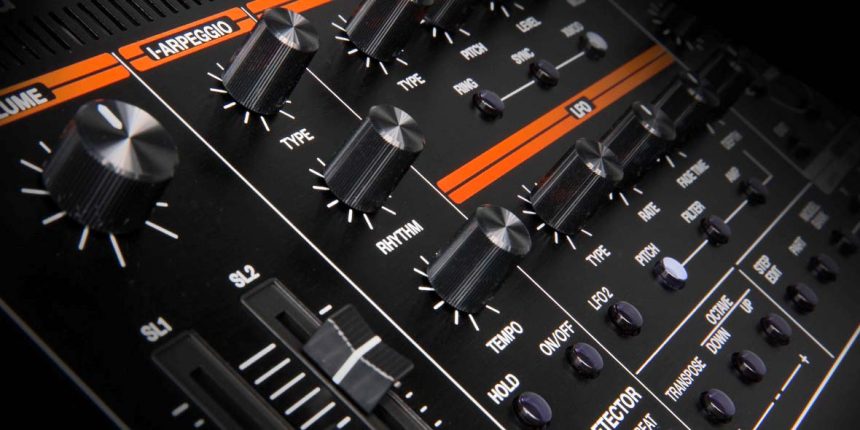
Connected via USB and used with its drivers it is seen as audio card with 5 stereo inputs (the 5 parts of the synth) and a input total synth output (mix). There is also a named arpeggiator i-arpeggio, the result of years of study and work by Roland engineers.
The arpeggiator in addition to working in normal mode it can exploit a kind of artificial intelligence to change its performance according to the style and notes you play. I won't go into the maze of i-arpeggio also because a separate article would be needed.

Roland has released a firmware update that adds step sequencer functions to the arpeggiator. On the upper level is the Scene, the final container for the configurations of the 5 parts, patches, splits, levels, master effects and some small master keyboard functions such as sending different program changes for each of the 5 parts. Let's not forget that the older brother Jupiter it has the same firmware as the little one Xm and that the master keyboard possibilities on a 5 octave synt could be really useful.
The sound
The synth sounds very organic and present, the simulated analog models are correct. The simulation really goes further, in the synth there is a thermometer, the temperature reading can be used to determine the pitch of the emulated models which also have a parameter available that determines their aging. No small feat to make analog models sound good without flooding them with effects. The piano sounds of the RD Piano models are very good but to better appreciate them you need to use a keyboard with more octaves, perhaps weighted and external. I compared some waveforms of the XV model with the identical ones of the JD-XA, the difference is not as abysmal as I thought at the beginning (the Roland JD-XA is still a synth that at the time was sold for 1.700 euros); luckily the Jupiter has less aliasing high octaves and sounds with more dynamics.
The construction
The materials used and the assembly are very good, the encoders and potentiometers are solid well positioned, to the touch they give a feeling of using a much more expensive instrument: obviously there are only those used more frequently, a problem that is felt above all in programming model bank XV which has 260 parameters per tone. In this case there is no panel that holds up, not even that of the older brother Jupiter X which still offers greater programming speed. The top is all metal and incorporates 2-way stereo speakers which, along with the ability to power it via batteries, can come in handy in "flying" situations.
The keyboard has a reduced pitch but manages to have its own dignity without giving a feeling of plasticity, unfortunately theAfter Touch it is reserved only for the older brother. Mod Wheels and Pitch Bend are a bit tiny, I would have preferred the classic Roland sticks (the only one that allows me to do the famous bending of "Save a Prayer." properly.) The synth sends and receives via MIDI over Bluetooth

Regarding the future of the “Zen Core” system, Roland will periodically update all the firmware of the latest Synth / Drum Machine models. There is talk of a complete compatibility and interchangeability of sounds between devices that use the ZEN Core Synthesis System so for now: Fantom, Jupiter X and Xm, MC-707 and MC 101. We are talking about synth sounds that do not use the samples contained in the SRX expansions that only Fantom can load and that are not emulations of analog models.
Final Conclusions
What to say, it is one of the few synths that I can recommend to everyone, very useful live where you need a lot of quality sounds concentrated in a single machine, it can be easily transported and therefore wherever you go you will have a Swiss army knife you can count on for have a very wide choice of sound. Also great for learning (of course you need a certain budget) to study the architectures of several historical roland synths. Of course, if you have roadies that can mount and transport a 5 or 6 keyboard setup every time, then it's another matter, being surrounded by Rick Wakeman synths always has a certain effect….
Pro?
I have never seen such a concentration of sounds in such a small space (for example the Roland Integra 7 has a lot of them but has no keyboard and controls on the panel)
Battery operation in addition to the sound card function can be very useful in conjunction with a laptop to set up an easily transportable production station.
The sound convinces, it is by no means still or cold, it seems to really listen to something much more expensive.
Versus?
I would have liked a better organization of the menus, for the analog model banks everything goes smoothly but in the emulation of the XV the parameters available are 262 (yes I counted them) and keeping them at bay is not very fast, especially if you want to. editing the sound in great detail: would a larger display help?
The search for the various waveforms (again as regards the XV emulation) is quite slow, they are contained in 5 banks and in an order that I honestly cannot understand, there are more than 2.100 and a nice search database by type would have facilitated the selection.
Robert Honey
I thank the Cav. Music House Quinto Fabio (SA), for giving me the opportunity to use the Jupiter X and Xm, for as long as necessary to be able to perform a thorough test of the product.