

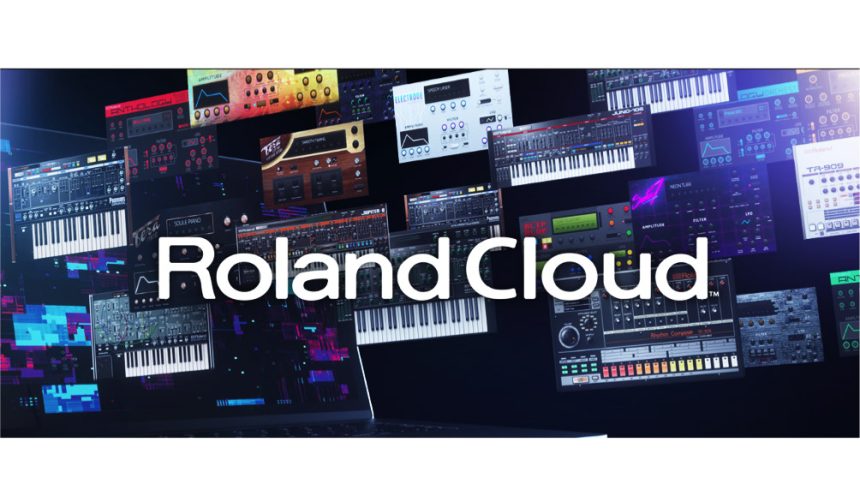
Few remember that Roland has been in the music computing industry for years now. In the 90s EDIROL was born, which since 1997 has dedicated itself not only to Midi files (at the time it was the most important brand), also to the IT sector and in 2009 it was incorporated into the ROLAND brand.
Let's not forget that for a period Roland she was the owner and developer of the well-known DAW SONAR. Consequently it is not surprising that Roland was the first of the three major Japanese brands (Yamaha, Korg and indeed Roland) to arrive at Cloud, although it must be said that all three houses have dedicated themselves, in their own way, to the world of information technology.
Korg she was perhaps the first to understand the importance of plug-ins, creating the famous package LEGACY, containing the most famous synths in the history of Korg.
yamaha, as always, it aimed at the top of the range, acquiring STEINBERG.
Roland, with the annexation of EDIROL, he started producing some software VSTi For example, Orchestral or the legendary Sound Canvas.
Later they were born AIR, Plug-Outs (i.e. the ability to load native plug-ins on some synthesizers) and finally the CLOUD.
What is the Roland Cloud?
In a nutshell, it can be said that it is a subscription that allows access to a whole series of software, in part you can buy it, in part not (access only through the Cloud).
How much? 19,95 € per month, or 207 euros per year.
Before saying “It's expensive!”, It should be noted that this subscription allows you to have access to all the tools in the catalog today and also in the future; for example, early this fall it was possible to have the JX-3P. In addition, every 12 months of subscription (not necessarily consecutive) Roland gives away a plug-in of our choice, with unlimited access over time.
Does purchasing hardware guarantee this flexibility?
Simply put, with the purchase price of a top-of-the-range workstation you are guaranteed a subscription to the Cloud for 14 years, and in the end you have 14 plug-ins in your pocket.
And the workstation purchased, after 14 years, what happens to it?
We're still a long way from replacing dedicated hardware with a laptop or tablet, but that's the way it looks.
Warning: I'm not saying that software is "life", but only that the future seems to be heading in that direction.
Returning to Roland Cloud, what do we have access to?
First of all a 40 virtual synthesizers of the highest range, divided into 6 categories, plus a software dedicated to editing: the famous R-Mix.
As I said synthesizers are categorized into 6 different categories.
AIR
This category contains the VSTi versions of the synthesizers SYSTEM 1 e SYSTEM 8.
Virtually identical to their Hardware brothers, they use the same technology Analog Behavior Circuit. They can be loaded into the latter as a Plug-Out.
This kind of technology exploits the physical modeling synthesis applied to circuits (for further information I should write another article): practically inside them we do not find a simple LPF circuit, but the LPF of the Jupiter 8, the Juno 106 and the V-Synth .
In a nutshell, physical modeling calculates the reaction under certain variants (temperature, electricity, physical defects, etc.) of the components with which the best known synths have been built. This explains why System 1 and 8 represent a huge step forward in the history of sound synthesis.

LEGENDARY
This category needs no explanation, the list of machines alone is already exhaustive:
* JX-3P
*TR-808
*TR-909
* JV1080
* SRX SERIES
* D-50
* JUPITER-8
* JUNO-106
* SRX-ORCHESTRA
* SH-101
* SYSTEM-100
* PROMARS
* SH-2
* SOUND CANVAS.
Returning to what has been said about the accesses and the price, my subscription is starting from August and the JX-3P was added immediately in the autumn; What if in the future I find the JD800, or maybe the JX-8P, or the V-SYNTH?
TERA
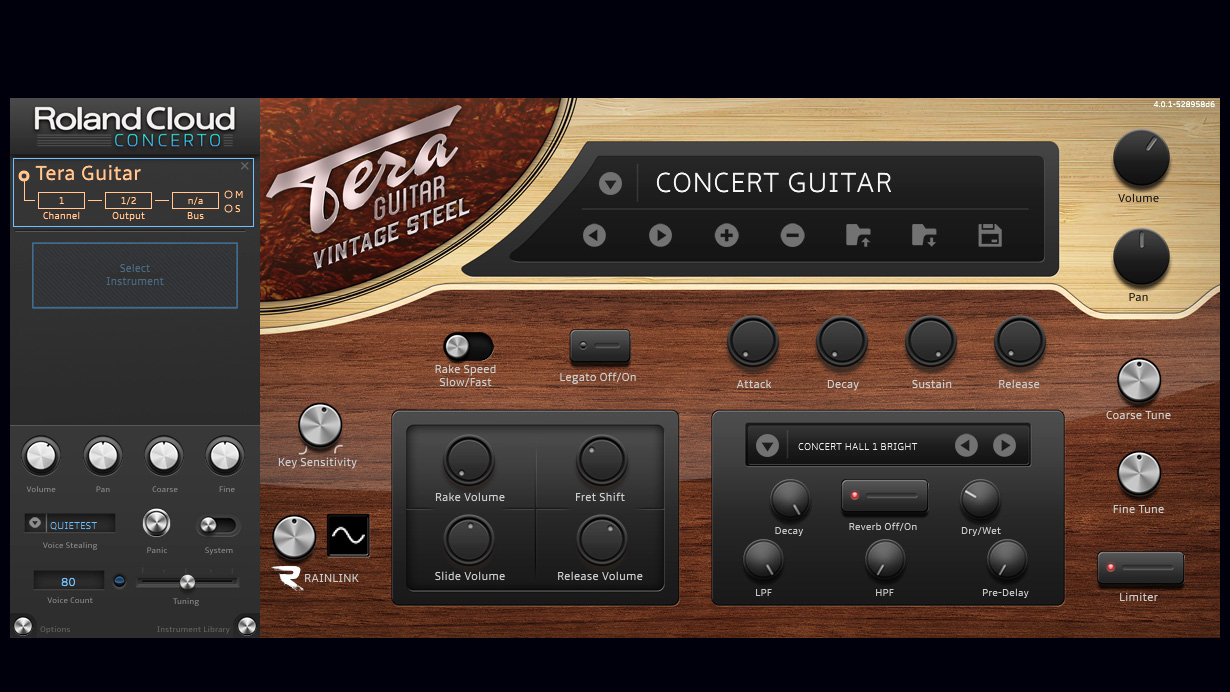
It contains, to date, two high-end Virtual Instruments dedicated to acoustic guitar and acoustic piano.
I have to be honest: of all the virtual machines that are inside the ROLAND CLOUD, these two are the ones that have satisfied me least, I still have not understood if it is for the quality or because the approach was not the best. However, it must be said that the competition in this field is very fierce, and TERA Instruments cannot yet consider themselves up to par.
But since I might be wrong, I'd be happy to know what you think.
In the meantime, I will deepen their knowledge and if anything I will write a new article dedicated only to TERA Instruments.
ANTHOLOGY
Here they are 7 libraries divided into 11 volumes, dedicated to very specific historical periods ranging from '85 al '93: the golden age of sound synthesis!
To this is added a bookcase dedicated to the electric piano, very light and stable, and one dedicated to the orchestral sections in 4 volumes.
Whatever the sound we need, ANTHOLOGY provide the most famous sounds of the XNUMXs and XNUMXs, cataloged by decade, including those of Duran Duran in “Save a prayer” and those of PROPAGANDA: here you can find them all.
However, these are not closed libraries and ends in themselves, because each library allows access to the simplest forms of programming, such as, for example, cutoff, resonance and ADSR.

FLAVR extension
Reduction of flavor (flavor, scent, fragrance), FLAVR contains 8 synthesizers dedicated to as many different genres:
* Trapped: Synth dedicated to TRAP;
* SUGAR: Synth dedicated to TROPICAL;
* RESIN: Dedicated to HIP HOP and NEO SOUL;
* GRIT: Dedicated to TRANCE and Dance in general;
* SECTOR-7: Dedicated to the RETRO WAVE;
* FUNKY FEVER: Dedicated to FUNKY and DISCO;
* BLIP BLOP: Dedicated to RETRO GAMING;
* ELECTRODE: Dedicated to the ELECTRO HOUSE.
To all this we must add the R-MIX software, released on the market about nine years ago, which allows you to review the mixes managing to isolate (roughly) the instruments contained within it (a sort of AUDIOSCULPT Lite version).
However, this software is only available on the WINDOWS platform.
PROJECTED IMPACT
Is it worth it?
In my opinion, yes!
The Cloud allows you to have access to a series of software that would otherwise be prohibitively expensive, considering that, by making two calculations, if Roland were to sell all the software in the Cloud, the required amount would be around 4.000-5.000 euros.
In addition, the subscription gives, every 12 paid months (not necessarily consecutive), a plug-in of your choice that will become yours for life, regardless of whether you want to renew the subscription or not.
DOES ROLAND CLOUD ALLOW US TO REPLACE HARDWARE?
NO!
The future is certainly turned towards virtual synthesis, which will not be used either via laptop, but via Tablet (have you seen what an iPad Pro 2018 does?) And this implies that workstations are destined to die.
In the past, a M1 of Korg for the following reasons:
• It contained in a single machine 4 essential machines for home Recording (synths, sequencers, drum-machines, effects units);
• Gave us access to sampled sounds at an affordable price,
• There was no internet,
• Personal Computers were still in their infancy and mainframes were exorbitantly priced.
Today what is the point of having a sequencer, 32 midi tracks inside a machine, when one DAW free provides unlimited tracks?
With synthesis it is a bit different.
Let's not talk about real analogs, which are a bit like acoustic instruments, they can never be replaced, simply because there are too many variants involved (place, temperature, duration of the materials, humidity, voltage stability, etc.).
As for digital synths, many insert a plug-in into hardware and sell it for the price of hardware.
To date, the “iteration” aspect with the instrument is missing, nothing that with a good master keyboard or a good controller cannot be done, even if this means programming and not everyone likes it.
My "NI" therefore depends on the fact that you have to get busy with programming and the day this activity will be easier to perform, the transition will be assured.
THE FUTURE OF ROLAND CLOUD
Surely the most attractive part is the continuous updating of the software.
Aside from the fact that the software is all constantly updated, Roland Cloud promises the constant addition of new tools from the past and the future!
So we expect the VSYNTH, the JD800, and, why not, also the E30, the G800, in addition to the synths of the future, which frankly I don't know where they will go.
Is it worth having the ROLAND CLOUD installed in your laptop?
Absolutely yes!
Fabio Badalamenti