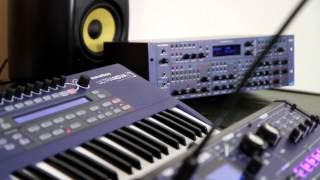


1983 was a great year for synth enthusiasts. Yamaha launches the DX-7, Roland the SH-101 and Oberheim what has become one of my favorite synths: the OB-8. Who among you has never listened to "Jump" by Van Halen? This is what we are talking about.

Oberheim:
I already know that the fussy eaters will want to point out that that mythical round of "synth brass" was done with an OBXa but, believe me, we are not far from it. Presented as a worthy successor to the OBXa, the OB-8 inherits all of its features, adding others and elevating the product to the state of the art. This caused the OB-8 to somehow obscure the shining star Prophet which for years had radiated with all its power the musical energy of the time. Tim Oberheim started his production of synthesizers as early as 1974, when he conceived expansions for the monophonic synthesizers of the time especially the MiniMoog. We are talking about the now famous SEM (Synthesizer Expander Module), conceived with the concept of supporting and enhancing the timbre of monophonic instruments already on the market. The SEM, in practice, is a synthesizer in the form of a module (therefore without keyboard) equipped with two analog oscillators, a 2-pole multimode filter, a pair of ADR envelopes (Aattack, Dhey, Release) and an LFO. Each of the two oscillators provides a triangular or rectangular waveform. Unlike the synths in vogue at the time, equipped with 4-pole filters (24dB / Octave), the SEM provided a filter with a "thinner" tone considering the slope of only 12dB per octave but, here's the beauty, it offered many others filter types in addition to the classic Lowpass including a HighPass, a BandPass and a BandReject (Notch). Oberheim's great leap into the synthesizer market occurred by coupling several SEMs together with a keyboard as well as an analog sequencer and thus providing portable and very versatile polyphonic instruments. The release, in 1975, of Two-Voice marks a significant step forward from the emperors of the time such as Moog and ARP. In fact, none of them had yet presented an instrument on the market that was not monophonic. Could they ever be satisfied with this? Of course not! In fact, in the same year the Four-Voice was presented, an even more powerful version equipped with four SEM modules (2 oscillators per module = 8 oscillators !!!), a simple analog mixer and (from '76) a capable Polyphonic Synthesizer Programmer to store 16 patches for a single voice. This type of synthesizer had, as a “cons”, the programming obstacle considering that each module was independent and therefore everything had to be programmed as if you were dealing with several synthesizers side by side. Unfortunately, this product was eclipsed by the Sequential Circuits Prophet 5 which provided true polyphony, a unique control interface, and good memory capacity. The latest product in this series was the Eight-Voice, a mammoth beast of 16 oscillators, 8 filters, 16 envelopes and more. The unchallenged rise of the competition led Oberheim towards the production of synthesizers with a truly polyphonic circuitry and thus inaugurating the legendary OB series. The first of the series was the OB-X, with the peculiarity of being available in 4, 6 or 8 voice format. Equipped with a 2-pole Lowpass filter with a dedicated envelope generator, a VCA with ADSR envelope generator and an LFO it stood up to the Prophet 5 both in terms of sound quality and price, much more competitive. It also has a "special" function called Polymod (a sort of frequency modulation) absent in future synthesizers of the series. It should be noted that the filter of this instrument is designed using totally discrete components, similarly to Moog. There are no integrated circuits but only resistors, capacitors and so on. This makes it much warmer than similar filters but with integrated components. It is for this reason that vintage experts dare to put the OB-X on the same level as the MemoryMoog. Continuing with our story, the need to propose a volumetrically smaller, lighter and more resistant system for live performances led the house to develop a new version of their firstborn: the OB-SX. This version is quite similar, if not identical, to the OB-X but with the sacrifice of an octave of the keyboard (reduced to 48 notes); most of the knobs to control each parameter and the ability to save your own sounds. In fact, this machine has only presets. Also of this synthesizer there are various revisions whose changes concern only the aesthetic side and the quantity of presets available. Of note is the digital technology with which Oberheim equipped these synthesizers. Considering that this is a “pre-MIDI” period, the possibility of being able to replace the presets of the OB-SX with sounds saved on the OB-X cassette was a great added value. The beauty of this company is that it has never sat on its laurels and has continued to churn out great and increasingly advanced products. The natural evolution of the prodigal son bears the name of OB-Xa. This spaceship has sonic characteristics comparable to the enemy of all time, the Prophet 5, but with the difference that the available versions reached up to 8 voices with the possibility of splits, multitimbrality and saving of these parameters (from 32 for the first models up to 120 for the most "recent"). The great novelty, introduced with this model, is the presence of the Curtis chips (the infamous CEMs, highly sought after by vintage lovers today) which have given greater stability to the circuitry and that typical tone of the Oberheim filters now much sought after. The filter is the strong point of this model, available in fact in 4-pole version with selectable slope at 12dB or 24dB. The possibility of being able to “split” the keyboard, made the OB-Xa a synthesizer capable of playing two different programs with 4 voices per section while, the layer mode, allowed the synth to be able to play two programs overlapped simultaneously. Finished? Absolutely not! The perfect condiment for the recipe of a great success is given by the addition of portamento, unison, sample and hold, chord memory and three LFOs. It is almost impossible to think that, with a similar instrument, Oberheim could have made an "encore". This flagship has everything a musician of the time could want and yet the parent company was not watching their brand become more and more prestigious. The icing on the cake was missing.
The arrival of the OB-8:
The latest addition to this successful series was the OB-8. This synthesizer, with a warm tone that is both bright and rich, has 8-voice polyphony and the classic Oberheim character. Being born in the "pre MIDI" era, this synth also has no protocol implementation, although some models were later equipped with "retrofits" (added circuits not originally designed for that machine) that implemented 9 MIDI channels. As previously mentioned, Oberheim developed its own digital communication system and the OB-8, as designed, could become the control center of a "mini studio" if connected to other modules produced by the parent company (a sequencer polyphonic and a drum machine). The features are very similar to the OB-Xa with the difference that this model is only available in 8 voices. The filter is the same, with CEM chip and the possibility to choose between 12dB and 24dB. Among the most important additions there is the possibility of putting the oscillators in sync (another function already present in the Prophet 5 and with a very acid character), the presence of an 8-note arpeggiator with external synchronization and a whole set of new parameters available by pressing the “Page 2” button on the front panel. The memory allocation is also very respectable: 120 slots for programs, 12 for splits and 12 for doubles (multitimbral patches). No doubt about it, a true masterpiece of the 80s. I turn on the synthesizer and, after waiting a few minutes for the "warm up" (even if the oscillators are stable, I always prefer to wait a few minutes to warm up so that I can fully appreciate the power of the analog sound), I start playing a couple of factory sounds of our OB-8. Suddenly I feel like I'm rejuvenating and going back in time. I play some Van Halen riffs, I try to reprogram the legendary “sweep pad” of Tom Sawyer of Rush and it comes almost natural to look for the typical 80's sound of Depeche Mode. One of the things I love about this synthesizer is its versatility. It is capable of being both sweet, soft, warm and enveloping as well as bright, rich in harmonics and even acid using the "sync" of the oscillators. The envelopes respond in a very satisfactory way both for “long” and dissolving sounds, and for fast transients useful for percussive or hammer tones. The filter has the sound, which has become a classic, Oberheim. There is no other way to explain this timbre which, with its nuances, becomes unmistakable to the ear of the vintage enthusiast who is able to recognize it in a mix almost at first glance. In 12dB mode, the sound is richer in high harmonics and is airy. The “resonance” manages to excellently emphasize the filter cutoff, giving the timbre further character. In 24dB mode (4 poles, similar to what we find on the MiniMoog) we get darker and more full-bodied tones, very useful for enveloping sounds of pads, drones, "anti-wall-bearing" basses and anything else we could wish to have a good push in the low end. That's it? Of course not! The high engineering of the OB-8 gives us the ability to surgically control many aspects of the sound we want to develop. We are therefore able to independently tune all the voices of the synthesizer and even to be able to set them in Unison. This function, for the uninitiated, allows you to assign multiple voices to a single note in order to create much fatter timbres. A little help? You know those very “FAT” basses and leads that products like the Roland JP-8080 or the Access Virus (SuperSaw, HyperSaw and so on) boast so much? They are nothing more than the "software" versions of what, on the old analogs, is called Unison. In modern Virtual Analog synthesizers, this function can be polyphonicized so as to assign multiple voices to a single note but, at the same time, have enough polyphony to be able to play complex parts. The greater the distance between the individual voices, the more drastic the effect will be. We will go from a light “flanging” to a sound that is totally discontinuous in phase and, when appropriately processed, with a timbre that I would dare to define as “liquid”.
A matter of control:
One of the greatest strengths of the OB-8, in my opinion, is its great versatility in editing and controlling modulations. From the spacious front panel of the synthesizer it is possible to operate a second page of controls which, in the first runs of the instrument, lie hidden and can be activated via a combination of keys. The lucky owners of more recent revisions, however, will find the word “Page 2” directly on the panel. In short, by activating this page, the knobs and buttons will be able to control other parameters that were previously not accessible. For example, the control labeled “LOUDNESS ENVELOPE RELEASE” will become the control for the “SUSTAIN PEDAL RELEASE”, as per the manual. Once you have gained access, you will have a number of parameters at your disposal, including some very advanced ones considering the synthesizer's development era. Functions such as LFO phase control and quantization; select the waveform that will act as trigger and which point of the waveform will retrigger (ie it will start the selected waveform from zero); always envelopes for LFOs; various modes of portamento and other very useful parameters. Let's now move on to the Modulation Panel, which is a section totally dedicated to real-time controls for sound modulations. Nowadays, on the vast majority of synthesizers, we always find the usual couple "pitch bend" and "modulation wheel" while, on our good old OB-8, we have a small button room very useful for our live performances . Two transpose buttons allow you to shift the entire range of the keyboard by one octave above or below normal pitch. The MODE button allows you to select whether some controls will be used by the arpeggiator or not. This is because the MODULATION / PITCH BEND section and the arpeggiator share the same physical controls in the Modulation Panel. The nice thing is that, even with the button activated, the two central levers will continue to work as usual and all that will change will only be the parameters controlled by the buttons on the panel. Excellent choice of being able to select the wave form intended for vibrato, controllable by the modulation lever, or the possibility of performing the "pitch bend" only on an oscillator. Being the second, an oscillator, it becomes clear what timbral changes we could obtain by putting the two oscillators in “sync”. Still regarding the “pitch bend”, the way to set the depth of the control is brilliant: holding down the AMOUNT button and then playing any key on the keyboard. The interval between the lowest C and the note pressed will be the actual applicable “pitch bending” interval. As icing on the cake we find the arpeggiator and chord memory. The first is equipped with the programming of transpositions, so that you can play octave intervals between the arpeggiated notes. The latter, on the other hand, allows us to “memorize” a chord that can be played with a single note. The very useful “Chord Hold” command also allows us to hold the chord even once the key has been released. A really useful function for giving harmonic support to our solos.
Conclusions:
Here we are, at the end of our journey. We tested one of the largest and most historic synthesizers ever produced and which, inexorably, marked an important period in the international music scene. A cutting-edge machine even if, unfortunately, not free from some small defects. Just to name one, the oscillators do not have a dedicated volume control and, therefore, it is not possible to mix them as we are usually used with other machines; the lack of control for the "Pulse Width”Dedicated for each oscillator makes the calibration of this parameter a bit difficult. This, frankly, I find a rather "serious" shortcoming considering the excellent engineering of the product and its price range for the time. Fortunately, these small shortcomings tend to vanish, in our eyes, as soon as our fingers start playing this instrument.
Article published in CM2 Magazine. Thanks to Mr. Luke Capozzi for having collaborated in the drafting of the article.