

Frame drums is a collection of 4 percussion instruments belonging to the popular tradition.
Percussion, especially in more musically contaminated areas, adds color to songs and enriches musical works with often exotic-sounding rhythmic accents. It represents an element in the mix that can truly make the difference. Let's take a closer look at how it works.
It is a library for Kontakt which includes the following contents and features:
19 Kontakt tools (.nki)
- More than 8 Round Robin configurations per sample
- More than 3 Velocity layers per sample
160 total samples, recorded with 24bit / 48KHz sampling depth
- Samples available in formats Contact e WAV
The library has an overall extension of 178 MB unzippati and is available for digital download on the site www.audiothing.net or also on the Kontakt library hub (www.kontakthub.com), at the price of 20 euros.

Audio Thing is an Irish audio software company, focused on VST plugins e Sample Libraries. It was founded in 2011 by the composer, sound designer and programmer Charles Castellano, which, for the production of its software, avails itself of the collaboration of some freelancers for sound and graphic design and in the field of Digital Signal Processing.
frame drums it is placed in the rich sector of libraries dedicated to percussive instruments. It presents the sampling of 2 Bodhran and 2 Tambourines, so we are talking about two of the main drums that can be counted in the broad instrumental category of frame drums (frame drums in English, hence the title of Audiothing's work).
These are instruments of very ancient origin built with a curved wooden frame (originally by steam), with or without rattles, on which a different animal skin is mounted depending on the type of percussion. There is iconographic material that dates back more than 6000 years which depicts performers intent on playing this type of instruments, especially during religious ceremonies or rituals. For example, it may be interesting to know that from some ethnographic studies it would have emerged that the first player of a frame drum was a woman named Lipushiau, grandson of a Sumerian king in Mesopotamia. She lived in the city of Ur 5000 years ago and apparently played to perform healing rituals in the temple dedicated to the Moon.
As for the drums sampled here, as anticipated, we have a couple of tambourines and a couple of Bodhran at our disposal. The tambourines have been widespread since time immemorial in all ancient civilizations, from the Jews to the Egyptians, from the Sumerians to the Hittites. They developed particularly in Mediterranean Europe. Famous are those used in the repertoires of the tarantella of southern Italy. We are therefore in full popular reign, even if the so-called modern technique has for some years emancipated the tambourine from the exclusively traditional dimension in which it originates, exponentially expanding its uses and playing techniques in other musical contexts, such as Rock, Jazz, Swing, Ethno world, rhythmic improvisation, experimentation, etc…, in some cases bringing the sounds of the instrument closer to those produced by a classic drums.
The Bodhran is a more recent frame drum (the first traces of its existence date back to the end of 1600). It is an Irish and Celtic descendant of the tambourine and, since its appearance, has gradually supplanted its ancestor in the rhythmic accompaniment of jigs and reels. This type of drum typically mounts a goat skin and is often played using the tipper, a turned wooden stick rounded at the ends, but it can also be played directly using the hand. The name of the instrument would derive from the Gaelic word Bodhor, which means “with a soft or dull sound”, thus recalling the typical timbre of this type of drum, depending on the tuning of the skin.

But now rest assured, the lesson is over ... let's set fire to the powders and see how this library behaves.
TECHNICAL-STYLISTIC ANALYSIS OF THE CONTENTS
We come immediately to the beating heart of the library. Frame Drums features 19 Kontakt instruments. Let's see them in their salient features.
All the instruments have a practical and equipped interface that includes a control section equipped with four modules:
Envelope, through which you can adjust the attack, decay and release values of the sound
Reverb, equipped with seven different environments and Size and Wet (Amount) controls
Equalizer, with an equalizer a 4 band (Low, Mid Low, Mid High, High)
- An RR button which, where available, enables or disables the repetitions of the Round Robin alternation algorithm
Il Bodhran Big championship is an 18 inch drum. It is available in the following articulations:
- Bodhran Big. Hand Mute. Closed sound. It reproduces the sound obtained by playing the Bodhran with the open hand hitting it in the central part and leaving the hand in contact with the skin thus avoiding making it vibrate. The result is a sharp and defined blow. It can also be carried on the edge for an even more closed sound. The sound of the samples of this .nki they are really convincing, dry but at the same time not without good colorings.
- Bodhran Big. Hand Slide Loop. The hand is gently passed over the skin to produce a slight rustle. Using the default settings, the samples sound rather unreliable. Too much background hum. However, it is possible to greatly improve the articulation by acting on the attack and release controls and on the equalizer. You will get a decent sound.
- Bodhran Big. Hand Slide. You can make a copy-paste of the comment just explained, except that in this tool the samples are not looped as above.
- Bodhran Big. Hand Slow. This tool impressed me a lot. It practically manages to get real soundscapes out of a drum, if not almost drones if we increase the Low values of the equalizer! It is really a nice surprise. It doesn't have much to do with a Bodhran acoustically, but it adds a truly unexpected tone to the library.
- Bodhran Big. Hand. Open sound. The blow is still carried with the hand, but here letting the skin vibrate. The samples sound clean, clear and definitely realistic. Even changing the Room in which they are virtually played, the result is always excellent and full of resonance.
- Bodhran Big. Mallet ring. Here we pass to the instruments obtained by sampling the bodhran with the typical wooden stick. In this case the blow is carried with the stick on the frame. The samples sound very good if you stay in the low and medium low sound register of the keyboard of the Kontakt instrument. Here it seems to hit wood with wood. Seeing is believing. In the medium and high registers of the keyboard, however, the result is much less exciting.
- Bodhran Big. Mallet Slow. The sounds are very similar to those of the homologous instrument played with an open hand. The same enriched tonal potential, therefore, even if honestly it seems a bit of a duplicate to me.
- Bodhran Big. Mallet. Open sound obtained by carrying the hit through the tipper. This is perhaps the most common playing technique for playing the bodhran and the sampled samples for this instrument are very good. Especially in the lower registers it seems that there is someone in the room who is physically playing!
The next 5 instruments dedicated to Bodhran, they sample a smaller drum, but the articulations and stylistic techniques performed are the same as those already seen for the older brother (Hand Slow, Hand, Mallet Ring, Mallet Slow, Mallet). Clearly, as this Bodhran is smaller, the sounds produced are placed in a higher frequency spectrum. It is excellent in a mix to couple simultaneous performances of both Bodhran, thus obtaining a complete percussive session.
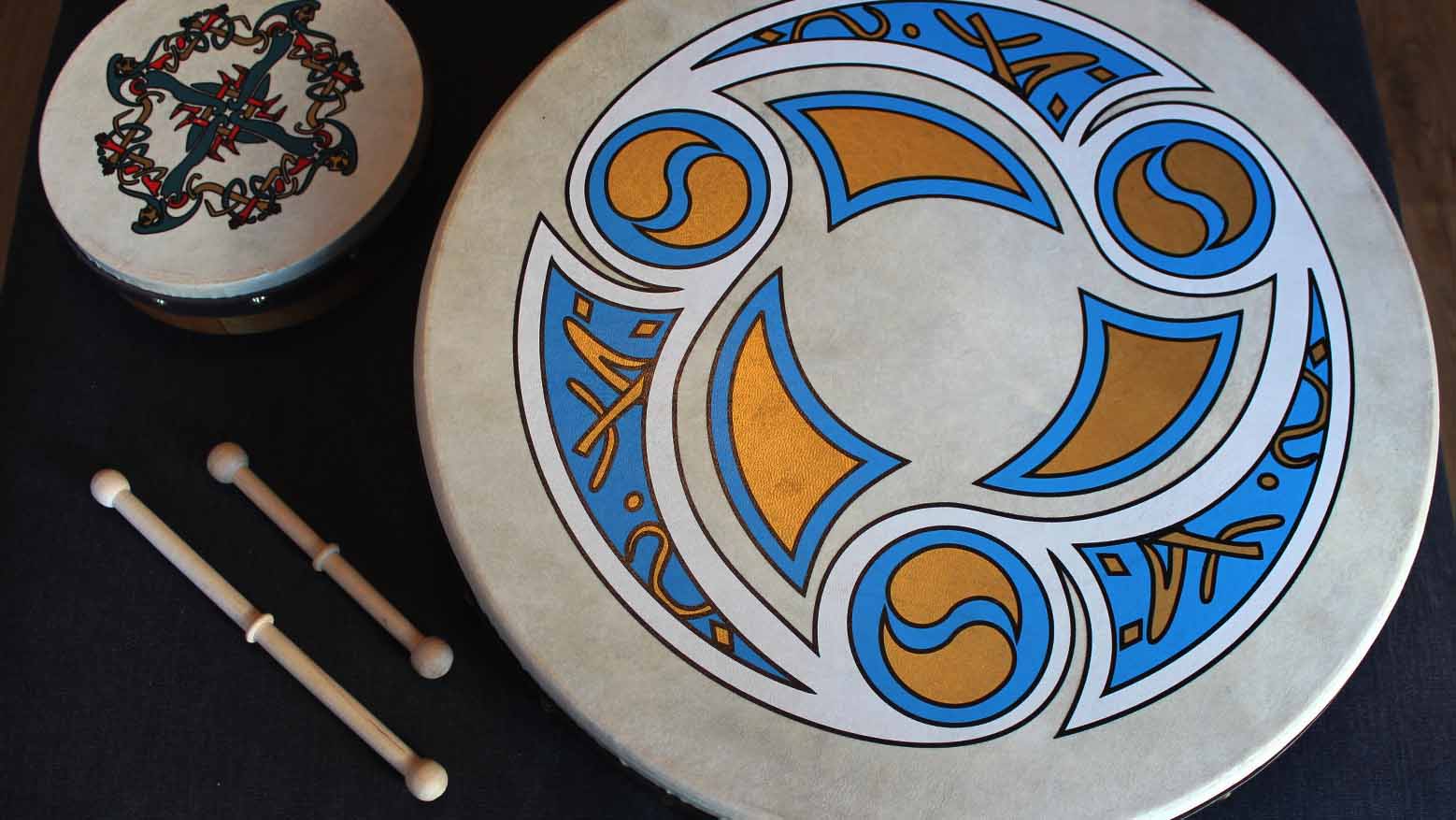
The remaining ones 6 Contact Instruments of the library are dedicated to the tambourine. Respectively, 3 tools for the Big Tambourine (measure of 8 inches) and 3 tools for the Tambourine Small.
Of course we also see these:
- Tambourine Big. gestures. The sound of the rattles is reproduced through the execution of three specific gestures of movement. By boosting the high frequencies of the equalizer a little and increasing the amount of the reverb, you get an extremely crystal clear sound rich in harmonics. Too bad there are only these three gestures.
- Tambourine Big. Hand. Open sound. The blow is carried with the hand to the center of the skin. There are only eight samples available, but thanks to the Round Robins and multiple Velocity Layers, you get a well-matched range of tones and shades. Just a tip: give a little boost to the low and medium low otherwise the rattling of the rattles risks covering a lot of the blows brought to the skin.
- Tambourine Big. Mallet. The blow is this time carried on the tambourine through a stick. It is not a very usual playing technique for the tambourine, but this experiment produces clear and pervasive sounding samples. By playing this instrument it will not be necessary to make corrections in the equalization phase: the sounds are already well distributed and both the hits and the rattles cut out their space well in the mix.
- Tambourine Small. gestures. The rattles are smaller and less resonant, but the articulation is very similar to that of the first instrument dedicated to the tambourine. Unlike here we have even fewer gestures available. Only 2.
- Tambourine Small. Hand. Homologous instrument of the major version, here declined on the smaller tambourine. To be honest, however, I don't notice substantial tonal differences. Same strengths and weaknesses of the Tambourine Big in the Hand joint.
- Tambourine Small. Mallet. Here, however, compared to the Big version, there are several different colorings in the sound of the smaller tambourine. And they are very convincing and ready to stand out nicely in the mix. Perhaps, however, since there is no Ring articulation instrument dedicated to the tambourine, here it would have been possible to insert at least a few samples in that configuration.

This is essentially the complete review of the contents that Frame Drums offers us when used in the Kontakt environment. There are then, as anticipated, 160 samples available in WAV. The samples are recorded with a good sampling depth and in fact sound clean and realistic, especially thanks to the numerous articulations.
Bodhràn are available in samples divided into Big Hand, Big Hand Mute, Big Hand Slide, Big Hand Slide Loop, Big Mallet, Big Mallet Mute, Small Hand, Small Hand Mute, Small Mallet, Small Mallet Mute, all with various configurations Round Robin (up to 8).
In the tambourine field we have: Big Gesture A, Big Gesture B, Big Gesture C, Big Hand, Big Hand Mute, Big Mallet, Big Mallet Mute, Small Hand, Small Hand Mute, Small Mallet and Small Mallet Mute.
RECOMMENDED USES AND POTENTIAL DESTINATIONS
Frame Drums is a frame drum library. It will certainly be suitable for compositions that are part of the popular tradition, be it of Celtic matrix, where the Bodhran will be the masters, or of Mediterranean extraction, where the tambourine occupies a prominent place in the rhythmic structures of tarantella e tammurriate. Having said this trivially, the library then lends itself to characterize the accompaniment of many other musical genres. The presence of various articulations, some of which are decidedly experimental, guarantees the possibility of use even in more varied sound territories; can help to create a good rhythmic carpet for productions intended for film or game scoring or, why not, also to be used in purely live sessions to enrich rock, pop and orchestral songs with ethnic accents and colors.
In the small audio demos regarding the review of this library that you can find on the Soundcloud of Age Of Audio, you will get a taste of the versatility of this title.
PROJECTED IMPACT
Frame Drums is certainly not a monumental library. The sampled instruments are only two in a panorama, that of the frame drums, which includes an infinity of instruments. Just to name a few of the best known: Tambourine (Spain), Daf (Iran) e kanjira (India). However, at relatively low cost, much more could not be expected, and it must be said that on the tools they focused on, the Audiothing team did a rather convincing job overall. Buy a few packs of cigarettes cheaper and if you have 20 euros left over, I recommend it.
ADVANTAGES
- Various articulations of Round Robin and Velocity Layers that make the sounds very realistic and avoid the annoying "machine gun effect"
- Very nice and complete controls and effects compartment of the .nki interface
- Excellent value for money
DEFECTS
- Bodhran Hand Slide Loop articulation with really too much background noise
- Some instruments are practically the duplication of others
- Very few articulations of gestures available for the Tambourine
https://soundcloud.com/ageofaudio/frame-drums-audiothing-bodhrans-audio-demo
https://soundcloud.com/ageofaudio/frame-drums-audiothing-tambourines-audio-demo
Peter Fraccavento