
Most of the software and sound libraries end up wandering aimlessly in the limbo of the internet, in fact very few are the elect who manage to earn a place in the Olympus of the great majors. This is the first of a long series of articles, where the undersigned, helped by recommendations from friends and users, will try to sift through all the "circles" of the internet, even the deepest and most remote ones.

It will be my intent to make known, and perhaps appreciate, all those masterpieces that, unfortunately, died before finding an adequate diffusion, perhaps because they were not supported by an effective advertising push or only because they were conceived by too ambitious and not very functional projects. Journey to the underworld In the limbo I was talking about I had already met in the past MrRay e ORGANized trio, two products that, although born quietly, then met with some success with the public, so much so that they were implemented for free in the new keyboards Lionstracs and in the new masters behringer. I wanted to dedicate this first appointment, and I hope it will be a long series of these, to a very particular niche library, whose sound seems truly forged in the lower areas of Hell (IX Circle of the underworld). We are talking about Get Distorted! Do not go through this library you pure of ears!
Get Distorted:

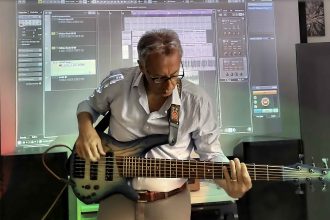
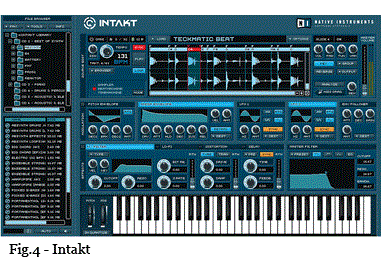
This is a new "compact" library dedicated to distorted guitars and "powerchords", the author is the German guitarist Alex Pfeffer (Fig.1). The library, in Kontakt and Gigastudio 3 format, amounts to about 250 Megabytes, and is available, for those wishing to make it their own, at the website http://store.cellarroom.de/ (Fig.2) with the possibility of immediate download. The Kontakt format allows the use of all those "features" necessary for the realization of a realistic "performance", just think for example of the concept of "round robin". It is a rather "light" product and can therefore be integrated into any "templates" already overloaded with tools. The "pay, download and use immediately" mode is now proposing itself as the new standard for the use of audio / sampling products, thanks to the new ADSL technologies with which it is possible to download several gigabytes in a reasonable time, eliminate shipping costs and " bypassing ”the frequent malfunctions of traditional delivery systems. To frame the product, just think that the Pfeiffer library allows to obtain that “wall of sound” frequently used both in modern rock / metal music and in electronic and so-called “hybrid” music. Yes, because today it is somewhat limiting to associate this type of sound exclusively with “school” genres (Hard rock, heavy metal, nu-metal…). Just think of how film and television soundtrack composers are able to mix orchestra, analog synthesis and “hard” sounds in a single product, with often very pleasant results. To get an idea I would recommend listening to composers such as Marco Beltrami (Fig.3) (Io Robot, Underworld, Resident evil) or Graeme Revell (Il Corvo, Daredevil). I take this opportunity to report a gem: Marco Beltrami offers on his website www.marcobeltrami.com numerous scores of his soundtracks to download for free in PDF format. A nice (and rare) gesture and an opportunity to acquire some tricks of the trade of an appreciated composer. Get Distorted is divided into two parts: the actual library and two sections of “licks” for an “on the fly” use of effect phrases (according to Alex, the licks will soon be increased). The "sustained" articulation provides three orders of sounds that can be activated using the "velocity: with a soft touch (0-43) you get a" slide "down to the pressed key, at intermediate velocity values (44-84) you get the real powerchord, finally with a stronger pressure (85-127) you get a slide, this time upwards. By using the three articulations, it is possible to obtain legate effects within a “performance”, simulating the passage from chord to chord. For each note there is a “round robin”, ie the automatic activation of two different recordings that alternate when a note is repeated, this technique is very useful to avoid the unpleasant “machine gun” effect. The “detached” joint is available in the double “open” and “blocked” modes. Any Nu-metal enthusiast or any genre characterized by "heavy" sounds (with possible mixes of electronics), will appreciate the possibility of using the brakes on fast beats in unison on the kick drum. The double presence, then, of open and stopped powerchords, significantly improves the simulation and at the same time offers many rhythmic possibilities. In the case of the detachments, the number of round robin repetitions rises to four (therefore four versions for each single chord), ideal for "repetition" use even at sensibly fast tempos. The Fretnoise connector program is an interesting "patch" designed for the "release sample" (ie it is activated only when the key is released). The patch simulates the connection noise of two chords caused by the natural movement of the hand on the fretboard of the guitar. This, combined for example, with a “sustained” articulation, allows you to more realistically simulate the passage from one chord to another. Also in this case the "round robin" is present. At the end of the library there are the “special infects”, that is a collection of effects that can be obtained on the guitar and that do not fall into the category of played notes. We find, among many, slides, artificial harmonics, and so-called "chops" (short noises of resting the palm on the bridge). The second part of the library is made up, as I said, by the "licks" which are currently 20 and will be expanded in the coming months. Positive note is that they are also supplied in RMX and REX format for use, for example, in Stylus Rmx and Native instruments Intakt (Fig.4). Another nice feature of Get Distorted is the presence of dual programs, both for sustained and staccato patches. The purpose of this duplication lies in the possibility of recreating that typical “wall of sound” obtained in rock guitar recording. In reality it is created by recording two different guitar tracks playing in unison, to which diametrically opposite pan values are attributed, one track on the far right and one on the left. In the case of Get Distorted, this is possible thanks to the duplication of patches obtained not as a result of processing a single track but as the result of two different recordings. The effect is obtained by assigning two simultaneous channels to the midi track on which the Sustained 1 and 2 patches are positioned, for example, attributing pan values -127 and 127. The most demanding can also use two duplicated midi tracks, each of the which processed with a slight "randomizer", in order to simulate different velocity values for the two tracks. I can assure you that the final effect is very realistic. We had the opportunity to ask Alex a couple of questions about the library:
Interview:
Anthony Campeglia: Alex, what guitars and effects did you use to get the Get Distorted "wall" of sound?

AP: The guitar used for recording is a Gibson Epiphone Custom with 11-70 GHS Zakk Wylde Edition strings (Fig.5), and the sounds were obtained by processing the signal using Native instruments Guitar Rig and Steinberg Warp VST. The overall sound was achieved by mixing three different sources in mono, a somewhat lengthy and laborious process.
AC: The question is inevitable: why did you use digital processors like Guitar Rig and Warp VST (Fig.6).?
AP: For two reasons: with digital everything is more flexible and it is possible to modify the result even at a great distance from the original recording, correcting and improving the sound. Furthermore, it is currently not easy to recognize, in the modern rock scenario, where analog or digital processors have been used. Certainly there are purists of analog sound, but in my opinion the digital revolution did not represent a worsening of the quality and originality of the sounds, it simply offered a different and equally interesting alternative. My aim, in the case of the library, was not to create a guitar library in the most classic of meanings, but to obtain a dirty, bad sound, capable of making the user's tracks and arrangements really aggressive.
AC: Do the "patches" include "key-switches" to activate various playing modes and / or tone variants?
AP: No, for the moment he makes extensive use of the "round robin;" in the future there is the prospect of adding new patches that will also use the "key-switches".
AC: Are there any differences in use between the version for GigaStudio and that for Kontakt2?
AP: - No, in terms of functionality and timbre they are absolutely identical. Everyone can make full use of the library with their own "sampler".
AC: Is there the possibility of having "on demand" licks, perhaps from midifiles that the user can send?

AP: Having licks on demand would be equivalent to a normal recording session as a guitarist, which is something I usually do. But I sincerely believe that customized licks for a specific song would not be achievable with the current costs of the licks I offer. On the other hand, I could consider special requests, to be added to the list of licks already present on my site.
AC: - Don't you think your library could still be expanded and improved? Don't you think in the future to expand it with the recording of other guitars and to add a section of single notes or arpeggios?
AP:Yes, currently I have already recorded the audio material and am working on the final product. However, I don't want to declare a precise date yet, as too many companies announce products and then experience sensational delays. I prefer to surprise my consumers when I'm ready.
AC: Are you satisfied with the download system?
AP: Yes, absolutely. Even my buyers are particularly happy with it as there is no delay between the moment of purchase and the moment in which the product can be used.
AC: - Future projects? Are you planning to build new libraries or make a record?


AP: - I am currently busy working on many successful video game titles as well as "trailers". I also recently made demos for Project Sam's fantastic new percussion collection, True Strike 2 (Fig.7). I recommend everyone to try it. Conclusions Our journey into the underworld of music began, unlike Dante's itinerary, we did not pass through the gate of antinferno, also because I did not have enough pennies for the "bribe" to give to Charon (Fig.8). We have just been able to glimpse, from a great distance, what happened in limbo and then find ourselves catapulted into the most remote meanders of Hades, right here, where the sound is forged with kHz hits and where the air exudes exasperated frequencies. We feel in this place a real possibility of redemption, a necessary step for the longed-for musical paradise. In this Inferno the pattern of the circles is the opposite of Dante's: it starts from the bottom and then goes upwards, the musical Paradise, a place where every user could draw all sorts of sounds for the creation of their own works (obviously without having to deal with the CPU). Our first stage therefore concerned a rather interesting guitar library. Honestly I know this kind of music and sounds, it is not among my favorites, however I must admit that the library is well structured, characterized by extreme simplicity and remarkable effectiveness, the sound is convincing. Although the signal is processed by VSTs, and not by hardware, there is no signal loss and that classic "mosquito" sound texture typical of processing at the limit of digital saturation, indeed even on very fast and saturated transients the signal remains well balanced, this is certainly the strong point of the product… will it be due to the excellent quality of the plug-ins, or did our Alex Pfeiffer use some small tricks during the recording or mastering phase that he did not want to reveal? However, for all lovers of the genre I would recommend, at the end of the job, to get an analog reel recorder or a fairly characterizing tube compressor, in order to amalgamate these infernal sounds with the remaining tracks of the mix. The Get Distorted library is a niche product and will certainly be appreciated especially for all lovers of the electronic and hard rock genre, such as Pantera (Fig.9), an ideal purchase for those who prefer dirty and hard timbres to the limit of saturation: however, this does not exclude, as I said earlier, that a more sparing use can also give a certain originality to other musical genres. We just hope that Alex will later add a section of single notes and arpeggios to the library, an “upgrade” that will be useful especially for its use in other musical genres. If you take into account its much more expensive and famous opponents, the Q / P ratio is very high, obviously for the final evaluation I took into account the standard "that the internet offers, with its very cheap prices. Our journey will continue in the next episodes, we will explore what the other 3 "bolge" of the IX circle offer us before we can go back to the next one ……. the next
USEFUL INFORMATION:
Producer: Alex Pfeiffer
Model: Get Distorted
Website: http://store.cellarroom.de/
Distributor: Alex Pfeiffer
Price: Euro 49,00 for the main library Euro 9 for each package of 10 licks Equipment: It is sold by download only
Antonio Campeglia