
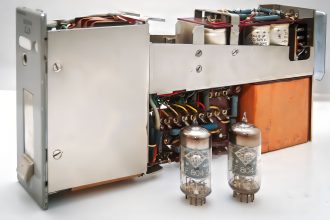


I am going to talk about the emulation for UAD2 systems of UNIVERSAL AUDIO, both Apollo and Satellite, of two very famous hardware instruments: the first is the Fender 55 Twin Deluxe, vintage guitar amplifier; the second a channel strip consisting of preamp, compressor and equalizer built by Manley, the Voxbox.
Both instruments are included in the elite of their respective categories; Universal Audio, as always, chooses a very important and complex target for its modeling work. If the results are like those of the Fatso and Ampex these two pieces of software will be another step in bridging the gap between analog and digital processing, work that the company has been successfully carrying out for more than 10 years.

To make the most of the real-time potential of these two models, I got myself a Apollo twin duo, previously reviewed on this same portal, which quickly opened the doors to processing a zero latency through the whole park plugins di UAD.
For those not accustomed to the UAD system, we are talking about two product lines, Apollo and Satellite, suitable for signal processing through processors dsp dedicated, placed in external chassis to our workstation, connected to the machine through connections firewire, thunderbolt o usb. On these external processors the only plugins that run are those produced specifically for this platform. Our review is about two plugins of this suite.
The Satellite consists of processors mainly dedicated to mixing that can be conveniently opened in our favorite DAW in formats AU, VST e Aax; but since the software sends to the processors are done through the DAW's audio engine, they are not suitable for zero latency recording.

The Apolloinstead, alongside the DSP processors a real audio interface that varies according to the most disparate needs and budgets, from the small interface with 2 entrances and 4 outputs, to larger interfaces with eight preamps or with 16 line inputs and outputs; all the interfaces of the Apollo line flank the control software of the DSP processors with a second software called Console which, on a logical level, interfaces with the sound card before the DAW and allows us to direct the signals to it in the way we prefer, also implementing a very interesting technology called UNISON.
This feature allows us to take advantage of the preamps of the board, integrating them with software modeling of Preamp blazoned which, at zero latency, give us the possibility to emulate the operation of the aforementioned units.
Console obviously allows us to build setups with aux sends to reverberate a zero latency monitoring, or to monitor microphones heavily processed by emulations of PRE, tapes e ambienti but record them completely flat; in short, it allows us to use the Apollo interfaces, as a real hardware console that precedes our DAW.
Personally I am of the opinion that the only way to evaluate certain things is not to talk about them, but to listen; for this reason when I write this type of articles I try to integrate as many files as possible. Whenever I quote an audio file, a link will be integrated to download it, a 24 bit 44100 Hz, from the servers of soundcloud. The best way to use these files is to open them all in our DAW, put them all in Mute and run a SOLO selective that allows us to appreciate the differences (test A/B).
FENDER 55 TWIN DELUXE
We are talking about an extremely characteristic amplifier, with a sound devoted to a certain type of performance, so you have to be very careful with the judgments.
Perhaps for an emulation of this caliber, being the first endorsement with Fender, to Universal Audio a somewhat more generalist model would have helped. In any case, there may be a huge demand for this type of emulation that is not covered by competitors.
Emulation delivers three cone types, JP12 / J120 / GB25; various mic and instrument inputs can be coupled, in addition to the normal controllers of the De Luxe, a rich microphone panel (it would be great if it could be integrated with the microphone system of the Ocean Studio Plugins, but it seems that this is not the case). Emulated microphones include two models dynamic, two a vacuum and a capacitor.
Just plugged the guitar cable into the input HI-Z of the audio interface, the signal from that input is recognized.
We spent a lot of time experimenting with various timbres between presets and combinations, including through the use of other processors. The overall impression is that the emulation is wonderfully dynamic, on both clean and distorted. The dynamics reach surprising levels, even in intense moments of drive in which often in software emulations the transients are swallowed by the chaos of harmonic distortion and the rhythmic nuances tend to die.

After half an hour of testing, we realized that the monitoring through the control cabinets was not credible, because, at certain amplifier settings, the guitarist would not have perceived such low pressures. To make the idea dynamic, the monitoring had to be projected through more powerful speakers. We have therefore set up an amplified speaker in the recording room, monitoring the output of the Workstation. The result was truly incredible. The sensation of having a pressure in the room attributable to that which the real amplifier would have produced has significantly increased the feeling of the performer compared to simply listening to oneself from the monitor speakers of the direction. This experience has highlighted the most important feature of this emulation: an incredible dynamics, heard only when microphones a true Deluxe, a precision of the transients impressive, a dynamic increase of the saturation depending on the intensity of the performance of a unique naturalness that I personally have never found in an emulation of an amp, even in the same softtube of the edtech UAD.

Below is a list of audio files that we have compiled with a brief description.
BRITISH STUDIO BLUES - I really like aggressive but not harsh harmonics, the attack of the notes is defined and legible. All perforated dynamic shades are super legible.
LEAD - this sound is really "piercing". Small and fit for purpose with extremely dense harmonics. Beautiful transients.
NASAL CRUNCH - it will also be nasal, but the bass are evident and make this tone very complete. The thing that amazes me once again is the definition of the transients and the smooth flavor of aggressive yet composed harmonics.
DELUXE ONLY - much less composed than the other audio examples, this sound would stand out in any mix. Excellent transition between chord and lead, in my opinion the yield is extremely natural.
SUPERCLEAN - I kept it on purpose for last, steps a 17 e 29 second in my opinion they are the real presentation card of this modeling, try to listen to it with a nice sustained volume. I have never heard a similar dynamic in an emulation.
Manley VOXBOX
I've been lucky enough to use this hardware for a long time and know it really well;
Personally, I think it could have been called bassbox, voxbox, acusticguitarbox, "everything" box, because it is an incredible channel, at its tube preamp adds one optoelectric compressor similar in speed to classic optoelectrics of UREI but with the addition of 5 preset di attack e release which make it very versatile. In addition to a to be, an extended version of the MEQ extension, mid range equalizer which however comes, like the Pultec, to touch many other isofrequencies.
The Voxbox test was very extensive, in order not to create a file labyrinth I tried to focus essentially on voice although several other tests were conducted.

My idea is that this is not just any plugin, and until you try it you can't have a comparison.
As can be seen from the file flat recorded with the Apollo preamp without UNISON functionality, the voice acquires the body, brilliance and a natural punch already in the second processing which involves only the switching on of the preamp.
Here are some demonstration files with small explanatory notes. To fully appreciate the differences I recommend carrying out tests A/B as previously described, especially for this test.
DIRECT APOLLO PRE with AKG c414 - this is the PRE of the Apollo, with the filter built-in activated.
VOXBOX PRE - the mid-high profile begins to become firmer as well as the dynamics of the medium-low; harmonic density grows around speech frequencies, which perhaps would have benefited from less gain.
VOXBOX PRE + COMP the voice is decidedly firmer even if the interaction of the compressor is not drastic, there is a small release gap in the middle of the word "few" after the gloss, which does nothing but highlight the naturalness of the processor's behavior. Thanks to the action of the compressor the harmonic density on the frequencies 3500/7000 she became less aggressive. Very beautifull!
VOXBOX PRE + COMP + EQ Not that the recovery needed, in my opinion, an eq, but that's it… what are you doing, don't you try it? It is a practice that I don't usually use but I thought I'd further streamline the voice and try to give a boost beyond the speech frequencies to see how the signal reacts. Interesting result.
VOXBOX PRE + COMP + EQ + HEAVY ES: ok, we're in the dance with over processing in performance, let's dance. For me the result is extreme but effective. I am so cautious because I am not used to processing so much in recording, but if the results were always so defined I would get carried away more often.
Usually in my conclusions I decide whether or not to buy the plug in, and I must say that the Fender, although I have never heard anything like this, except from a Fender placed 30 centimeters from my head, it will presumably not be one of my next purchases, because it is not in the target of my usual productions.
But if I had to face some production rock, sincere and authentic blues o country definitely mine 199 € would be well spent.
Different speech for the Manley Voxbox.
I find it extremely advantageous to use preamp emulations during the mix: they tend to color the signal by reducing its dynamic range without having to compress it, which makes using compressors more delicate, without having to use too drastic settings. It must be said that, unlike the Vision Channel API or 88rs NEVE (again for UAD platform), it is a really cpu-hungry device; on my Octocore satellite, in the mix I can open them 8. But for the tonal capacity of this jewel (it manages to stop a electric bass without applying a compression envelope ...), these are definitely worth the money for me 299 €. The use with UNISON devices is a godsend and puts the performer himself in the optimal condition to work with a processed voice, which allows him to add nuances and details compared to working with a flat signal. A MUST HAVE.
NOTES AND ACKNOWLEDGMENTS
For the two tests I made use of two fantastic musicians and friends, both characterized by a strong and brilliant vocation for black music: Robert Frattini, session guitarist and songwriter, who lent his work for the Fender test, e Massimiliano D'Alessandro, guitarist, singer and songwriter who courtesy of Casa Lava Records, leaves us some voice fragments with which to evaluate the performance of the Voxbox.

Finally, I thank all the people who made these little tests of mine possible: Roberto Frattini (whose discography I attach below), Massimiliano D'Alessandro and Casa Lavica, as well as the facility where the tests were carried out: The art of studio noises di Silvio Speranza in Marano of Naples.
Robert Frattini, “The memory of masks”, 2014, Psych Up Melodies;
Victorzeta and the Blue Flowers, "Dans le rêve", 2013, / Bulbart / Fullheads / Audioglobe
Good listening and good comparison to all of you.
John Rome
AUDIO DEMO
Fender UAD Super Clean - Output - Stereo Out
Fender UAD Deluxe only - Output - Stereo Out
Fender UAD Nasal Crunch - Output - Stereo Out
Fender UAD Lead Output - Stereo Out
UAD - DIRECT APOLLO PRE with Akg C414 - Output - Stereo Out
UAD - VOXBOX PRE Output - Stereo Out
UAD - VOXBOX PRE + COMP Output - Stereo Out
UAD - VOXBOX PRE + COMP + EQ Output - Stereo Out
UAD - VOXBOX PRE + COMP + EQ + HEAVY DEES Output - Stereo Out


