

Major Update for the Virtual Collection of Arturia, one of the very few suites of synthesizers, and not only, existing in the audio panorama. Thanks to the courtesy of Midiware, national distributor Arturia, we are able to report on this new version which contains interesting new entries and some important updates for tools already included with the previous version.
News
Arthur presents VC6 (Virtual Ccollection), which, with this new update, leads to ben 21 the emulations of glorious instruments of the past.
In case you missed the review of the VC5, the links are this ARTURIA V Collection 5 and this ARTURIA V Collection 5.3 update, and in them you will find a complete analysis of the peculiarities of the Arturia suite.
Quickly reviewing the VC6, we note mainly the following news:
4 new tools: Buchla Easel V, Honer Clavinet V, Fairlight CMI V, Yamaha DX7 V;
Restyling chart for 3 previous instruments: Solina v, Vox Continental V, Wurli V;
- 2 Major Updates: Analog Lab v3 e Plan V2.
New Tools
The new 4 tools certainly need no introduction. If for the Clavinet and DX7, there are other emulations among the libraries of competing brands, a real novelty is represented by the other 2 titles. Let's start with them.
Buchla Easel V
Designed by Don Buchla, a real competitor of the most famous modular synths Moog, the Easel was among the first Synths semi-modular of history, produced around the 1973 and resubmitted in an "enhanced" form a few years ago.
The virtual version of Arturia, as you can see from the images, fully retraces the concept of Buchla, with the Oscillators Complex e Modulation, able to generate raw timbres far beyond the usual Sinusoid, Triangular, Square, Saw tooth. The double “Lopass Gate” is also well represented, which can function independently both as Filter (LPF 12 dB / oct), which as an Amplifier or a combination of them (Filter + Ampli).

Since the Easel was conceptually equipped with a capacitive keyboard with arpeggiator functions, the latter was also reproduced not only graphically, but also in the various connection options to the actual sound module.
By enabling the Modulations panel, the Easel gives access to 4 modulation areas, specific to Arturia, structured as follows:
Left hand: 5 slot modulation, each of which can intervene on any synthesis parameter, as well as modulate any of the other slots, or any of the parameters of the other 3 modulation areas. The control parameters, in addition to the Amount, are represented by a real Uni / Bipolar envelope with up to 16 intervention points, which can be looped and synchronized to the DAW Host.
right-hand: actually a sequencer / arpeggiator in piano roll mode, with two octaves of positioning. Among other things, you can decide to intervene on the execution mode (Once, Loop), the speed, which can be synchronized to the DAW, the Gate (Lenght, Random).
- Gravity: a completely new two-dimensional area (X, Y) in which to place "obstacles" on which a virtual ball bounces. The position of the ball obviously modulates the two parameters associated with the X and Y axes;
Effects: two independent units capable of generating Ambient FX (Rev, Delay, Analog Delay), Modulation (Flanger, Chorus, Phaser), Distortion (Overdrive, Destroy), EQ and Compressor FX.
Supplied, approx 280 presets that represent all too well the typical sounds of the Buchla synth.
Fairlight CMI V
With the Fairlight emulation, the Arturia opens the door to the management of sampled sounds. So far, in fact, the emulations have all been based on the reconstruction a physical models o virtualAnalog of the models taken as reference. Obviously, for what was in fact the first sampler in history, it could not be done otherwise.
The instrument management, as for all the others in the suite, takes place on two levels of intervention. By enabling only the keyboard, you have direct control of the following parameters: Filter, Sample Start, Vibrato Speed, Vibrato Depth, Aux Level, Attack, Damping 1, Damping 2.
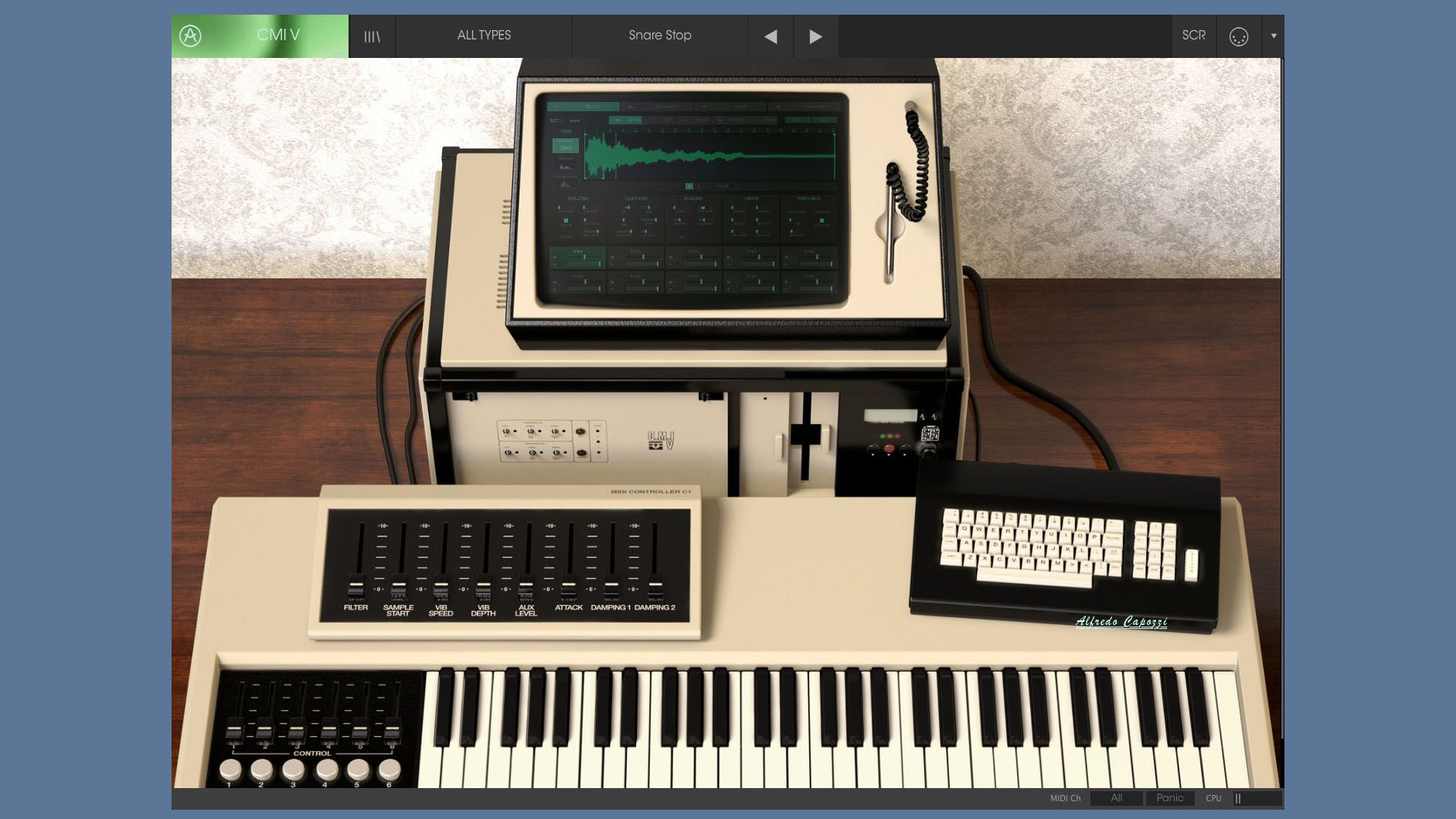
By accessing the actual programming page (Screen Panel Mode), the following intervention possibilities are opened:
1) For each Sound, up to 10 Slots, each of which can manage samples or synthesized sounds;
2) 3 synthesis modes: Sampling, Time Synth, Spectral Synth. For each of the 3 syntheses, the user accesses specific pages for editing the waveform (2D or 3D), or the 32 Harmonics (Spectral Synth, i.e. additive synthesis); Mapping of Samples (Multisampling), Filters, Envelopes, extensive Modulation functions, as already said for the other instruments.
3) Import of samples from outside (Wav, Aiff);
4) Conversion of additive sound into Sample;
5) SEQUENCER. Very similar graphically and operationally to the “Page R” of the original, the Sequencer allows the programming of up to 32 Steps. For each slot, on the grid, it is possible to establish the note with relative velocity and duration. Up to 8 Patterns can be chained to each other. Make a Copy & Paste for easier programming; establish a criterion of polyrhythm and swing of the sequences.
6) MIXER: Each slot has its own audio channel. It is possible to insert an effect (compared to those already seen for the Buchla, here we also find AutoPan, Leslie, PitchShift, Distortion, Limiter), as it is there is an Aux Send and standard Mute, Solo, Pan controls. The master channel has two inserts.
7) TUNE / MAP: like the Performance / Combination of keyboard workstations, here it is possible to subject the 10 slots to Split / Laye logic, as well as to establish the Note Root of the samples and the Mono / Poly mode.
Note: In the version had in beta to carry out this test, the Fairlight made available “only” 32 Presets. It is possible that in the final version there are many more.

Yamaha DX7 V
There is very little to say about the history and importance of FM synthesis in audio production. On the DX7, even less, if not to indicate to those few who still do not know, that, presented in the '83 together with DX9, was Yamaha's best-selling “popular” synth, and the first example to have integrated programmable FM synthesis, discovered about a decade earlier by Jhon Chowing, in the MIT labs.
The virtual model Arturia exactly replicates all parameters of the original keyboard model, starting from 6 operators freely configurable in one of the 32 Standard algorithms. The novelty is given by the fact that between the programming pages, it is possible to feed the Feedback on each of the 6 operators (on the DX7 it is possible to do it only on one). Among the further novelties of this virtual version there is to consider:
1) 25 waveforms, including the sine wave, each of which can be inverted and put into Sync;
2) Resonant filters (LPF, BPF, HPF) for each operator;
3) Monophonic and polyphonic Unison Mode;
4) 3 Types of Envelope: 7 level / rate DX4 standard; DADSR; MultiSeg up to 16 points with variable Slope;
5) 3 8 × 8 matrices for modulations addressable to any synthesis parameter, 2 LFOs, 1 Sequencer up to 32 Steps, 2 Further Envelopes configurable as the previous ones;
6) Oscilloscope on the Master Out;
7) FX: same as those described above for the EASEL;

Not everyone knows that the original DX7 had scaled MIDI dynamics (100 values) and a conversion to 12bit. Well: even the Arturia version can emulate these peculiarities, as well as obviously offering a "Modern" alternative that brings the values of Dynamics to 128 and the DAC a 16bit.
Particular not to be underestimated in programming, is that each operator has its own color and the relative parameters can be recalled either from the left column if the specific area has been opened, or by clicking on the desired operator in the central algorithm window.
Setting the level of 2 to zero simulates the FM synthesis to 4 Operators, typical, for example, of the sound cards that accompanied all PCs in the nineties or, if you want to stay at Yamaha, the TX81Z.
It is a pity that not all the parameters follow the same color as the recalled Operator.
In case the beyond were not enough 430 Preset supplied, sufficient in my opinion to appreciate the FM sound, know that even the DX7 V by Arturia can read all the libraries sysex, developed in almost 35 years by users around the world. So, you already know how to spend the next few days!
Honer Clavinet V
Built starting in '64, the Clavinet became famous thanks to artists such as Stevie Wonder (Superstition), Led Zeppelin (Trampled Under Foot), Eagles (Life In The Fast Lane), ... and the Funky genre in particular, where the instrument it has assumed importance like Bass, Drums and Guitar, becoming an icon as much as, for example, the Hammond organ in Rock.
To the basic model, Arturia has added several new parameters / controls:
- FX, including a Tube Ampli emulator;
- Harmonic Profile: a series of emulations with which to reformulate the character of the instrument's pickups;
- 8 controls / parameters, developed according to physical models, with which to intervene on the sound characteristics.
Circa 75 the Presets supplied.

Update
Piano V and Analog Lab have had their update. Without going into too much detail, since it was already discussed in the test of VC5 to which I refer you, I will add generically the most salient aspects of the two tools:
Plan V2
- 12 versions of Piano (in V1 there are 9), rebuilt on physical models. Both grand and upright pianos can be found. Some traditional, others very experimental;
- The parameters adapt instantly to the type of piano model recalled;
- Each virtual parameter modifies the constructive characteristics of the instrument. We have: Master tuning, detuning and stretch tuning; Hammer type and position, relative to the strings; Noise levels for the hammers, dampers, and pedals; Soundboard resonance; Velocity curve shaping and presets.
- 4 microphones with relative possibility of placement, level and pan;
- Compressor FX, Stereo Delay, different convolution reverb models, 5-Band EQ, 3 of which are parametric and two side shelving;

As far as the 'Analog Lab v3, in addition to a slight graphic restyling, the Preset tagging has been revised and improved, which obviously includes the full implementation of the new tools. The programming part of the Layers has been better organized, but there is no possibility, once two tools have been recalled, to be able to disable one on the fly, without necessarily entering the Edit page.
Conclusions
It should be noted that the test took place on one Beta version of VC6, so some aspects may have undergone improvements before the final version was released. For the new instruments, I thought it appropriate to present them only in the most important characteristics, as well as I hope, for example, for a few more Presets for the Fairlight.
I didn't have the Solina V, Vox Continental V, Wurli V available to evaluate the graphic restyling.
Regarding the new entries, the Buchla in particular, but also the DX7 and the Farlight, are to be considered must, if a careful and targeted use is made, perhaps in combination with a Synclavier or a Matrix 12, already present from previous versions. Combinations, easily achievable in the Analog Lab V3, which, I remember, collects all the Presets of the individual libraries.
The personal opinion remains the same as in VC5. Arturia is the only one that develops emulations based on physical models, rather than samples (except, of course, for the new Farlight) and this puts the VC, in addition to full use in electronic productions, also in a particularly suitable for educational use.
Price: Euro 499,00 (on offer until January 10th 399,00)
Distributor: Midiware.
Nota: while wanting to be fully objective, this test is in any case based on the direct experience of the writer, so all evaluations and indications must then be mediated by the skills and knowledge acquired by the end user.
Audio Demo
Buchla Easel V - BEasel by A. Capozzi
https://soundcloud.com/ageofaudio/demo-audio-buchla-easel-v-beasel
Yamaha DX7 V - YDX by Alfredo Capozzi