

One of the possible professional goals of any musician concerns the dream of becoming an endorsement, that is, a demonstrator of more or less prestigious brands.
This, not only for the desire to get their hands on professional products, which many crave, but also for the fact that this allows for an important visibility in the music scene.
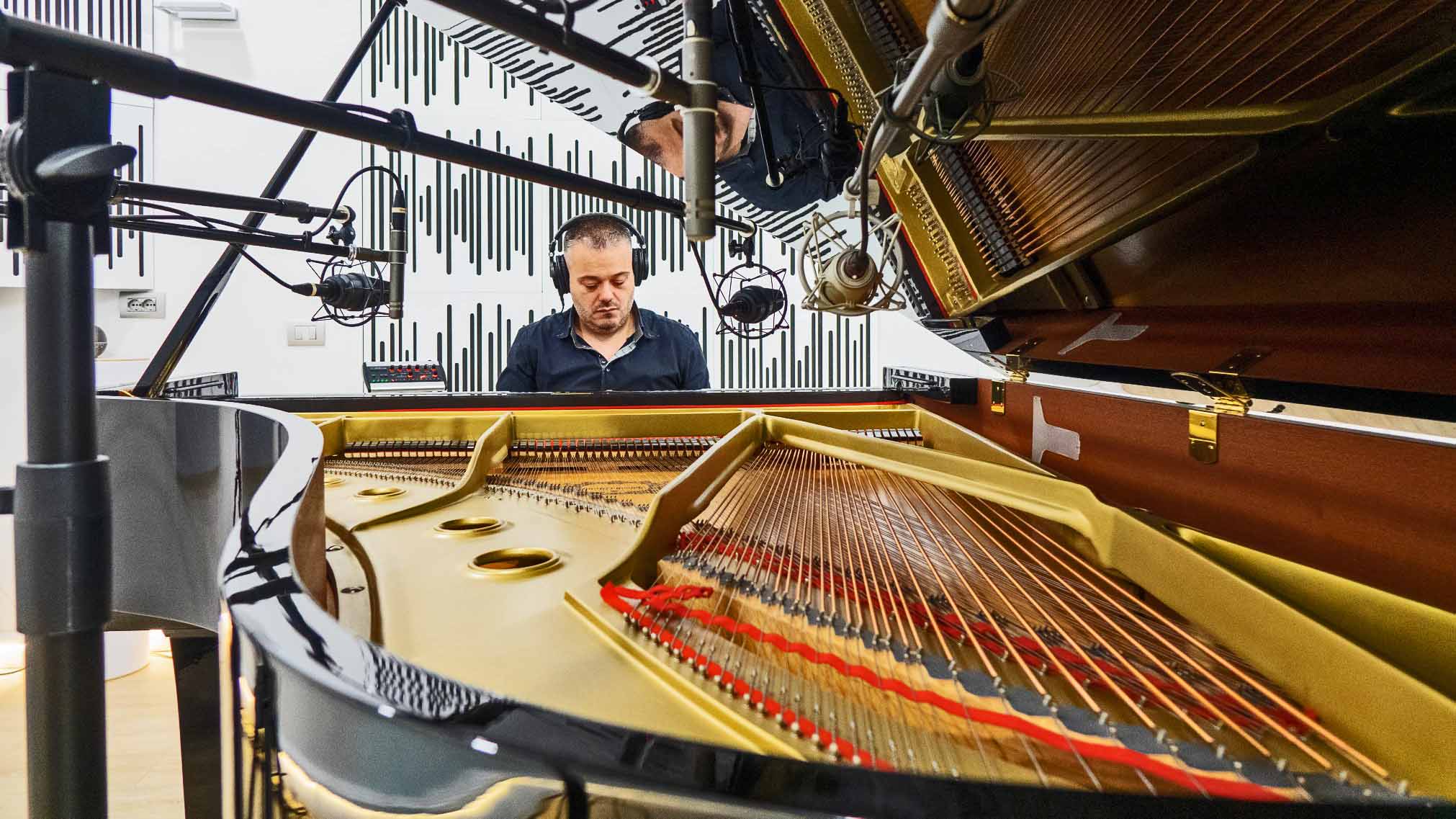
In this panorama, it falls Manuel Montesanti, well known in the panorama of professional keyboard players who use Synths and similar trinkets, a little less by many pianist teachers who have placed their attention only on a traditional, classical repertoire to teach music. This small premise is a must because Manuele, in addition to being a skilled "fusion" pianist for needs of the work he does for Yamaha , he also anticipated, and by many years, the so dear "distance teaching"With which the whole world of Italian schools has had to deal and is dealing with in the present period dictated by the Covid-19 emergency.
When you are a forerunner of some training processes, I am personally the first to be intrigued, since my teaching activities "oblige" me to try to be an innovator in a teaching that changes its skin year by year. Not only because it is dictated to us by the structure in which we operate, but above all by the tangible and unstoppable growth of the new generations who "demand" from their teachers methods and languages in line with contemporary times.
Therefore, remaining anchored to the technological rather than pedagogical processes that distinguish Manuele's teaching, we will try to understand what were the personal processes of study and cultural growth that allowed him to reach the international court of Yamaha, Synth and Workstation sector.
Alfredo Capozzi: How do you become a Yamaha demonstrator?
Manuel Montesanti: So, practically when I was a kid, parallel to what was the piano study, I watched carefully what was happening in the United States. At the time I was following Chick Corea in particular and I noticed that, whatever he did, he had a considerable sponsorship from important brands, especially Yamaha. Even when I started touring, I had colleagues who often talked to me about endorsement, as it was for all the rest of the artists I followed.

AC: So what happened?
Basically, at the age of 19-20 I started making the first demos for Midiware; the company passed me some instruments that I studied at home and then demonstrated them at the first musical instrument fairs. I have always followed the Fairs: from the famous DISMA of Pesaro, imagine when I was a child, up to the last national fairs as well as local ones. I was always looking for collaborations from any prestigious brands. And so it happened that at the DISMA of the 2000s, if I remember correctly, I found myself in the Tascam stand, which hosted Midiware, to demonstrate the GigaStudio and GigaSampler which had recently been purchased by Tascam itself. Since the Tascam stand was close to the Yamaha one, when I started playing, the Yamaha managers approached me and I exchanged a few words with them: it was the occasion with which I started the first contacts. Shortly thereafter, then, a notice came out on the Yamaha website indicating the search for demonstrators. I went to audition, passing it very well, but the problem arose that the Synth demonstrators had already been assigned; each region, in practice, had already had its own demonstrator. However, taking advantage of the fact that we stayed at Yamaha for two days, taking the opportunity to take a look at all the instruments, it happened that I made a new demo in front of the French President of the time who was in the company. That president, to my surprise, I remember saying < >, proposing to become an endorser and official demonstrator. Obviously he worried that I was willing to travel, but since I was touring continuously at the time, I pointed out that that aspect was the norm for me.

From there, therefore, I began to collaborate very closely with Yamaha, starting with the mixer 01 times and the workstation Reason ES, as an Artist demonstrator, until he became a European endorser in 2015 with the release of the Installation and then, on an ongoing basis, Endorser World Wide since Yamaha wanted me to perform at NAMM and at international fairs such as MusikMesse. I've been to NAMM several times to demonstrate the Montage and CP series pianos of which I am also one of the sound designers today. Since 2017, in practice, I have become one of the Yamaha's 8 global sound designers Corporation of Japan, currently developing libraries and demo songs. Then we come back to this topic.
AC: Now let's talk about your beginnings: where did you carry out your musical training and what was the teaching on which you took the first steps?
MM: In 1985 I received the famous pianola as a gift from Santa Claus Bontempi. I began to play and I never left the instrument, so much so that they were all a bit stunned by this thing, < >. Basically I was playing a lot of things, playing by ear whatever I heard. Never seen an instrument in the hands of anyone in the family: zero musicians, zero music! The practice consisted in the fact that I heard a piece and played it directly with the instrument: I was about 6 years old. After a few years, addressed to an environment a little more conforming to teaching, I started attending the Santa Cecilia Conservatory From Rome. First privately to then enter as an intern, but I was not very good, from the point of view of traditional teaching: I was very good harmonically speaking, but from the point of view of classical execution and of the classical technique that was required of me, I immediately understood that I did not it was in my strings. So, at the time of the old system, I took the solfeggio exams, then the 5th year, up to the Harmony exam. I did all this until I was 14-15, even if I always had synthesizers at hand, more and more fascinated by this whole world of avant-garde music: from jazz to blues, up to the fusion of the 80s. In short, in the end I decided, and luckily, since I was really scarce from a classical musical point of view, to change direction. I went to study atUM (Uuniversity of Musica.ndr) and there I met crazy teachers, with crazy classmates, so much so that today everyone works as professionals. In short, they were really happy years: I remember that the most beautiful musical years I lived were those and I was only 15 years old as a kid, I entered there that I didn't even know a theme song. The first year was terrible because I didn't know any of this and I practically found myself in an environment that was completely new to me and didactically speaking, from the point of view of musical language, the acronyms for me were things from outside of head, used to reading everything in double key; in short, another planet. Nevertheless, in 3 years, I completed the 5 required by the regular study of the UM educational programs, starting at 18 to work with the first tours, the first concerts and some television broadcasts. I specify that the tours naturally concerned the Italian singer-songwriters, the usual ones, but even there I understood that it was not my mood, it was not my passion inherent in the musical field, so in 2003 they changed a few things, with the of the collaboration with Yamaha.
AC: After or during your classical studies, was there a particular experience that enticed you towards the pop genre and from there to pursue a career as an endorser?
MM: There was no real event; more than anything else I have to say that I have been particularly perceptive to understand what my limits were and what maybe my qualities were in the musical field: it's like when you love a woman, in the sense that you cannot find a woman who is far from your points of sight and you have to find the one that brings you to the best condition of life. It's a bit like that, music is the same, you can't take it seriously and turn it into a job if you don't get along well with it. So I found my best "music" girlfriend, the muse of my life, in the jazz-fusion field, above all because I have always carried on the use of synthesizers as a passion at the same time as performing practice. If you then consider that all my idols always had synthesizers on the stages, not a day went by that I went looking for news on synths, their sound, producers, etc. In short, Synths have influenced at least 80% of my musical career.
AC: You had the opportunity, with the appointment of TeknoDay 2019, to have contact with the students of the Music High Schools, in particular from Campania: what impression did they make on you and what changes do you have in music teaching compared to your past?
MM: The experience was great because there were quite a few guys with an enthusiasm figo like the one I had at the time and so this thing cheered me up a lot. Then we kept in touch with some guys via Facebook, we became friends and the other thing that impressed me, especially the students of Campania, is that the average level is really high, they play bad, they are very good. I met some who were really very good from a technical point of view. I believe the merit of this is above all of those who follow them. As for others, I repeat, I have really heard excellent and very young pianists. At “TeknoDay” the main impression was just that there. There are some positives and quite a few negatives when it comes to teaching changes. From a positive point of view we say that many of the activities that make up my work before were not considered an integral part of it or just not considered.

The figure of the sound designer or the endorser just did not exist. It was not known what this stuff was here, today it is already a step forward to see how the technological and musical part are taken a little more into consideration. Another positive aspect concerns the increase in activities and the openings towards other points of reference by the Conservatives themselves. I am referring to the openings towards other non-academic musical languages that serve to open the minds of children. The slightly more negative part of this change that I don't agree with is the carelessness and lack of study. To say, I was someone who studied 12 hours a day, I had a social life practically canceled. I'm not saying to get to these levels of madness, however, the guys I see study very little and take many of the things with carelessness. I mean, everyone wants to play because there is the idea that you go around the world, you perform on stage, you become cool. Unlike other countries, I notice that here in Italy there is very little study culture and without it, without that effort, you have few chances. When you work it is not that you can be helped by your friend or by the situation, you really have to play so when you have to prove who you are you have to do it through the black and white keys. Obviously the more you study, the more you prepare, the more your average level grows. To be a professional musician you have to study and face sacrifices. It is also a bet with yourself trying to evolve and improve with the study.
AC: Today your demos and videos tell of an ambition towards Fusion: in your opinion, how much has this musical genre evolved? How much has music technology contributed to this?
MM: So, let's say that today it is not only Fusion that is the leader in this sector, which has definitely expanded. In the 80s it was a bit different, today talking about jazz, fusion or gospel is part of a global conception of music. They are all genres placed in the same cauldron. Before it was a very sectorial thing, today the mooder and jazzer encompasses all this, in my opinion. As for the basic technology, I could tell you that, in addition to offering novelties in the sound field, it has brought as its main aspect the possibility for everyone (even the musician lost in the Amazon forest) to be able to make themselves known using their own means. Today everyone has means such as social media, facebook, YouTube, etc .. To give an example, Chick Corea has already become what he has become thanks to the web. The same thing happened for Snarky Puppy, today they are characters who make world tours with their music, but they managed to do all this thanks to what the network makes available to everyone. So let's say that this is the technological aspect that in my opinion caused a radical change in this sector.
AC.: Were there any musicians who particularly inspired you towards this genre?
MM.: Obviously yes. As I told you before, I have seen synths with Chick Corea, Herbie Hancock, geniuses of fusion music or “electric jazz”, let's call it a bit like that. I saw Chick Corea and I listened to him for the first time right there and it was they who led me in this direction. Going forward I tried to mediate between work and personal experiences together with other musicians. I tried to find my way but I have always continued to study, I have never stopped: I believe that interrupting the study is the most serious mistake a musician can make. To stay on the musical theme, I am in love with Bach and I have never found such a funk groove as in "Well Tempered Harpsichord", only that he wrote it about 300 years ago! Furthermore, being a patient of harmony you imagined when I started studying counterpoint and what were the forms of harmonization of the inverse canons. Already at the time I went really "out of my mind", but one realizes that in jazz everything returns: it is reproduced, reproposed. Many things that are done in the modern world are possible thanks to musicians who had already done it before. Without Bach, in my opinion, they went nowhere, I always call him the alien. I don't know how many characters in the world are able to do this. So let's say Bach is my point of reference as well as Debussy. I learned the modes, I imported the “modal” aperture as well as what the alterations were like pussies used by Korea himself, also used by the same Jazzmen after him. However Debussy was another of my teachers. Then came "Miles" around 18 and I found myself completely shaken so much so that I became a total nerd. At the same time as Miles Davis I touched Zappa first hand and from there I started calling these musicians by their own name that is “masters” because they wrote some incredible things. In summary, without going on for a long time I'll talk to you about Bach, Debussy, Frank Zappa and Miles Davis, these are my points of reference.

AC: Would you advise today's youth to listen to more music from the past? Which genres and why?
MM: I would advise everyone to listen to classical music for two reasons. First, because one realizes that all of this is thanks to those who have laid the foundations. As I said before, without Bach we would not have gone anywhere, the same goes for Mozart and others. The second aspect concerns the importance of listening to music from an early age, already as a newborn, especially also to parents precisely because at the psychological level, at the life level, at the level of character formation, music is fundamental and makes you a better person. This is a thought not only mine but also of all those who face and work in music therapy. There is little to do, if we all listened to more music we would live in a much better world with better people. Long live the music!
AC: Let's talk about your activity as a teacher and trainer: with your teaching channels you have anticipated by a few years what MIUR (Ministery ofIconstruction, ofUUniversity and Research) this year became the DaD (Didactic a Dinstance): how did you manage and manage the technologies for this purpose?
MM: In 2008 I founded the site www.lezionipianoforte.net I was twenty-eight and the portal has been going on for twelve years, I think I was perhaps the first in Italy to do an operation of this kind. At the same time I have always carried out online teaching and, despite having also received criticism, I think it is the future. A few days ago I learned that more than half of Berkeley's revenue from Boston Berkeley (not just any provincial school) comes from revenue online. So if they who are number one in the world do this, we should think about it maybe investing in that direction.

AC: What didactic models do you propose in your lessons?
MM: Basically on the Lezionidipianoforte.net portal there are three courses with three different didactic programs. The first course is "Modern jazz piano"Where all the issues related to the appearance of the modern piano are studied such as technique, reading, applied harmony, improvisation and above all Piano Comping. As for the second course, it is the "MIDI and Multi Style Keyboards”And is more about the technological aspect of the keyboard player. This course includes some musical aspects of the modern jazz piano course but with an in-depth study of the technological aspects that a keyboardist, in my opinion, should know by default: presence on stage, equipment to be used, technical needs, voice aspects, management of the rubber stamp. Another fundamental aspect concerns how one behaves in the studio and what is mainly used to reach a goal that sincerely represents a bit the current producer and the current musical situation for everything related to Home Recording. Obviously, all the topics related to the course are addressed Sound design, MIDI, etc. applied to both software and hardware tools including DAWs. The latest course dedicated exclusively to all Yamaha users is called "Yamaha Synth Online Course"In which all the needs of end users are taken into consideration, there are customized courses according to skills. To say, a user could start with the basic question: "How do you turn on the synth?" up to dissect all the technological features and use of this synth. Therefore, from this point of view, it is a highly personalized course produced in collaboration with the Italian branch of Yamaha Music Europe and is specific for all users who use the CP 88/73 series Stage Piano, the new Combo Organ YC61 and of course Motif, moXF, the glorious Montage and MODX.
AC: What kind of skills and previous experience should the students accessing your training possess?
MM: It depends a lot on the type of course, as regards the course "Modern jazz piano”I would prefer that the student had a good technical-theoretical and piano basis to speed up the times a little and get to follow what is the didactic evolution of the course. For the other two courses it would be enough to have as a background the knowledge relating to the computer system, the management of an audio channel, the management of a MIDI channel. A thorough knowledge of the MIDI protocol would still be preferable. However, in my experience, I can tell you that I started courses mainly with users who knew practically nothing and today are doing great, so it is my preference rather than a basic requirement to be able to access the course.
AC: AgeOfAudio is a portal purely centered on audio technologies: what have been in your opinion, since you started as a demonstrator, the aspects that have decreed the strong changes of direction of the current offer of software and hardware tools?
MM: Let's face it, the sound generators are always the same, there was nothing revolutionary and each one adopts the concepts founded by the innovators of the 70s, 80s and 90s. What changed everyone's course a bit was the computing power of the processors of both the hardware tools and the computer systems that manage the software. Today, thanks to these enormous computing powers, we do science fiction things and manage what were once impossible algorithms for a computer system. Today it is possible to manage these sound generation synthesis algorithms without problem and above all the costs are much more competitive. For example, before to do a Home Recording the investment for a product quality-price ratio was quite high, there was a big gap compared to today's costs. Nowadays with affordable setup, if used properly, you can get crazy results. The technology above all has given very encouraging and super cool signals also from the point of view of communication; to say today you live in Burundi and with a connection you still have both the opportunity to get involved and to share your music or videos. In short, you do everything yourself without going through the famous label manufacturer or anything like that, this thing is essential. In fact, the musician should invest a lot of his time, as well as in the study of the instrument or in general training, also in the study of what the web is, of how the concept of sharing works, of Open Source because in my opinion it saves life.

AC: How do you see the current Home Recording landscape and how do you measure this evaluation?
MM.: I have practically anticipated the answer in some of the questions asked above, but I believe that the great thing about Home Recording is that it is easy to master for all musicians and that it represents 90% of the modern musician's setup.
AC: How much does the Yamaha tone influence your way of composing? Do you have your own production setup?
MM: Basically yes, I am very lucky because even before I became an artist, sound designer or demonstrator of Yamaha synths, I always had a precise tone in mind. I first touched a DX7 in 1991, I was 11, while the instrument that characterized my training (and I literally sweated to be able to buy it) was the SY99. I believe that the SY 99 was the digital synth par excellence, the most beautiful one I have ever touched in relation to the time in which it was produced both for how it sounded and for what it allowed to do. As for my production setup let's say I use a lot of them. I was just as lucky because I have, for example, a lot of endorsement behind me as far as software houses are concerned, that I use many of their software synths also for the didactic aspects, so I use my hardware and software tools a lot simultaneously and in parallel. Let's say, to the extent of a good 50 and 50.
AC: How much pre-production and how much studio production is there in your modus operandi?
MM: It basically depends on how ideas are born. Mainly I approach myself in the most musical way possible, in the sense that I put myself right at the piano and try to find harmonic ideas, themes and harmonizations. Obviously then I develop everything in my DAW. And if I have the opportunity to involve some friends, especially as I did in the DriftLab projects, I rely on real instrumentalists, but I do it in the second phase. It is a very piano approach, that is to say, very “easy”.
AC: In addition to your Yamaha setup, which you certainly prefer, is there any instrument in the current production landscape that you consider useful to recommend for quality / production functionality or that particularly intrigues you?
MM: As I told you, I am very lucky because I am practically endorser of all the hardware and software tools that I use to work and that I really like. I have a StudioLogic Sledge two, I have the tools SWAM, of Audio modeling, I have the tools of IK Multimedia. Honestly what I recommend and then really what I use (of which I am not an endorser of course) are the products Spectrasonics. I think Omnisphere is one of the most beautiful virtual instruments for keyboard players on the market, obviously for those who prefer synts, programming, etc.
AC: Before saying goodbye and thanking you again for your availability, one last classic question: what are your future projects?
MM: From a business point of view I am about to finish the “Store” section or the famous shopping cart of my web portal. In addition to producing Library and works of Sound design for Yamaha and many others of course I would like to sell my Libraries in different formats. And then I would like ... I always continue to produce my songs even if the time I have available is always short. These are songs that I then use in demos, clinics and with which I would like to finish and set up my own recording business, taking everything that has been done over time and making a real record out of it. And then I would like ... I have ideas for improvement and development and expansion of the portal. I am quite a perfectionist, so I would like to bring piano lessons.net to the nth degree from the point of view of efficiency with respect to educational programs, communication, those that are Live streaming, etc. These are partly my future projects. Then there are several other work ideas, which I cannot talk about because there are too many things at stake. Fortunately I continue to always have a lot of stimuli from the point of view of creation in general, both didactic and that of Sound designer, as well as that of musician. That's it, thanks to you for this great interview and chat.
Alfred Capozzi