


After having addressed the chapter concerning i Queen, this time we will examine both the studio and live setup of another great band that has marked the history of rock: Toto. A band made up of session-men of an incredible level, who managed to create dozens of famous hits, remaining on the crest of the wave even today.
Despite the disappearance of the drummer Jeff Porcaro in 1992, of his brother Mike in 2015 and the various singers who have alternated over the years, between Bobby Kimball, Fergie Frederiksen e Joseph Williams, Toto have released their latest work (Toto XIV), a remarkable album, under the guidance of the leader, the guitarist Steve lukather, flanked by the other historical member, David Paic to keyboards. For this work they made use of the return in training of the other Porcaro (Steve), also on keyboards, and of Joseph Williams, singer of the band already in the late 80s. An album has come out that can easily go alongside other historical records of the group.

I This, after the classic meeting in the engraving studio, they are born at the end of 1977, with the original line-up featuring Bobby Kimball on vocals, Steve Lukather on guitar, David Paich and Steve Porcaro on keyboards, David Hungate on bass and Jeff Porcaro on drums. Their first work was the "Toto" album by 1978 which contained singles such as hold the line, Georgy Porgy, Manuela Run, Girl Goodbye.
The two keyboardists of the band were both great talents and had a fairly similar background, both sons of musicians (Paich's father was a soundtrack composer, while Porcaro's a percussionist). The roles of both were quite precise: Paich took care of the writing and played many piano parts and the main riffs of the songs, Steve Porcaro was the one who experimented on the most disparate synthesizers.
For the first album the historian was used (and abused) by both, in the vast majority of the songs on the album Yamaha CS-80 (Fig. 1): we can understand this by listening to the brass and leads of that record. They were quite used by Porcaro also a Minimoog, that piloted the historic module Oberheim SEM, it's a Harp 2600.

More or less the instrumentation remained this also in the following years. Obviously the band in the studio experimented with many new equipment: an example is in 1979, when they acquired a semi-craft Polyfusion Modular (Fig. 2), a real modular "beast", nicknamed by the band "Damius”, Which was used on disc only in 1982 with the album Total IV. Meanwhile both keyboard players received theendorsement laid down by the Yamaha , an official support that has become indissoluble, so much so that even today by going to the NAMM in Anaheim it is possible to find one of the two keyboard players performing at the stand of the Japanese house.

After two good albums, but not excellent (Turn Back ed Hydra, on the latter we can hear the brand new Roland VP330), Toto got into fourth with their fourth album, with the significant title Toto IV. Inside there were two historical pieces from their repertoire, "Africa" and "Rosanna". And these two songs deserve our attention, as regards the setup used.
For "Africa", an absolute masterpiece, composed by Paich and Jeff Porcaro, a Yamaha GS-1, one of the first FM synth (although not programmable, for the sound of kalimba, on six tracks that moved at different rhythms. The same GS-1 was also used for the effect organo path that you can listen to and then a CS-80 for i brass. Live, these instruments were also accompanied by one Jupiter 8.
For "Rosanna " the thing was even more complicated, especially as regards the central solo part, which was a question and answer between Paich and Porcaro (and also between various instruments). At the beginning Steve Porcaro starts with a sound of Trumpet emulated in FM by the PolyFusion Modular; followed by a sequence programmed with a Roland Micro Composer, until the Minimoog enters, always played by Porcaro; closes the solo, a combination of parts played by both Porcaro and Paich, superimposing the CS-80, the GS-1, a Hammond organ and a Prophet V.
To further mark the partnership with Yamaha, the band created in 1983, with Porcaro and Paich, a side-project entirely sponsored by this house, which saw the presence of the composer James Newton Howard (who among other things has collaborated several times with the band both in studio and live). The work, clearly of a fusion matrix, entitled The Sheffield Lab, saw the presence of an arsenal completely branded Yamaha, among the brand new ones DX-1 (Fig.3) e Dx-7 and the now dated GS-1.

With the next album, Insulation, of the 1984, among other things, a half failure, which saw the entry of the last of the Porcaro, Mike, on bass, in place of David Hungate who has always been reluctant to life on the road, the band also began to use the new discoveries Yamaha, i.e. both DX-1 and DX-7. There DX-1 we can also see it in the video of the song "Angel don't cry ", While the DX-7 obviously it was used and abused both in the studio and live.
For subsequent albums, Fahrenheit e The Seventh One, the band used purely Yamaha material in the studio, apart from theEmu Emulator II (Fig. 4) on The Seventh One. This last album featured hits that have remained in history such as "Stop Loving You " and "Pamela ", on which Paich used two piano types in the solo, one clean and one effect with a delay and a chorus activated via midi via a pedal; for brass, the record featured numerous arrangements made by Jim Horn (never name was more suitable ...), both with real instruments and through synths.

On the tour, which also saw them pass through Florence and .. Sanremo… instead, they were replicated by Porcaro thanks to the usual DX7 (updated to the second version) with the addition of a saxophonist (more unique than rare in the band's history). Just the tour of The Seventh One, was the swan song of Steve Porcaro, as an official member of the group. By now the band did not like the fact that he worked a lot with other artists, like Michael Jackson in Thriller (where, however, the full band participated), so they opted for a consensual separation: the second of the Porcaro, continued to collaborate on the band's records on several occasions, but returned with them on stage only for a brief appearance in the 1998 and then on a permanent basis from 2010.
Obviously for the band, the abandonment of Porcaro was a fairly calculated problem, even if for some live performances four hands were required. First of all, the live setup was greatly streamlined: Paich until the mid-90s was only seen with a Yamaha KX-88 (which replaced the glorious CP80 used until the middle of the previous decade) which piloted a piano expander and little else, with the new Yamaha first SY-77 and then theSY-99. Then the keyboard technician With John Jessel, from behind the scenes, he always piloted some sequenced parts with SY-77 or 99 and added some brass parts where necessary.
In 2003, on the occasion of the band's 25th anniversary, David Paich can be seen on stage with a Yamaha Pattern 8 and a Korg Triton Studio. In 2004 the keyboard player decided to take a break, worn out by tens of years of work, and in his place until 2008 there was Greg Philliganes, endorsers Korg, which he mainly used Korg Triton Extreme for the next two tours (Paich and Porcaro were always present in the studio).
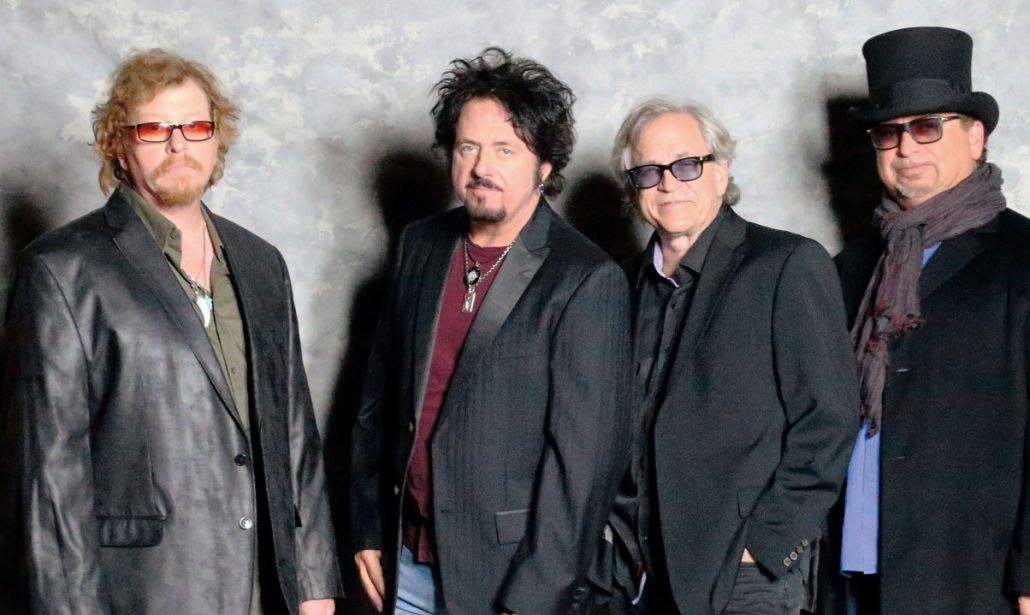
In the last tours of the band, both in celebration and in support of the new album Total XIV, the main instrumentation is all supplied by Yamaha, which has brought to the stage all the latest discoveries between Motif XS, XF and CP4 as a piano-stage.
It is curious, however, to note how things have changed for the Paich-Porcaro duo. In fact, in some recent interviews, it turns out they both really like Apple software Mainstage, from which many presets drive (from the Motif).
You would expect who knows what mega-software, designed exclusively for them. Instead in the studio i pianos they are almost essentially coming from Pianoteq. No grand piano or anything else was used. Indeed, Porcaro explains that in one song he used a very banal preset from theEXS-24 (!!), artfully modified to obtain the sound that best suited the song.
For the strings, on the other hand, the London Symphonic Strings ofAria Sounds and some libraries of the Spitfire, as Mural e Sand, obviously not used live due to their extreme CPU burden.

It seems strange, but even characters of this caliber have to deal with the heaviness of plug-ins on CPUs, so much so that Porcaro has stated that in the studio he often uses simulations Arthur for synths, but live much prefers theES-2 of Logic, because it is much less heavy. In addition also Rhodes, Wurlitzer and Hammond come from the internal libraries of Logic X. For the Hammond, in addition to theEVB3 by Logic, the sound is “doubled” with the B4 from Native Instruments to give more distortion. Also, for some "bell" sounds, it is always used Sculpture of Logic and rarely Omnisphere, again due to its heaviness on the CPU. Finally, the EXS-24 is used a lot to load some samples useful to the band in some live songs.
[:


